
Commercial training providers and corporate academies face a persistent financial gamble when scheduling public training sessions. If you cancel a course too late, you alienate paying customers and damage your institutional reputation. Conversely, running an under-enrolled course often results in severe financial losses. To protect commercial margins, training managers must understand their open enrolment break even threshold. Calculating your baseline numbers before marketing a course eliminates guesswork completely.
Mastering scheduled course economics allows training providers to schedule sessions with absolute confidence. Instead of hoping for packed classrooms, commercial directors rely on structured financial models to determine go/no-go dates. In this comprehensive operational guide, we provide a complete course break even calculation framework. Furthermore, we explore fixed versus variable cost structures, define the minimum class size training formula, and share proven strategies to maximize public course profitability.
Key Takeaways

The Core Formula:
Minimum Viable Class Size (MVCS) equals total fixed costs divided by the unit contribution margin.
Always Round Up:
Because you cannot enroll fractional students, you must always round up your break-even result to the next whole integer.
Define Decision Gates:
Implement strict “Go / No-Go” deadlines (such as T-minus 14 days) to cancel or pivot under-enrolled courses before incurring non-refundable venue and travel penalties.
Shift Fixed Costs to Variable:
Transitioning to virtual instructor-led delivery (vILT) and on-demand cloud labs significantly lowers fixed overhead, reducing the seats needed to break even.
Automate Course Logistics:
Utilizing a robust LMS to handle commercial registrations, payment processing, and user provisioning reduces operational overhead and protects course margins.
The Financial Mechanics of Public Training Delivery
Open-enrolment courses operate on a very different business model than dedicated enterprise delivery. When an organization books an internal corporate cohort, the client pays a flat rate that guarantees immediate profit. In contrast, public schedule courses rely on individual seat sales. Consequently, the commercial risk falls entirely on the training provider.
Every scheduled public course incurs two distinct types of expenses: fixed costs and variable costs. To conduct an accurate break-even analysis, training managers must categorize every operational line item correctly:
- Fixed Costs: These expenses remain identical regardless of whether you enroll one student or twenty students. Major fixed costs include instructor daily fees, physical classroom rental, audio-visual equipment leasing, and baseline digital advertising spend.
- Variable Costs: These expenses scale directly with each additional student enrolled. Common variable costs include printed workbooks, specialized lab access licenses, exam vouchers, catered lunches, and individual software seats.
Before launching a commercial schedule, training directors must audit these operational figures thoroughly. Utilizing modern training needs assessment tools helps organizations predict market demand accurately before committing to upfront venue deposits.
The Break-Even Formula: Finding Your Minimum Viable Class Size
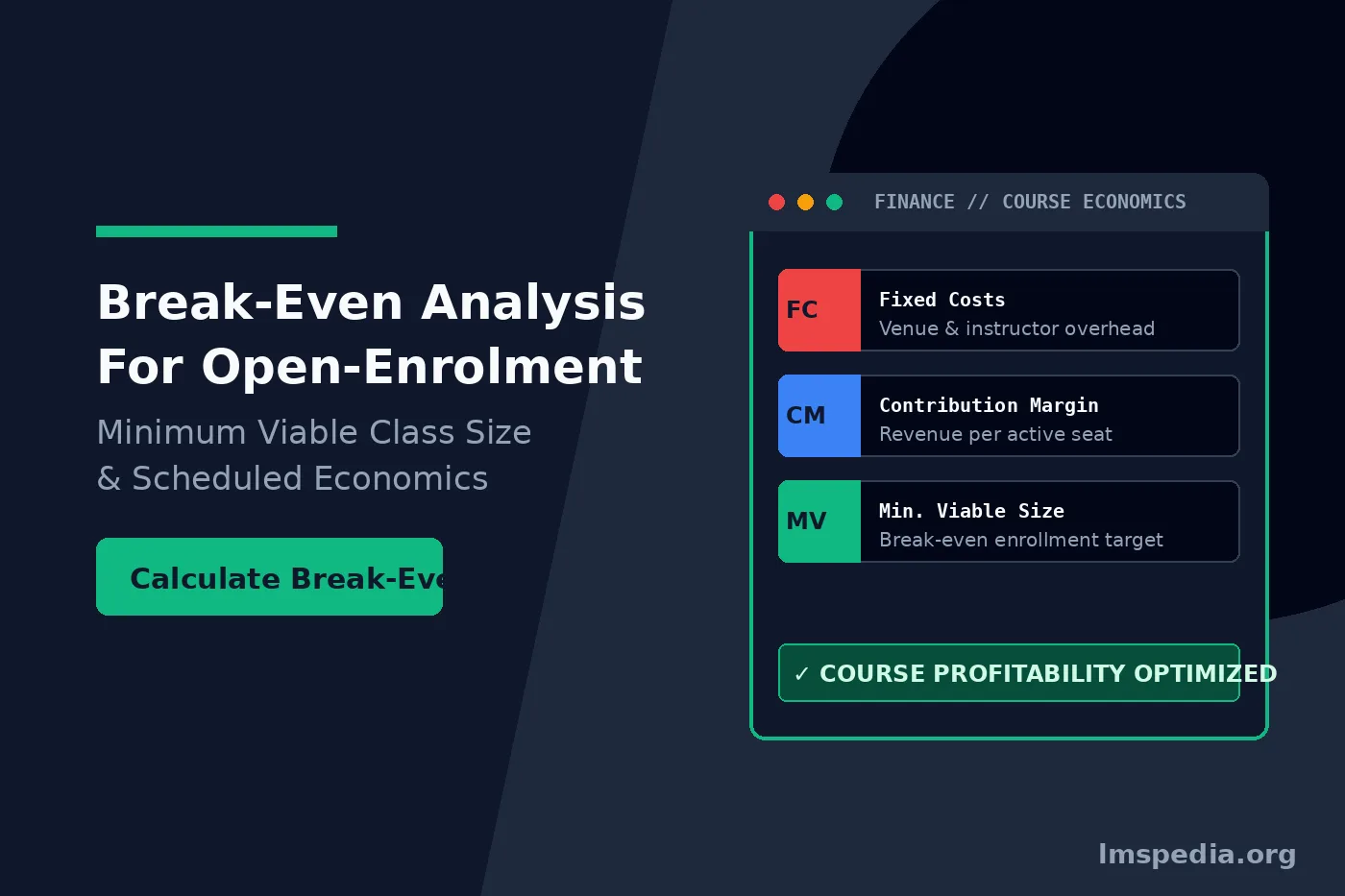
The core objective of a break-even analysis is finding your Minimum Viable Class Size (MVCS). This number represents the absolute minimum number of enrolled delegates required to cover total operational expenses without losing money.
To calculate this metric, organizations utilize the contribution margin model. The contribution margin measures the remaining revenue per student after paying for their direct variable costs. That remaining cash flow actively pays down the course’s fixed overhead expenses.
| Financial Component | Operational Definition | Mathematical Formula |
|---|---|---|
| Revenue Per Seat (P) | The gross ticket price paid by an individual delegate. | Published Course Fee ($) |
| Variable Cost Per Seat (V) | The direct expense incurred by adding one extra student. | Materials + Catering + Lab Licenses + Exam Fees |
| Unit Contribution Margin (CM) | The profit generated per individual student to pay fixed overhead. | $CM = P – V$ |
| Total Fixed Costs (FC) | The unchangeable operational cost of running the session. | Instructor Pay + Venue Rental + Fixed Marketing |
| Minimum Viable Class Size (MVCS) | The exact student headcount needed to achieve zero profit and zero loss. | $MVCS = \frac{FC}{CM} = \frac{FC}{P – V}$ |
When solving this formula, you will frequently produce a decimal result. For example, your calculation might yield an MVCS of 4.3 students. In operational practice, training providers must always round up to the next whole number. Therefore, an MVCS of 4.3 requires 5 confirmed enrollments to avoid an operational loss.
Step-by-Step Scenario: Calculating Course Economics
To observe this financial framework in action, let us evaluate a realistic commercial training example. Consider a three-day, in-person Project Management Professional (PMP) bootcamp hosted in a major metropolitan hotel.
1. Identifying Operational Cost Variables
- Ticket Price ($P$): $1,500 per delegate.
- Instructor Delivery Fee: $3,000 for three days ($1,000 per day).
- Venue and AV Rental: $1,800 for the hotel conference room.
- Marketing Acquisition Budget: $1,200 allocated to digital advertising.
- Total Fixed Overhead ($FC$): $\$3,000 + \$1,800 + \$1,200 = \$6,000$.
- Variable Cost Per Student ($V$): $150 (printed binder) + $100 (catered meals) + $250 (official exam license) = $500 per student.
2. Calculating the Unit Contribution Margin
Next, subtract the variable expenses from the gross seat price to determine how much each student contributes toward fixed venue and instructor overhead:
$$CM = \$1,500 – \$500 = \$1,000$$
Every enrolled student generates exactly $1,000 in gross margin to offset fixed overhead.
3. Determining the Minimum Viable Class Size
Finally, divide total fixed costs by the individual unit contribution margin:
$$MVCS = \frac{\$6,000}{\$1,000} = 6 \text{ Students}$$
In this specific operational scenario, the training academy must enroll exactly 6 students to achieve an open enrolment break even state. The 7th enrolled student delivers the first dollar of net operating profit.
Setting Clear “Go / No-Go” Cancellation Timelines
Calculating your baseline break-even number is only the first half of the operational strategy. Training organizations must also establish strict decision gates to determine when to cancel or confirm a course. Leaving cancellation decisions to the last minute guarantees financial losses and frustrates students.
Leading commercial academies implement a three-tiered cancellation schedule based on supplier attrition penalties:
- T-Minus 21 Days (The Initial Milestone): Assess preliminary registration trends. If enrollment sits below 50% of your MVCS, intensify marketing outreach immediately through targeted email campaigns.
- T-Minus 14 Days (The Decision Gate): Review firm enrollments against venue cancellation deadlines. Most hotel venues permit penalty-free room cancellations up to 14 days prior to the event. If your headcount remains below your MVCS, cancel the in-person event or convert it to a virtual delivery format.
- T-Minus 7 Days (Confirmation Lockdown): Confirm instructor travel bookings, order course workbooks, and issue final logistics details to delegates. After this milestone, your operational costs lock in permanently.
To align your administrative team with these operational milestones, training managers should consult instructional management strategies found across enterprise learning design and operational frameworks.
Strategies to Lower Your Break-Even Threshold
If your calculated MVCS is too high, filling seats becomes an unsustainable uphill battle. Successful training businesses actively engineer their delivery models to lower fixed overhead. Consequently, they make low-enrollment cohorts profitable.
1. Transitioning to Virtual Delivery (vILT)
Physical classroom rental and catering represent a massive portion of fixed overhead. By shifting courses to virtual instructor-led training (vILT), you eliminate venue leasing, attendee catering, and instructor travel costs entirely. In our previous PMP example, removing the $1,800 hotel fee and $100 per-student catering drops the break-even threshold from 6 students down to 4 students.
2. Dynamic Digital Lab Provisioning
Technical training courses (such as cloud computing or cybersecurity) frequently require complex hands-on lab environments. Purchasing dedicated on-premises lab hardware creates heavy fixed depreciation costs. Instead, providers should deploy on-demand cloud sandboxes that spin up only when a student logs in. This architecture converts fixed infrastructure costs into pure variable costs that scale down when enrollment is low.
To ensure secure, frictionless access to virtual environments, training platforms should automate user identity management. Review this technical guide detailing how SCIM protocols automate secure user provisioning.
3. Optimizing LMS Administration and Platform Costs
Running multi-course commercial operations requires scalable administrative tools. If your team manages enrollments manually across disparate spreadsheets, administrative overhead eats away at course margins. Deploying a structured Learning Management System (LMS) automates registration workflows, payment processing, and certificate generation.
When selecting software to support scheduled courses, compare scalable enterprise architectures. For instance, studying the differences between Open LMS vs Totara Learn helps managers choose tools that streamline commercial reporting.
Furthermore, maintaining strict administrative governance prevents configuration errors during registration surges. Explore best practices on architecting clear LMS user roles and permissions to protect your commercial operations.
Leveraging Pricing and B2B Anchoring
Furthermore, implementing dynamic pricing strategies accelerates your journey toward the break-even point. Specifically, commercial training providers offer steep early-bird discounts to secure baseline enrollments months in advance. Once the scheduled course hits its minimum viable class size, the commercial risk disappears entirely. Consequently, sales teams can revert to premium, full-price ticketing for the remaining available seats. This tiered pricing approach guarantees operational safety early while maximizing your overall profitability later.
Additionally, smart training directors utilize corporate anchoring to eliminate financial anxiety completely. Instead of relying purely on individual ticket sales, they sell a bulk block of seats to a single enterprise client. Therefore, this single strategic transaction immediately covers the entire fixed venue overhead cost. Subsequently, every public ticket that an individual learner buys directly becomes pure net margin. Ultimately, blending B2B bulk sales with open-enrolment marketing creates a highly resilient revenue model.
Even with rigorous financial modeling, some scheduled sessions will inevitably miss their enrollment targets. When a course fails to reach its minimum viable class size, protecting your captured revenue becomes paramount. Instead of issuing immediate cash refunds, commercial academies should proactively offer flexible transfer credits or priority seating in upcoming virtual cohorts. By communicating these alternatives clearly before the official cancellation date, training providers retain the customer relationship and preserve critical cash flow. Ultimately, converting a cancelled registration into a future enrollment ensures that temporary scheduling setbacks never permanently damage your annual revenue projections.
Conclusion
Operating a profitable commercial training business requires disciplined financial governance. Relying on intuition when scheduling public training sessions inevitably leads to cancelled courses, angry customers, and eroded profit margins. By implementing a standardized course break even calculation, commercial providers take full control over their operational destiny.
Understanding your minimum class size training requirements empowers your team to set realistic enrollment targets, structure firm go/no-go cancellation gates, and negotiate favorable supplier contracts. Ultimately, mastering the economics of open-enrolment delivery ensures that your training organization remains resilient, predictable, and highly profitable year after year.
FAQ
Q1. What is the minimum viable class size in commercial training?
The minimum viable class size is the exact number of paid attendees required to generate enough revenue to cover all fixed and variable costs associated with delivering a specific course session.
Q2. How do fixed costs differ from variable costs in training operations?
Fixed costs (like instructor fees and room hire) do not change regardless of student numbers. Variable costs (like student workbooks, meal catering, and software licenses) increase with every extra student enrolled.
Q3. What should a training provider do if a course does not meet its break-even target?
If a course fails to hit its minimum class size before the contract cancellation deadline, providers typically pivot the cohort to virtual delivery, reschedule delegates to a later date, or merge registrations with another session.
Q4. Why is the contribution margin important for course pricing?
The contribution margin reveals exactly how much revenue from each ticket sale remains to pay down fixed overhead after covering the direct, individual costs of teaching that student.
Q5. How does virtual delivery affect the break-even calculation?
Virtual training eliminates classroom rental, catering, and travel expenses. Consequently, it drastically reduces total fixed costs, allowing providers to run smaller, highly profitable cohorts.