
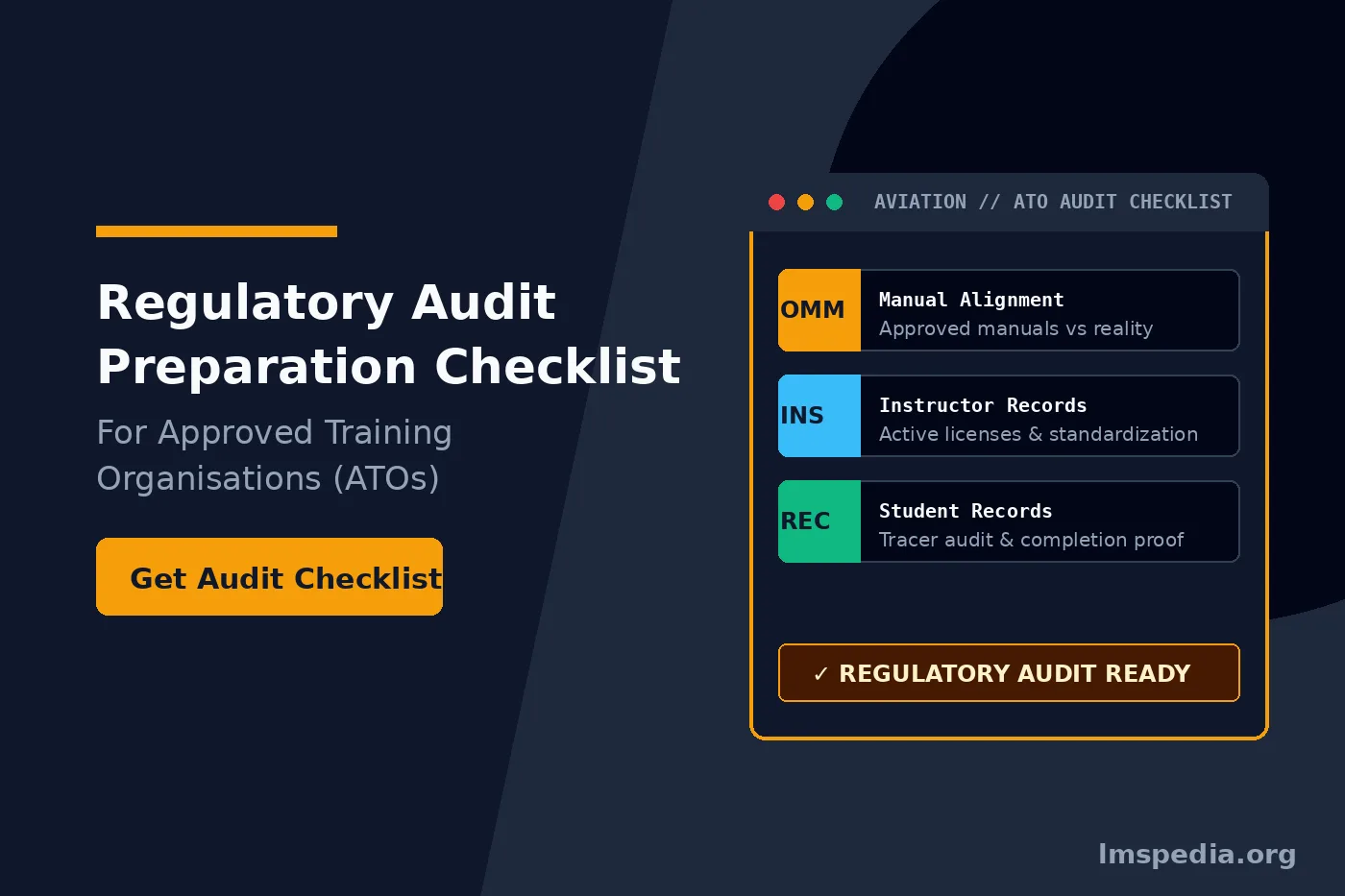
In the highly regulated aviation industry, a regulatory audit triggers intense anxiety for any Approved Training Organisation (ATO). Regulators do not conduct audits merely to observe your daily operations. Instead, they actively search for discrepancies between your approved manuals and your actual training delivery. If an inspector finds a single missing instructor credential or an undocumented syllabus change, they can suspend your operating certificate instantly. Therefore, utilizing a comprehensive ato audit checklist remains the only reliable defense against catastrophic compliance failures.
Thorough aviation training audit preparation requires far more than frantically organizing paper files the week before inspectors arrive. It demands a systematic, year-round approach to quality assurance. Organizations must align their digital systems, instructional frameworks, and personnel records flawlessly. In this guide, we provide a rigorous, step-by-step regulator inspection checklist ato. Furthermore, we explore common compliance traps and highlight how automated systems protect your training approvals.
Key Takeaways

Manuals Must Match Reality:
Regulators actively look for discrepancies between your approved Training Manual and your actual classroom or flight line procedures. If they do not match, you fail the audit.
Instructor Qualifications are Critical:
You must maintain flawless records proving that every instructor held valid licenses, medicals, and internal authorizations on the exact dates they delivered training.
The Tracer Methodology:
Auditors will select a random student and trace their entire training history backward. Missing signatures, skipped prerequisites, or out-of-sequence lessons trigger immediate findings.
Compliance Monitoring is Mandatory:
You must prove that your internal audit system actively finds errors, documents root causes, and implements closed-loop corrective actions before the regulator arrives.
Digital Security Requires Automation:
If you use an LMS, regulators demand proof that training records are secure from unauthorized alteration. Automated identity provisioning (like SCIM) ensures strict access control.
Phase 1: Manuals and Organizational Documentation
Every aviation audit begins in the same place: your core documentation. Inspectors want to verify that you actually follow the procedures you promised to follow. Therefore, your manuals must reflect absolute reality. If your Training Manual (TM) specifies that you use a specific software for exams, but your instructors use paper tests, you will fail the audit immediately.
Before inspectors walk through your doors, your compliance team must verify the following document controls:
- Organization Management Manual (OMM) Currency: Verify that your OMM contains the most recent organizational chart. Furthermore, ensure that the regulator formally approved the current nominated persons (Accountable Manager, Head of Training, Chief Flight Instructor).
- Training Manual (TM) Alignment: Cross-reference your TM against your daily operations. You must confirm that all listed course syllabi, session durations, and grading rubrics match what instructors actually teach in the classroom or simulator.
- Operations Manual (OM) Accuracy: For flight training organizations, inspect your OM. You must ensure all flight time limitations, weather minimums, and dispatch procedures remain up-to-date and actively enforced.
- Version Control Discipline: Eliminate all outdated manuals from classrooms and shared digital drives. Consequently, you guarantee that staff only access the latest, regulator-approved document versions.
To establish a flawless document baseline, ATOs should review parallel regulatory frameworks. For example, understanding EASA Part 147 maintenance training organisation approvals provides excellent insights into strict manual formatting.
Phase 2: Instructor and Assessor Qualifications
Regulators scrutinize your instructional staff relentlessly. They do not just verify that an instructor holds a license. Specifically, they demand proof that the instructor was legally qualified on the exact day they delivered a training module. Missing instructor records cause the most severe compliance penalties.
Your ato audit checklist must include a rigorous review of all personnel files. You must verify the following items for every instructor, examiner, and practical assessor:
- Active Licenses and Medicals: Ensure all instructor licenses and medical certificates remain valid. You must place copies of primary source verifications in their files.
- Initial Training and Standardization: Prove that every instructor completed your ATO’s specific onboarding program. Furthermore, you must document their standardization training before they taught their first solo class.
- Recurrent Training Logs: Verify that all instructors completed their mandatory annual refresher training. This includes updates on instructional techniques and new regulatory mandates.
- Scope of Authorization: Check that your internal authorization documents clearly state what courses each instructor can legally teach. If an instructor teaches a multi-engine simulator session, their file must show specific multi-engine authorization.
Tracking these expiration dates manually invites disaster. Regulators mandate strict historical archiving for these files. To understand exactly how long you must keep these credentials, consult our guide on aviation training records retention requirements.
Phase 3: Student Training Records and Evidence
Student records form the physical proof of your training product. When auditors employ tracer methodology, they select a recently graduated student and trace their entire training footprint backwards. They look for missing signatures, skipped lessons, and grading inconsistencies.
The Student Record Checklist
| Audit Item | Verification Action Required | Why Regulators Check This |
|---|---|---|
| Prerequisite Verification | Confirm proof of age, medical fitness, and baseline licenses before the start date. | Ensures the ATO did not enroll legally ineligible candidates into regulated courses. |
| Chronological Progression | Verify that ground school, simulator, and flight modules occurred in the approved sequence. | Proves the ATO followed the approved Training Manual syllabus without unauthorized shortcuts. |
| Grading and Feedback | Check that instructors left clear, actionable comments on failed or repeated lessons. | Validates that instructors actually assess competency rather than just ticking boxes blindly. |
| Signatures and Timestamps | Ensure both the student and the instructor signed every completed training session. | Provides legal accountability and prevents retroactive falsification of training records. |
| Course Completion Certificates | Match the final issued certificate against the ATO’s approved template and authorization limits. | Confirms the ATO only issues credentials for courses it holds explicit approval to teach. |
For organizations operating outside of flight operations, such as maintenance training, similar strict rules apply. You can review these overlapping mandates in our breakdown of FAA Part 145 repair station training requirements.
Phase 4: ATO Compliance Monitoring System
Modern aviation regulations require you to find your own mistakes before the regulator finds them. Therefore, robust ato compliance monitoring acts as your internal shield. Regulators will inspect your Compliance Monitoring Manager (CMM) and their internal audit schedule heavily.
You must prove that your internal audits function effectively. First, present your annual audit schedule. You must show that you audited every department (operations, ground training, simulators, records) within the last 12 months. Second, you must show the results of those internal audits. If your internal audits never find any errors, the regulator will assume your CMM is ineffective.
Third, and most importantly, you must demonstrate closed corrective action plans. When an internal audit discovers a problem, you must document the root cause analysis. Next, you must show the corrective action taken to fix the problem permanently. Finally, the Accountable Manager must sign off on the closure. This closed-loop system proves that your ATO possesses a healthy, functioning safety and compliance culture.
Phase 5: Analyzing EASA Audit Findings Training
Understanding past failures helps you prevent future ones. When analyzing common easa audit findings training, several consistent themes emerge across European and global ATOs. Knowing these traps allows you to adjust your aviation training audit preparation proactively.
A primary finding involves poor fatigue risk management among instructors. Regulators frequently discover that ATOs push their instructors beyond legal duty time limits. You must maintain crystal-clear duty logs. Furthermore, another common finding relates to inadequate facilities. If your Training Manual states that classrooms hold a maximum of 12 students, but auditors count 15 chairs and 15 students in a room, you receive an immediate non-compliance notice.
Additionally, auditors constantly find systemic issues driven by human error. Administrative staff often make transcription mistakes when copying grades from paper to digital systems late at night. These errors invalidate the training records completely. To insulate your operations against these specific psychological pitfalls, you must integrate strategies from the Dirty Dozen framework of human factors directly into your administrative workflows.
Phase 6: Digital Archiving and Security Protocols
Paper records belong in the past. Today, leading ATOs rely on advanced Learning Management Systems (LMS) and Training Management Systems (TMS) to maintain compliance. However, utilizing software introduces new regulatory requirements regarding data security and identity management.
When an auditor reviews your digital records, they will ask how you prevent unauthorized alterations. You must prove that an instructor cannot log into the system and change a failing grade to a passing grade three weeks after a simulator session ends. Consequently, you need robust audit trails and strict access controls.
Automating your identity management solves many of these vulnerabilities. When you sync your LMS with your central HR directory, you eliminate manual access errors. For instance, when an instructor leaves the company, automated systems revoke their LMS access instantly. To secure your compliance data effectively, your IT department should implement standardized identity protocols. You can learn how this architecture prevents unauthorized access by reviewing this guide on what SCIM is and how it powers identity security.
Conducting the Pre-Audit Gap Analysis
You must never treat the official audit as a practice run. Approximately 30 to 60 days before the regulator arrives, your management team must conduct a brutal pre-audit gap analysis. You should hire an external consultant or utilize personnel from a different department to run this mock audit. They must possess the authority to dig deep into your files without bias.
During this mock audit, use the exact checklist the regulator uses. Pull random student files. Interview instructors on their emergency procedures. Demand to see the calibration certificates for your flight training devices. If you uncover gaps during this phase, you still have time to implement corrective actions. To structure this evaluation phase properly, leverage standardized training needs assessment tools to map your current operational reality against strict legal obligations.
Conclusion
Surviving a regulatory inspection does not rely on luck. Instead, it requires meticulous organization, aggressive internal monitoring, and absolute transparency. By actively utilizing a strict ato audit checklist, you transform compliance from a reactive panic into a controlled, daily habit.
Organizations must align their manuals with reality, safeguard their instructor qualifications, and maintain flawless student records. Furthermore, embracing digital automation and closed-loop corrective actions proves to regulators that you operate a highly professional training environment. Ultimately, thorough preparation protects your operating certificate, ensures aviation safety, and elevates your reputation in the commercial training market.
FAQ
Q1. What is an ATO audit checklist?
An ATO audit checklist is a comprehensive tool used by Approved Training Organisations to prepare for regulatory inspections. It lists all mandatory compliance items, including manual version control, instructor qualifications, and student record integrity.
Q2. How far back do aviation auditors check training records?
Auditors typically focus heavily on records generated within the last 12 to 24 months. However, depending on specific regulatory retention rules, they possess the authority to request historical qualification data spanning several years.
Q3. What is ATO compliance monitoring?
Compliance monitoring is the internal quality assurance system within an ATO. It requires the organization to conduct its own scheduled internal audits, identify operational non-conformities, and implement corrective actions proactively.
Q4. What are the most common EASA audit findings for training organizations?
Common EASA findings include outdated training manuals, missing documentation for initial instructor standardization, incomplete student training folders, and ineffective internal compliance monitoring systems.
Q5. Can an ATO use digital records instead of paper files during an audit?
Yes, regulators encourage digital record-keeping. However, the ATO must prove that the digital system features robust security, strict access controls, and unalterable audit trails to prevent unauthorized data manipulation.