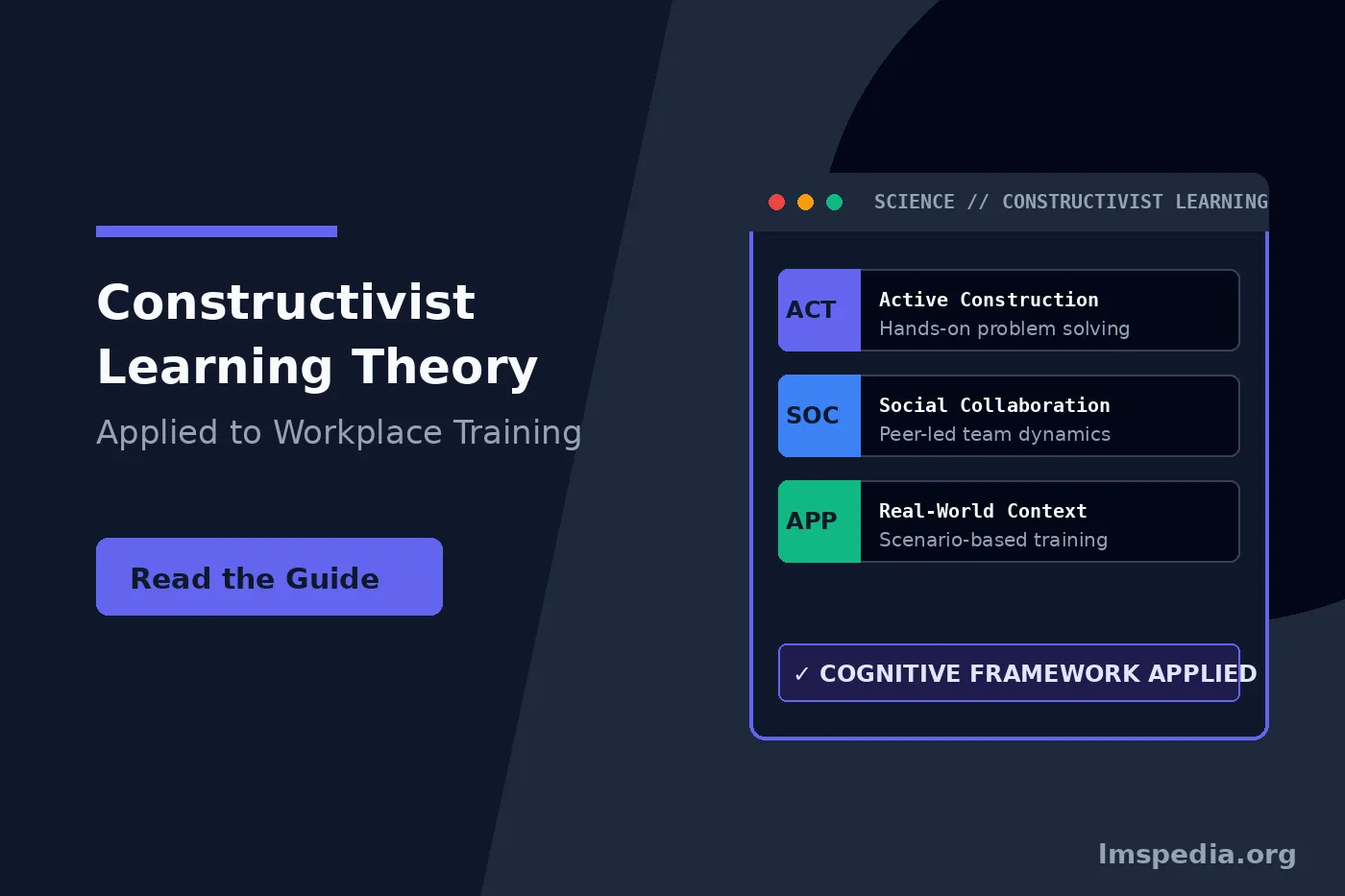
Constructivist Learning Theory in Corporate Training: Active Discovery
For decades, traditional corporate training relied entirely on passive transmission models. Instructional designers packaged information into dense PowerPoint decks or linear e-learning modules. Consequently, employees sat back, clicked next, and memorized compliance facts. Unsurprisingly, this passive approach causes abysmal knowledge retention. Furthermore, it creates little behavioral change on the job. Modern adults do not learn by absorbing pre-packaged lectures. Instead, they learn by doing, failing, and reflecting. Therefore, Learning and Development teams must embrace constructivist learning theory. Furthermore, enterprise buyers should cross-reference vendor capabilities against a comprehensive benchmark of core training management system features to avoid functional limitations.
Thinkers like Jean Piaget and Lev Vygotsky shaped constructivism. Crucially, constructivism asserts that learners build knowledge actively rather than absorbing information passively. Thus, constructivism in training transforms the corporate classroom into an interactive laboratory. In this guide, we examine how to implement constructivist instructional design, foster social learning, and transition workplace training toward active problem-solving.
Active Knowledge Construction: Constructivism shifts corporate training away from passive lecture consumption, requiring employees to build mental models actively through real-world problem-solving.
The Facilitator Shift: Instructors transition from traditional “sages on the stage” delivering data to coaches and facilitators guiding learners through authentic operational challenges. The Power of Social Learning: Grounded in social constructivism, enterprise training achieves higher retention when structured around peer collaboration, team problem-solving, and shared communities of practice. Scenario-Based Compliance: Even in heavily regulated sectors, constructivist methods replace rote memorization with digital sandboxes and simulations that teach employees why standard operating procedures matter. Performance-Based Metrics: Success in constructivist programs is measured through practical project outputs, peer reviews, and behavioral change rather than simple multiple-choice completion quizzes.
Key Takeaways

The Historical Context: From Behaviorism to Constructivism
To understand constructivism, we must examine what preceded it. Early corporate training borrowed heavily from behaviorism. Behaviorist training treated employees like stimulus-response machines. Companies rewarded correct answers and punished or ignored errors. While behaviorism works well for basic mechanical tasks, it fails entirely when applied to complex cognitive work. Modern workplaces require adaptive thinking, which behaviorist conditioning cannot support.
Later, cognitivism emerged and opened the black box of the human mind, viewing learners as information processors akin to computers. However, cognitivism still viewed knowledge as something external that instructors downloaded into learners. Constructivism shatters this notion completely. It posits that learners do not receive knowledge; they invent it. Employees filter every piece of corporate training through their unique worldview, past experiences, and daily professional pressures.
Understanding this cognitive evolution is vital for modern instructional designers. When organizations transition from static content delivery to dynamic knowledge construction, engagement skyrockets. To explore broader shifts in enterprise instructional design, review recent insights and frameworks available on the LMSPedia blog archive.
Core Principles of Constructivism in Corporate Training
Before designing enterprise curricula, instructional architects must understand the psychological mechanics driving constructivism. Traditional training assumes knowledge is an objective commodity. It assumes an instructor transfers that knowledge into an employee’s head. However, constructivism flips this paradigm completely by emphasizing that meaning is made by the individual.
Every employee enters training with a unique mental model. Past work history, daily challenges, and personal biases shape this model. Therefore, new information only becomes meaningful when learners actively integrate it into existing frameworks. If a new protocol contradicts an employee’s workflow, they reject it immediately. To succeed, they need space to test and question the material. To align your goals with active frameworks, review best practices on modern training needs assessment protocols.
Furthermore, constructivist environments embrace cognitive conflict, often called cognitive dissonance. When learners encounter a problem that disrupts their existing mental models, their brains experience tension. Resolving this tension forces them to restructure their understanding. This deep mental restructuring is what separates true professional development from temporary rote memorization.
Embrace Cognitive Conflict
Design scenarios that directly challenge prevailing workplace assumptions. Forcing learners to resolve cognitive dissonance creates permanent, actionable behavior change.
Shifting from Passive Transmission to Active Discovery
The most immediate application of discovery learning corporate strategy involves eliminating the traditional lecture model. In a constructivist program, the instructor becomes a facilitator. Instead of explaining software tools directly, the facilitator presents a realistic operational challenge. Then, they guide learners toward the solution.
For instance, consider customer service training. Rather than lecturing agents on theory, facilitators split teams into small groups. Next, they present a volatile customer complaint. Learners must construct a de-escalation strategy by analyzing past experiences and testing ideas. Ultimately, this active struggle creates deep neural pathways. Consequently, agents retrieve constructed solutions easily when facing real customers.
Furthermore, discovery learning forces employees to confront their own misconceptions. When an employee attempts to solve a complex operational problem and fails safely in a sandbox environment, their brain reorganizes its schema. This safe failure mechanism is the exact engine that drives true professional growth. Organizations that balance these discovery frameworks with flexible technical infrastructures often see faster time-to-competency for new hires.
Integrating Social Constructivism in the Workplace
While cognitive constructivism targets individual mental models, social constructivism workplace strategies emphasize communal activity. Lev Vygotsky’s Zone of Proximal Development demonstrates that adults achieve higher performance through peer collaboration than they ever could working in isolation.
Corporate LMS platforms often isolate learners behind desk modules. Conversely, constructivism demands collaboration. Modern enterprise training should embed collaborative touchpoints directly into daily workflows:
-
Peer-Led Problem Solving: Structure workshops around cross-functional challenges where staff co-create solutions.
-
Collaborative Case Studies: Replace quizzes with team-based evaluations requiring consensus.
-
Workspace Communities of Practice: Build digital channels where teams share emergent hacks and best practices.
When employees talk through problems together, they externalize their internal thought processes. This dialogue exposes gaps in understanding and introduces colleagues to alternative problem-solving strategies they never would have considered in isolation. For organizations managing complex blended environments or multi-platform architectures, comparing managed solutions like Open LMS vs Totara Learn can provide valuable insights into supporting collaborative communities.
To ensure collaborative spaces remain secure and engaging, training managers should consult frameworks on architecting clear LMS user roles and instructor permissions. Furthermore, enterprise software strategies evaluated by analysts at Gartner reinforce these platform selection criteria.
Designing Constructivist Instructional Frameworks
Building constructivist courses requires overhauling traditional design models like ADDIE. Instead of starting with content outlines, designers begin with real-world problems. Effective constructivist instructional design relies on four critical pillars:
| Design Pillar | Traditional Transmission Model | Constructivist Application |
| SimpliTrain | Automated collaborative session scheduling and group tracking. | Coordinates team problem-solving workshops and peer feedback sessions. |
| Starting Point | A list of topics and chapters to cover. | An authentic, messy, real-world workplace problem or case study. |
| Learner Role | Passive listener taking notes or clicking buttons. | Active investigator, problem-solver, and knowledge creator. |
| Instructor Role | Subject matter expert delivering lectures. | Facilitator, coach, and catalyst for critical thinking. |
| Assessment Type | Multiple-choice tests memorizing facts. | Demonstrated performance, project output, and peer critique. |
By shifting architecture toward authentic problem spaces, you eliminate gaps between training and working. Learners practice exact skills in exact operational contexts. This contextual alignment ensures that knowledge transfers smoothly from the virtual or physical classroom directly to the frontline of business operations.
Applying Constructivism to Regulated and Technical Training
Compliance officers often argue that constructivism is too loose for regulated industries. Critics claim that technical training leaves no room for discovering answers. Instead, staff must follow rigid standard operating procedures (SOPs). In high-consequence fields like aviation or heavy manufacturing, deviation from protocol can lead to catastrophic failure.
However, constructivism does not mean making up rules. Rather, it means understanding why rules exist. In compliance settings, constructivist approaches replace rote memorization with scenario-based simulations. For example, technicians work through a simulated contamination outbreak in a digital sandbox. They test hygiene hypotheses and observe consequences. Thus, they construct a deep understanding of why SOPs matter. This rigorous approach aligns with specialized technical pathways, such as navigating complex EASA Part 147 maintenance training organisation approvals.
Moreover, when technicians discover the systemic impact of skipping a procedural step through simulation, they develop intrinsic compliance. They follow protocols because they understand the downstream safety hazards, not simply because a handbook demands it. This mirrors broader safety frameworks, such as understanding systemic human factors outlined in the Skybrary Dirty Dozen framework. Additionally, maintaining verifiable compliance documentation through resources like our guide on LMS for compliance training and audit evidence ensures complete institutional readiness.
Validate Simulation Safety
Ensure digital sandboxes mirror actual operational environments strictly. Safe exploration must never inadvertently teach non-compliant procedural shortcuts.
Overcoming Barriers to Constructivist Corporate Training
Transitioning departments to constructivist methods requires navigating organizational hurdles. Stakeholders accustomed to traditional metrics often resist active learning because standard quizzes cannot measure it. When executives ask for completion percentages, proving the value of an open-ended collaborative workshop can feel challenging.
To secure executive buy-in, leaders must redefine success. Instead of tracking completion rates, constructivist programs utilize performance rubrics, portfolio reviews, and manager observations. Furthermore, your technical infrastructure must support interactive workflows. Modern platforms must empower collaboration without friction. Exploring advanced provisioning architectures like SCIM provisioning for enterprise LMS platforms ensures user groups remain synchronized with corporate directories.
Additionally, instructional designers must receive proper upskilling. Transitioning from writing bulleted slides to crafting complex, open-ended workplace simulations requires a completely different design skill set. Organizations must invest in training their L&D teams before expecting them to transform enterprise curricula.
Conclusion
Corporate training can no longer treat employees as empty vessels. In a fast-paced business world, workers must solve problems dynamically. By embracing constructivist learning theory, organizations move beyond forgettable compliance lectures and build active ecosystems.
Whether designing onboarding tracks or technical certifications, anchoring courses in real-world problem-solving yields profound results. When you empower employees to build their own understanding, training translates directly into business impact.
FAQ
Q1. What is constructivist learning theory in simple terms?
Constructivist learning theory states that people construct their own understanding and knowledge of the world through experiences and reflecting on those experiences, rather than passively taking in information.
Q2. How does constructivism differ from traditional corporate training?
Traditional training treats learners as passive recipients of information through lectures and e-learning slides, whereas constructivism treats learners as active problem-solvers who build knowledge by doing, discussing, and experimenting.
Q3. Can constructivist learning be used for compliance and safety training?
Yes. Instead of having employees memorize a static rulebook, constructivist compliance training uses interactive scenarios, simulations, and case studies to help learners understand the practical consequences and reasoning behind safety policies.
Q4. What is the role of the instructor in a constructivist training model?
In a constructivist model, the instructor acts as a facilitator, mentor, or coach. They do not feed answers to learners; instead, they guide discussions, pose challenging questions, and provide resources as learners solve problems collaboratively.
Q5. How do you measure the success of constructivist workplace training?
Because constructivist training focuses on critical thinking and problem-solving, success is measured using performance rubrics, practical project evaluations, peer assessments, and observed behavioral changes on the job rather than standard multiple-choice test scores.