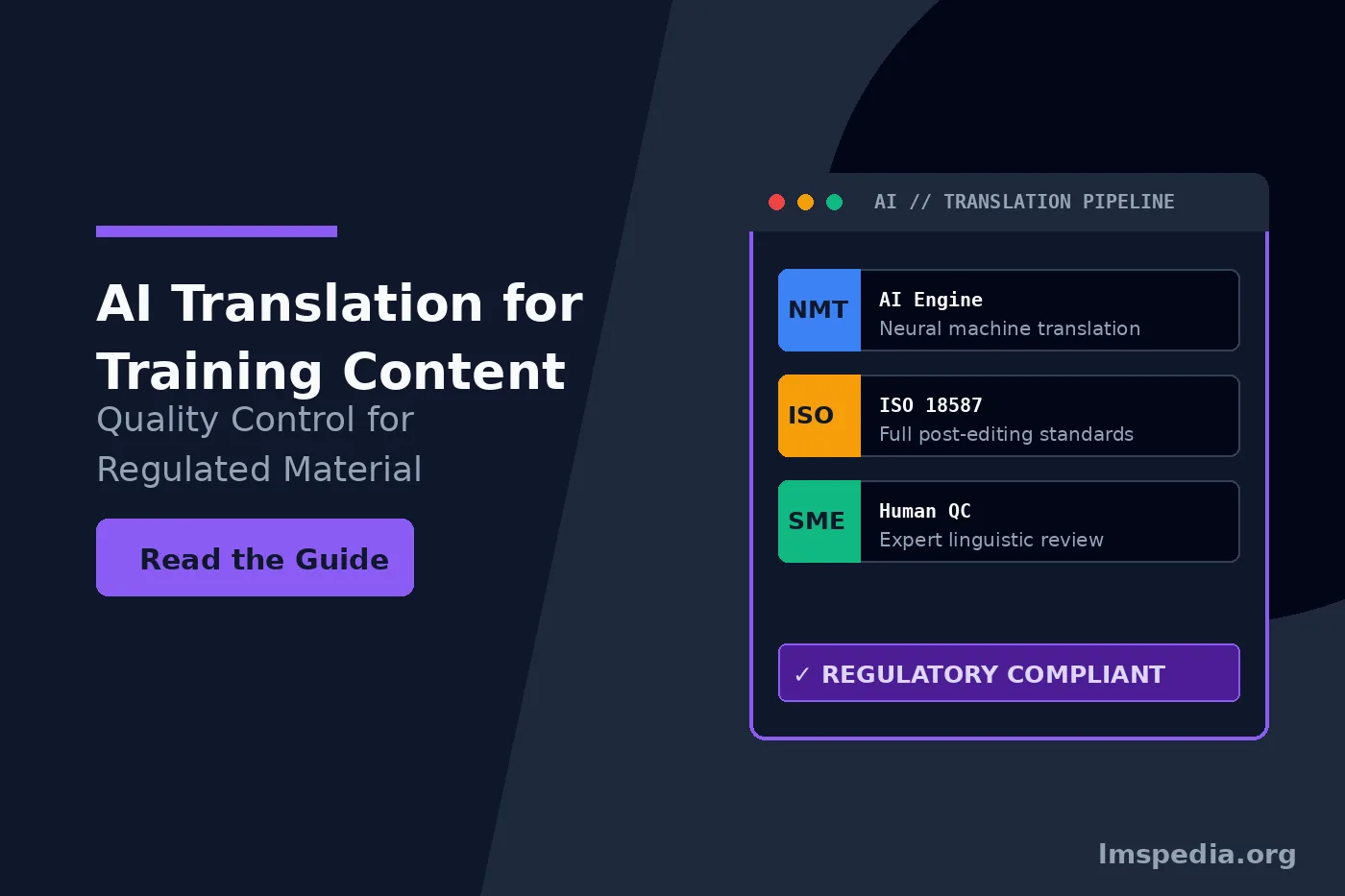
Global organizations face massive logistical challenges in the modern corporate learning environment. Specifically, they must deploy critical compliance and operational training across dozens of languages at the exact same time. Historically, traditional human translation proved too slow for this task. Moreover, this manual process was far too expensive to keep pace with rapid course updates. Consequently, Learning and Development teams are increasingly leveraging artificial intelligence to scale their global efforts. However, generating ai translation training content for highly regulated sectors introduces massive operational risk. These critical sectors include life sciences and aviation. For example, a single mistranslated technical term in a standard operating procedure can trigger catastrophic operational failures. Furthermore, bad translations in a safety manual can cause devastating compliance violations.
To successfully integrate machine translation elearning into your pipeline, you cannot simply copy and paste text into consumer grade AI tools. Instead, you must implement a highly structured and auditable quality control process. This process must be rooted firmly in international standards. For a broader overview of managing diverse language requirements in learning systems, you should review our comprehensive guide on deploying a multilingual LMS platform. In this technical reference guide, we will explore how to establish a robust translation review workflow. Ultimately, this workflow guarantees that your automated translations will meet strict regulatory standards.
Key Takeaways

Implement ISO 18587 Standards:
When using AI for translations, adhere to ISO 18587, the international standard for post-editing machine translation output. It ensures the final text reaches a quality level comparable to human translation.
Mandate Full Post-Editing:
Never rely on “light” post-editing for compliance content. Require “full” post-editing by qualified linguists to guarantee semantic accuracy, correct terminology, and cultural appropriateness.
Optimize Source Content First:
AI performs best on structured data. Before translation, ensure your source text uses simple sentences, avoids ambiguity, and strictly follows an approved corporate terminology glossary to prevent machine errors.
Require Domain Expertise:
Post-editors must possess specialized domain knowledge (e.g., in aviation or life sciences) because even a minor mistranslation can lead to severe safety risks or regulatory compliance issues.
Maintain Audit-Ready Documentation:
ISO 18587 requires detailed record-keeping of every step in the post-editing process. Track all human approvals and workflow steps in your Learning Record Store to prove quality control during a regulatory inspection.
Understanding the ISO Standards for Translation Quality
Regulated organizations cannot rely on subjective visual assessments of translation quality. Instead, they must adhere strictly to rigorous international frameworks. These frameworks clearly define professional linguistic standards for global businesses. Specifically, two distinct ISO standards govern the safe application of human and machine translation.
ISO 17100: The Human Translation Baseline
Before relying on artificial intelligence, organizations must first understand the traditional baseline for quality. ISO 17100 is the internationally recognized standard for professional translation services. It mandates strict requirements for translator qualifications. Specifically, it stipulates that professionals must hold recognized degrees in translation or linguistics. Alternatively, they must possess significant professional translation experience. Furthermore, ISO 17100 requires a rigorous production workflow for every single project. First, a primary linguist performs an initial translation. Second, a completely different qualified linguist completes a subsequent revision. Finally, a project manager executes a final verification step before delivery. Achieving ISO 17100 compliance guarantees a high level of safety. It proves that a translation provider has the proper infrastructure and quality management systems to deliver accurate results.
ISO 18587: Post Editing Machine Translation
When organizations introduce artificial intelligence into their workflows, they must pivot to ISO 18587. This specific standard defines the requirements for the human post editing of machine translated output. ISO 18587 explicitly states that its primary purpose is not to replace professional human translators with automatic tools. Rather, it dictates exactly how a qualified linguist must review and correct AI generated text. As a result, the final output reaches a quality level comparable to traditional human translation.
The standard strictly differentiates between light post editing and full post editing. Light post editing merely makes the output understandable for the reader. Conversely, full post editing ensures the final text is grammatically correct and indistinguishable from human writing. For regulated training content, you must always mandate full post editing. Therefore, you guarantee semantic accuracy, terminological consistency, and cultural appropriateness.
Designing a Compliant Translation Review Workflow
To achieve high multilingual course translation quality, you must build a comprehensive Human in the Loop pipeline. This process ensures that artificial intelligence accelerates the initial heavy lifting. However, qualified human subject matter experts maintain absolute ultimate control over the final output.
1. Pre Production and Source Optimization
The quality of your ai translation training content depends heavily on the quality of your source text. During the pre production phase, development teams must assess the source material. They must determine whether the text is actually suitable for machine translation at all. Source content should be extremely well written. It must utilize simple sentence structures and avoid ambiguous phrasing. Furthermore, it must maintain strict terminological consistency throughout the entire document.
Before feeding courses into an AI engine, you must establish an approved terminology glossary. This glossary forces the artificial intelligence to use exact corporate terminology. Consequently, it prevents the neural network from substituting highly specific medical or aeronautical terms with incorrect generic synonyms.
2. The Machine Translation Phase
Once you optimize the source text and load the glossary, the machine translation engine processes the course files. Modern neural machine translation engines analyze the context of entire sentences. They do not translate text word by word. As a result, this technology significantly improves the initial fluency of the output. However, the artificial intelligence still lacks genuine industry context. Therefore, making the next human review step is absolutely critical.
3. Full Post Editing by Qualified Linguists
According to ISO 18587, the human post editor must possess advanced proficiency in both the source and target languages. Additionally, they must deeply understand machine translation technologies and hold specialized domain knowledge. In sectors like life sciences or engineering, even a minor mistranslation can lead to massive safety risks. The post editor carefully reads the AI output. Next, they meticulously correct grammatical errors and reformulate unnatural sentences. Finally, they verify all terminology against the approved corporate glossary. They ensure the final text aligns perfectly with the required tone, style guide, and formatting rules.
Avoid Light Post Editing in Compliance
Never use light post editing for regulatory training, standard operating procedures, or safety manuals. Light post editing only ensures the text is basically legible. To successfully pass safety audits in life sciences or aviation, you must strictly demand full post editing. This guarantees absolute semantic accuracy and domain specific precision.
Localisation AI Training in Highly Regulated Sectors
Applying localisation ai training strategies differs drastically depending on your industry. You must carefully map your translation workflows directly to your specific regulatory requirements.
Life Sciences and Pharmaceutical Environments
In the pharmaceutical industry, training content dictates exactly how employees manufacture life saving drugs. If you use AI to translate a Good Manufacturing Practice module, the translation process itself becomes subject to regulatory scrutiny. You must maintain detailed records of who post edited the machine translation. Furthermore, you must record exactly when they approved it. To understand how to manage these digital signatures seamlessly, you should explore our deep dive on 21 CFR Part 11 audit trails for training systems. Additionally, your overarching platform must support rigid version control. You can read more about this in our guide to LMS pharmaceutical biotech GxP training.
Aviation and Aerospace Operations
The aviation sector relies heavily on hyper specific procedural language. A neural translation engine might incorrectly translate critical terms like runway incursion or thrust reverser. This happens frequently if the engine is not properly trained. Therefore, aviation learning teams must utilize translation memories. Translation memories are databases of previously approved human translations. Teams use these databases to train custom AI models. For a detailed breakdown of maintaining compliance on the tarmac, please review our comprehensive guide to aviation training localisation.
Safeguarding Data Privacy During Translation
In highly regulated sectors, corporate training materials frequently contain proprietary trade secrets. They also contain unreleased product specifications or sensitive employee data. Feeding this regulated material into free or consumer grade AI translation tools exposes your organization to severe data breaches. Public AI engines often ingest user inputs to train their global neural networks. As a result, your confidential standard operating procedures could inadvertently become public knowledge.
To maintain multilingual course translation quality without sacrificing security, organizations must exclusively utilize closed loop environments. You must only use enterprise grade AI translation tools. In these secure instances, vendor agreements strictly prohibit the AI from retaining your proprietary text. Furthermore, the vendor cannot use your data to train external language models.
Managing Multimedia and SCORM Localization
When organizations deploy modern compliance training, the courses rarely consist of simple text documents. Modern corporate learning modules heavily utilize interactive SCORM packages and instructional safety videos. They also feature complex audio voiceovers. Applying machine translation elearning strategies to these multimedia assets requires a highly specialized technical approach. You cannot simply translate the text script and expect the final video to function correctly on the screen.
Different languages require completely different amounts of space and time to convey the exact same message. For example, translating a safety video script from English to German often expands the text length by up to thirty percent. If you use an artificial intelligence voiceover tool to narrate the translated German script, a problem occurs. The audio will likely run significantly longer than the original English video animations.
To solve this synchronization issue, learning and development teams must utilize adaptive timing tools. These tools exist within modern elearning authoring software. Furthermore, translating interactive on screen text requires strict functional quality control testing. Quality assurance reviewers must physically play through the translated SCORM file in a secure staging environment. They must ensure that the expanded translated words do not break the visual interface. The text must not overlap critical navigation buttons or obscure important safety diagrams. By integrating these multimedia quality control steps directly into your broader translation review workflow, you guarantee success. International employees will receive the exact same engaging and compliant learning experience as their native speaking counterparts.
Creating a Continuous Feedback Loop
The most significant advantage of implementing a formal translation review workflow is machine learning. You gain the ability to make your AI engine progressively smarter over time. When a human subject matter expert executes full post editing on an AI generated course, valuable data is created. Their specific text corrections should not be discarded after the course goes live.
Instead, those precise human corrections must be fed directly back into your organization systems. You must upload them into your Translation Memory and your custom Neural Machine Translation model. By systematically training the AI with these validated corrections, the engine learns quickly. It memorizes your exact corporate phrasing and industry nuances. Over time, this continuous feedback loop drastically reduces the volume of human post editing required for future projects. Consequently, it accelerates deployment speeds while simultaneously maintaining absolute regulatory compliance.
Tracking Quality and Audit Readiness
Ultimately, regulators will hold your organization accountable for the training your employees consume. This accountability remains exactly the same regardless of whether a human or a machine translated the course. ISO 18587 takes documentation very seriously. It requires detailed records of every single step in the post editing process. These records serve as ultimate proof of quality assurance.
You must integrate your translation workflows directly into your Learning Record Store. Sometimes, an auditor might challenge the validity of a translated safety course. When this happens, your data architecture must easily prove that a qualified human validated the output. You must show the approval happened before the course was deployed to frontline workers. To ensure your data tracking is truly audit ready, you should review our architectural framework for LRS architecture and governance.
Conclusion
The integration of artificial intelligence is irreversibly transforming how global enterprises distribute learning content. However, generating ai translation training content for regulated industries is not a simple technological shortcut. It requires meticulous human oversight.
By adhering to ISO 18587 standards, you create a safe foundation. You must optimize source material and mandate full post editing by qualified human experts. By doing so, you can dramatically accelerate your machine translation elearning deployments without ever sacrificing safety. Establish a rigorous translation review workflow that prioritizes terminological accuracy and auditability. When executed correctly, AI translation stops being a dangerous compliance risk. Instead, it becomes a highly powerful strategic asset. Ultimately, it ensures your global workforce remains safe, qualified, and fully compliant across every single operational language.
FAQ
Q1. What is the difference between ISO 17100 and ISO 18587?
ISO 17100 is the international standard for traditional human translation services, requiring strict processes like initial translation, revision by a second linguist, and final verification. ISO 18587 specifically addresses machine translation, defining the requirements and workflow for human post-editing of AI-generated text.
Q2. Why can't I use raw machine translation for compliance training?
Raw machine translation lacks human intuition and specialized industry context. In highly regulated sectors like aviation or pharmaceuticals, minor linguistic errors can cause safety hazards and compliance violations. Therefore, human post-editing is mandatory to ensure semantic accuracy.
Q3. What is full post-editing in a translation review workflow?
Full post-editing is a comprehensive review process where a qualified human linguist meticulously corrects machine translation output. They ensure the text is grammatically correct, matches the target audience’s tone, follows formatting rules, and is indistinguishable from human writing.
Q4. How do glossaries improve ai translation training content?
Glossaries provide the AI engine with a fixed database of approved corporate terminology. This forces the machine to use the exact correct technical terms (e.g., specific drug names or aircraft parts) rather than substituting them with incorrect or generic synonyms.
Q5. Does using machine translation elearning violate FDA compliance?
No, using machine translation does not inherently violate compliance, provided you maintain strict quality control. You must ensure the final content is verified by human experts, and you must maintain secure, unalterable 21 CFR Part 11 audit trails documenting who approved the final translated version and when.