
In commercial aviation, passenger cabin safety rests directly on the rapid decision making and physical readiness of flight attendants. While passengers often see cabin crew assisting with boarding and in flight service, their primary operational responsibility is emergency management. From sudden cabin depressurizations and lithium battery fires to high speed emergency evacuations, cabin crews must execute complex, life saving procedures under extreme psychological pressure. To ensure these critical skills never deteriorate, civil aviation authorities mandate structured, recurring education. Managing flight attendant recurrent training is one of the most vital compliance priorities for any commercial airline.
However, global airlines operating across international jurisdictions must navigate differing regulatory frameworks. The Federal Aviation Administration (FAA) in the United States and the European Union Aviation Safety Agency (EASA) in Europe both enforce rigorous safety standards, yet their structural approaches to recurrent qualification, practical drill frequencies, and checking mechanisms vary significantly. To maintain continuous regulatory standing, flight operations leaders must master both frameworks. For organizations managing complex cross border crews, exploring specialized EASA compliance training software is essential to harmonize these disparate requirements.
Furthermore, managing recurrent schedules across thousands of crew members requires enterprise level automation. Training directors must ensure their technical infrastructure can track expirations, manage mock up simulator availability, and preserve digital audit trails. To see how leading airlines handle this operational challenge, review our evaluation of the best aviation training management systems. In this comparative guide, we will examine the core differences between FAA and EASA cabin crew regulations, break down mandatory practical drills, and explore best practices for tracking compliance.
Key Takeaways

Regulatory Foundations Differ:
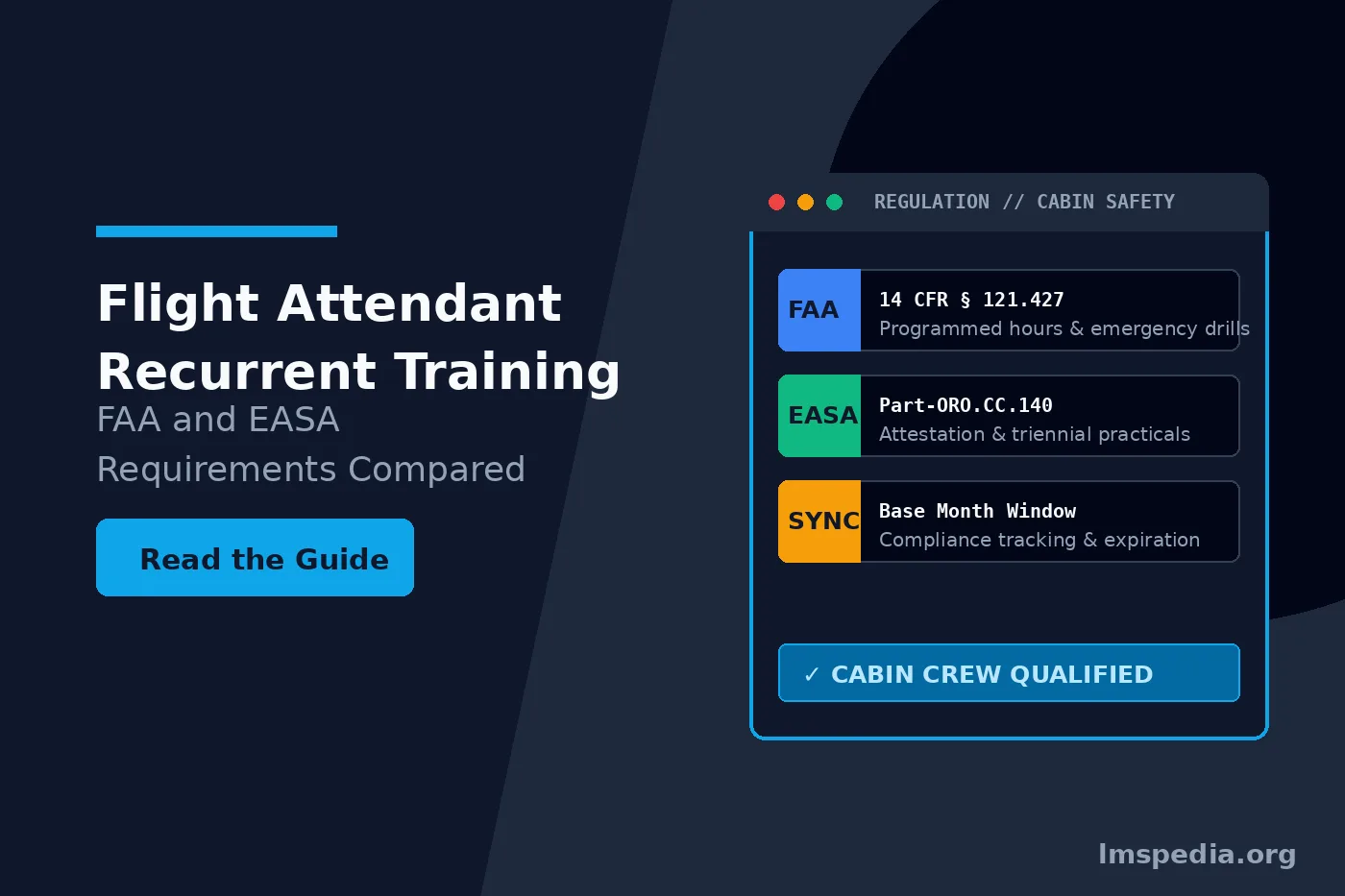
FAA recurrent training is governed by 14 CFR § 121.427 with structured programmed hours, while EASA operates under Part-ORO.CC.140 emphasizing competency checking and Attestation validity.
Base Month Flexibility:
Both FAA and EASA allow a three-month eligibility window (base month plus/minus one month) to complete recurrent qualifications without shifting the crew member’s original renewal date.
Rolling Triennial Modules under EASA:
EASA mandates that specific high-intensity practical exercises (such as wet ditching raft drills and live firefighting in smoke) must be completed every 3 years alongside annual core refreshers.
Practical Hands-On Drills are Mandatory:
Digital ground school cannot replace physical evaluations. Crew members must physically operate aircraft doors in emergency mode, don PBE within seconds, and execute evacuation commands in simulator mock-ups.
Automated Audit Readiness:
Airlines must transition away from paper attendance rosters to secure, digital training management platforms that track qualification validity, simulator device approvals, and evaluator sign-offs automatically.
FAA 121.427 Recurrent Training Framework
In the United States, commercial air carriers operating under Part 121 must adhere to strict federal regulations governing crew member qualifications. Specifically, 14 CFR § 121.427 establishes the legal baseline for faa 121.427 recurrent training for flight attendants.
The FAA framework focuses heavily on scheduled ground instruction and hands-on emergency equipment drills. Every flight attendant must complete recurring instruction to ensure they remain thoroughly familiar with their assigned aircraft types, emergency equipment locations, and crew coordination protocols. The standard FAA syllabus requires a minimum number of programmed classroom or digital instruction hours (typically 12 hours for Group I propeller aircraft and 24 hours for Group II turbojet aircraft, unless an airline has an approved Advanced Qualification Program that permits competency-based variations).
Core FAA Recurrent Syllabus Requirements
Under the FAA system, an approved recurrent syllabus must explicitly cover several mandatory instructional modules:
- Aircraft Specific Systems and Emergency Equipment: Detailed location and operation of emergency exits, fire extinguishers, portable oxygen bottles, Protective Breathing Equipment (PBE), and emergency locator transmitters.
- Emergency Procedures and Evacuations: Command hierarchies, passenger evacuation management, slide deployment, decompression responses, and planned ditching preparations.
- Crew Resource Management (CRM): Human factors, conflict resolution, threat and error management, and seamless communication between the flight deck and cabin crew.
- Aviation Security and Dangerous Goods: Recognition of suspicious behaviors, handling unruly passengers, hijack defense protocols, and identification of hazardous materials.
EASA Cabin Crew Recurrent Training Requirements
Across the European Union, cabin crew standards are governed by Commission Regulation (EU) No 965/2012, specifically outlined in Part-ORO (Organization Requirements for Air Operations) under subpart ORO.CC.140. The European approach to easa cabin crew recurrent training emphasizes standardized competency verification and formal crew attestation maintenance.
Under EASA, every cabin crew member holds an official Cabin Crew Attestation (CCA). To maintain the validity of this attestation and their specific aircraft type qualifications, flight attendants must undergo annual recurrent training combined with an annual checking evaluation. Unlike the purely hour-based models of legacy regulatory systems, EASA places strong emphasis on demonstrated practical performance during annual checks.
EASA Recurrent Cycle and Triennial Modules
EASA divides its cabin crew recurrent training requirements into annual core competencies and multi-year rolling modules. While core items such as emergency procedures, evacuation drills, and aircraft type differences are tested every 12 months, specific high-intensity practical exercises operate on a rolling triennial (every 3 years) cycle:
- Annual Requirements: Aircraft type emergency procedures, door operation in normal and emergency modes, line-oriented scenario assessments, aviation security, and medical first aid refresher modules.
- Triennial (3-Year) Practical Modules: Live firefighting drills with actual smoke filled enclosures, wet ditching drills involving life raft boarding in water facilities, and hands-on pyrotechnic demonstration where applicable.
| Regulatory Dimension | FAA Framework (14 CFR § 121.427) | EASA Framework (ORO.CC.140 & Part-CC) |
|---|---|---|
| Primary Regulation | 14 CFR Part 121 Subpart N (121.427) | EASA Air OPS Part-ORO.CC.140 / Part-CC |
| Standard Recurrent Interval | 12 Calendar Months (Base Month + Grace Month) | 12 Calendar Months (Valid to end of month) |
| Programmed Hours | Explicitly defined (e.g., 24 hours for Group II jets) | Competency and syllabus driven (no rigid hour minimum) |
| Wet Ditching Drills | Required initially; periodic hands-on per approved POI | Mandatory practical raft boarding every 3 years |
| Live Firefighting Drills | Periodic PBE and extinguisher discharge | Mandatory practical firefighting with smoke every 3 years |
| Evaluation Mechanism | Competency check / written exam & practical drill | Formal annual checking required for attestation validity |
Understand Base Month Flexibility
Both the FAA and EASA recognize the concept of an eligibility window or base month. Under FAA rules, if a flight attendant completes their recurrent training in the calendar month before or after their designated base month, they are considered to have completed it in the base month. This three-month eligibility window prevents airlines from suffering artificial date creep across large workforce rosters.
Flight Attendant Training Frequency and Validity Windows
Balancing crew utilization with regulatory deadlines requires training managers to maintain rigorous oversight of flight attendant training frequency. Failing to schedule a crew member within their legal window results in immediate grounding from commercial revenue flights.
When a flight attendant exceeds their recurrent deadline, they enter a delinquent or expired status. Under both FAA and EASA systems, an expired qualification cannot be remedied with a simple standard recurrent class. If the lapse exceeds defined operational limits (typically 6 months to 1 year depending on operator manuals), the flight attendant must complete an extensive requalification or refresher training syllabus before returning to flight status.
To compare how these flight attendant renewal windows mirror flight deck requirements, review our detailed guide on pilot recurrent training requirements frequency. Ensuring synchronicity between flight deck and cabin crew training cycles reduces overall simulator and ground school administrative overhead.
Hands-On Practical Drills and Simulator Evaluations
Theoretical knowledge delivered via digital ground school covers critical memory items, but true cabin safety depends on physical muscle memory. Both authorities require rigorous hands-on practical drills inside certified Cabin Emergency Evacuation Trainers (CEET) or actual aircraft cabins.
1. Emergency Exit and Door Operation
Flight attendants must physically operate every type of exit on each aircraft model they are qualified to fly. During flight attendant recurrent training, crew members must demonstrate opening doors in both normal mode and emergency armed mode (simulating slide deployment). They must also demonstrate manual inflation procedures if the primary automatic slide inflation mechanism fails.
2. Firefighting and Smoke Penetration
In-flight cabin fires represent an immediate existential threat to aircraft safety. Recurrent training requires crew members to don Protective Breathing Equipment (PBE) within a strict time limit (typically 15 seconds) and deploy halogen or water extinguishers against simulated lithium-ion battery fires, galley oven fires, and overhead bin blazes.
3. Decompression and Passenger Oxygen Management
Crews must demonstrate rapid donning of emergency oxygen masks, securing themselves into jumpseats during severe cabin altitude loss, and administering first-aid oxygen to simulated incapacitated passengers once the aircraft reaches a safe altitude.
4. Water Evacuation and Ditching Drills
During water survival drills, flight attendants practice slide-raft disconnection, survival kit deployment, canopy erection, and passenger boarding management in cold, simulated marine environments. EASA strictly enforces this hands-on wet drill every 36 months to ensure crews possess practical raft management capabilities.
Incorporate Competency-Based Training (CBTA)
Rather than merely checking off compliance boxes, progressive airlines are adopting Competency-Based Training and Assessment (CBTA) for cabin crews. CBTA assesses behavioral indicators such as leadership, situation awareness, and workload management during simulated emergencies. Learn how to implement this methodology by reading our framework on competency based training in aviation.
Structuring Measurable Learning Objectives for Cabin Crew
Whether designing digital ground school modules or grading criteria for practical simulator evaluations, instructional designers must build clear, defensible rubrics. Aviation auditors examine training syllabi closely to verify that learning objectives are actionable rather than vague.
Applying proven instructional design hierarchies ensures that training modules test higher-order operational capabilities rather than simple rote memorization. For detailed guidance on structuring cognitive hierarchies for aviation ground school, review our guide on Bloom’s taxonomy for corporate training. Clear learning objectives enable evaluators to measure cabin crew emergency responses against objective, repeatable standards during annual checking events.
Generating Defensible Training Records for Aviation Audits
An airline can execute world-class practical drills, but if the records are incomplete, the carrier will fail its regulatory audit. Aviation authorities require complete, unalterable proof of qualification for every active cabin crew member. Paper logbooks and physical sign-in sheets represent unacceptable regulatory risk.
Modern airlines deploy digital learning management systems that automatically capture:
- Exact timestamps for completed e-learning modules and regulatory theory exams.
- Digital signatures and license numbers of certified instructors and evaluators for practical drills.
- Specific aircraft tail numbers or CEET simulator device identifiers used during exit operations.
- Automated calculation of base month windows and expiration alerts sent directly to crew rostering software.
Conclusion
Delivering high quality flight attendant recurrent training is the bedrock of cabin safety and regulatory compliance. While both the FAA and EASA share the ultimate objective of zero preventable cabin fatalities, understanding their distinct procedural rules is essential for international air carriers. The FAA’s prescriptive hourly ground school mandates and EASA’s modular, rolling triennial practical checks each require deliberate operational planning.
By investing in modern training management systems, airlines can streamline their cabin crew recurrent training requirements, manage roster scheduling with precision, and eliminate compliance gaps. Treating recurrent qualification not merely as an administrative burden, but as a continuous operational capability, ensures that flight attendants remain fully prepared to protect their passengers in any aviation emergency.
FAQ
Q1. What is flight attendant recurrent training?
Flight attendant recurrent training is a mandatory, recurring instructional program required by aviation authorities (such as the FAA and EASA). It ensures that active cabin crew members maintain the necessary theoretical knowledge, emergency procedure skills, and hands-on physical proficiency required to handle in-flight emergencies and evacuations safely.
Q2. How often do flight attendants have to complete recurrent training?
Under both FAA and EASA regulations, flight attendants must complete recurrent training every 12 calendar months. Regulatory frameworks provide an eligibility window (a base month with an allowable grace month) to allow airlines flexibility in scheduling without altering the employee’s permanent annual renewal cycle.
Q3. What is the difference between FAA 121.427 and EASA cabin crew recurrent training?
The FAA framework under 14 CFR § 121.427 prescribes specific minimum ground instruction hours and annual aircraft-specific emergency reviews. EASA under Part-ORO.CC.140 focuses on maintaining the Cabin Crew Attestation (CCA) through annual competency checks combined with rolling 3-year triennial cycles for intensive drills like wet ditching and live firefighting.
Q4. What practical drills are required during cabin crew recurrent training?
Mandatory practical drills include opening aircraft emergency exits in both manual and armed emergency modes, slide evacuation procedures, donning Protective Breathing Equipment (PBE), fighting simulated cabin and lithium battery fires, deploying emergency oxygen, and executing ditching and life raft survival protocols.
Q5. What happens if a flight attendant misses their recurrent training deadline?
If a flight attendant exceeds their eligibility window without completing recurrent training, their flight qualification immediately lapses and they cannot legally operate on revenue flights. Depending on the duration of the lapse, they must complete an extensive requalification or refresher training syllabus before returning to line duty.