Enterprise organizations frequently struggle to choose the correct learning technology to manage their massive corporate training programs. Specifically, when evaluating open source architectures, learning and development directors inevitably face a critical decision. They must directly compare open lms vs totara learn to determine which system aligns best with their operational goals. Interestingly, both of these powerful platforms share a common genetic history rooted in the world’s most popular open source educational framework. However, they have evolved into completely distinct products designed for entirely different corporate use cases.
To understand the broader landscape before diving into this specific comparison, you should review our comprehensive guide detailing Moodle comparisons for corporate training. Furthermore, if you are actively seeking other enterprise-grade compliance tools, explore our breakdown of the best totara learn alternatives today. Ultimately, choosing between these two heavyweights requires a deep technical understanding of your own internal compliance requirements.
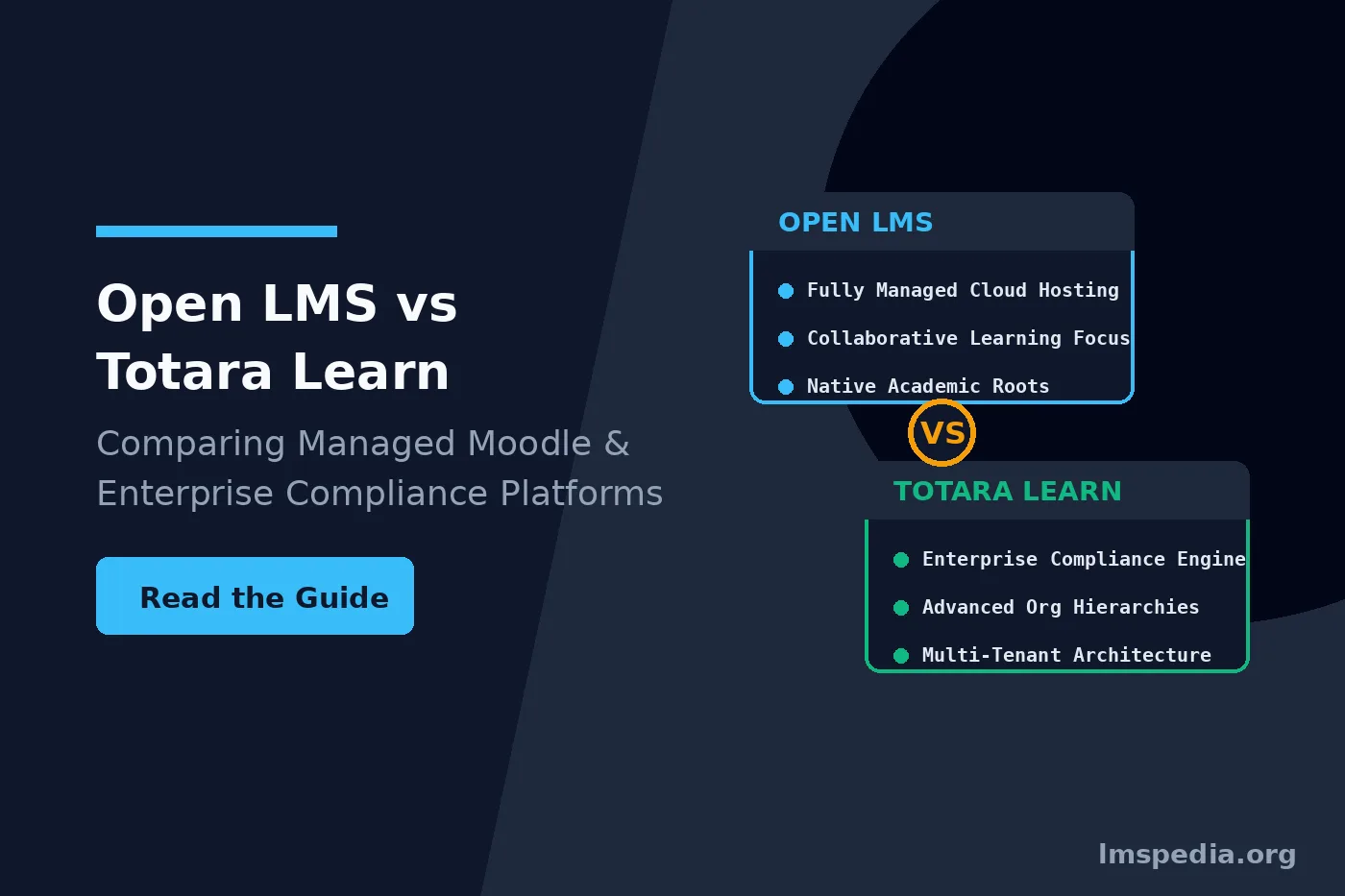
Open LMS provides a highly polished, fully managed software-as-a-service experience. Consequently, it removes the heavy technical burden of server maintenance from your internal IT department completely. Conversely, Totara Learn operates as a highly specialized fork of the original code. Therefore, it is purpose-built explicitly to handle massive corporate compliance matrices, complex organizational hierarchies, and automated certification renewals natively.
If your organization operates in a highly regulated industry, such as aviation or construction, this distinction becomes absolutely critical. For example, managing strict FAA Part 145 MRO training requirements demands a platform built specifically for regulatory auditing. Similarly, implementing complex contractor orientation software requires advanced compliance features. Let us explore the exact technical differences in this comprehensive software comparison.
Key Takeaways

Understand the Moodle Lineage:
Recognize that both platforms originate from the core open source Moodle framework but serve vastly different corporate audiences natively.
Choose Open LMS for Flexibility:
Select this managed platform if you need highly reliable hosting, seamless educational integrations, and a collaborative learning environment.
Leverage Totara for Compliance:
Deploy Totara when your enterprise requires strict certification paths, automated re-enrollments, and complex organizational hierarchies.
Evaluate Multi-Tenancy Needs:
Use Totara if you must support an extended enterprise model with distinct branded portals for various internal departments or external contractors.
Calculate Total Cost of Ownership:
Compare the exact implementation costs, ongoing hosting fees, and required vendor support packages before finalizing your commercial decision.
Understanding the Open Source Moodle Lineage
To accurately evaluate open lms vs totara learn, you must first understand their shared technical heritage. Both platforms originated from Moodle, which is currently the most widely adopted open source learning management system globally. However, standard Moodle was designed primarily for higher education environments, universities, and academic classrooms.
Consequently, standard Moodle lacks the native organizational hierarchy tools, advanced reporting functions, and compliance tracking mechanisms required by massive global corporations. Recognizing these severe limitations, different technology companies took the core open source code and modified it heavily. As a result, they created specialized corporate versions to fill this massive gap in the enterprise market.
The Divergence of Two Platforms
Open LMS decided to focus heavily on providing the absolute best managed hosting experience possible. They retained the core collaborative feel of the original framework but wrapped it in a highly secure, incredibly scalable cloud architecture. Alternatively, Totara recognized that corporations needed a fundamentally different software engine. Therefore, they forked the code completely. Ultimately, they stripped out the academic features and built a massive corporate compliance engine directly into the core platform natively.
Open LMS: The Managed Moodle Experience
When conducting a thorough managed Moodle comparison, Open LMS consistently ranks at the very top of the industry. Specifically, it provides a software-as-a-service solution that eliminates the massive headaches associated with self-hosting open source software.
AWS Infrastructure and Unmatched Scalability
The primary value proposition of Open LMS involves its world-class cloud infrastructure. The platform runs entirely on Amazon Web Services. Consequently, this specific architecture provides ninety-nine point nine percent guaranteed uptime. If your enterprise experiences a massive spike in user traffic because of a sudden company-wide compliance rollout, the server resources scale automatically to handle the load natively. Therefore, your system will never crash during a critical training deployment.
Conduit Integrations and Advanced Analytics
Furthermore, this platform features a highly proprietary integration engine called Conduit. Conduit allows administrators to connect their learning platform directly to external human resources information systems effortlessly. Thus, it automates user account creation, enrollment, and data synchronization without requiring complex custom coding.
Additionally, the platform provides an advanced personalized learning designer. This specific tool allows instructional designers to build highly customized, automated learning paths based on how a user interacts with the course material natively. To ensure your courses actually track correctly within these paths, review our diagnostic guide on fixing SCORM completion and success status errors thoroughly.
Totara Learn: Purpose Built for Enterprise Compliance
In contrast to the broader collaborative focus, Totara Learn serves as a precision-engineered corporate compliance tool. When evaluating open lms vs totara learn, the most glaring difference lies in how Totara handles organizational data natively.
Advanced Hierarchies and Dynamic Audiences
Totara features a deeply integrated organizational hierarchy engine. Administrators can mirror their exact corporate structure directly inside the software. Because of this, you can define specific positions, departments, and regional locations flawlessly. Consequently, this hierarchy powers a feature called Dynamic Audiences.
Instead of enrolling users into courses manually, administrators create rules. For example, an administrator can create a rule stating that every employee with the job title “Warehouse Manager” located in the “North American Region” must automatically be assigned the advanced forklift safety curriculum. If an employee transfers to a new department, the system updates their learning requirements automatically based on their new position. Indeed, this level of automation is absolutely vital for massive global enterprises.
Mastering Totara Compliance Tracking
The core strength of the platform relies entirely on its compliance tracking capabilities. The software utilizes a highly advanced Program and Certification management tool natively. Administrators can build complex certification paths that require users to complete multiple courses, attend live seminars, and pass strict final assessments. If you are building assessments, ensure your questions utilize proper cognitive levels by employing Bloom’s taxonomy training verbs carefully.
Crucially, Totara handles recurring compliance perfectly. For instance, if a safety certification expires every twelve months, the system automatically calculates the expiration date. It then actively warns the user, notifies their direct manager, and forces the user to retake the required material before their qualification lapses. Ultimately, this feature prevents catastrophic regulatory failures natively.
Align with Digital Credential Standards
When building your compliance pathways, ensure your platform can issue verifiable credentials upon completion. Explore how adopting modern Open Badges standards natively provides your workforce with secure, tamper-proof digital records of their corporate achievements.
Core Differences: open lms vs totara learn
To make an informed commercial decision, you must compare these two platforms across specific operational categories directly. While they look similar on the surface, their underlying database logic differs massively.
Compliance Focus vs Collaboration Focus
Totara focuses entirely on ensuring an employee is legally compliant and fully capable of performing their specific job role. It excels at tracking mandatory safety rules, regulatory mandates, and strict corporate policies. To understand how these strict tracking rules apply to highly regulated industries, review our guide covering competency-based training for aviation strategies.
Conversely, Open LMS leans heavily into collaboration, social learning, and accessible education. It provides excellent tools for discussion forums, peer reviews, and interactive digital classrooms. If your primary goal involves building a collaborative corporate university rather than a strict regulatory compliance machine, the managed collaborative platform provides a much friendlier user experience natively.
Multi-Tenancy and the Extended Enterprise
Massive corporations rarely train only their internal employees. They frequently need to train external contractors, franchise owners, and channel partners. Consequently, this requirement demands a multi-tenant software architecture. Totara provides highly robust multi-tenancy capabilities natively. Thus, administrators can create completely separate, uniquely branded portals for different external audiences within a single software installation.
While standard managed hosting platforms can achieve multi-tenancy through specific plugins, Totara handles the extended enterprise model natively out of the box. Therefore, if you must track compliance for external contractors securely, Totara provides a significantly stronger architectural foundation.
| Feature Category | Open LMS (Managed Platform) | Totara Learn (Enterprise Platform) |
|---|---|---|
| Core Primary Focus | Highly reliable hosting, academic crossover, and collaboration. | Strict corporate compliance, talent management, and hierarchies. |
| Infrastructure Hosting | Fully managed SaaS exclusively utilizing Amazon Web Services. | Highly flexible; can be self-hosted or hosted by a certified partner. |
| Organizational Hierarchies | Relies on standard grouping tools and distinct cohorts natively. | Features deeply integrated position and organizational hierarchy mapping. |
| Compliance Automation | Requires manual configuration or specific external plugins heavily. | Features native, highly advanced Program and Certification tracking rules. |
| Multi-Tenancy Support | Supported via specialized plugins or separate site installations. | Deeply integrated natively to support complex extended enterprise training. |
Evaluating Moodle Enterprise Hosting Options
The financial structure of these two platforms differs significantly. When evaluating enterprise hosting options, you must look far beyond the initial software licensing fee. Specifically, you must calculate the exact Total Cost of Ownership accurately.
Software as a Service vs Partner Networks
Open LMS operates as a traditional software-as-a-service vendor. You pay a single annual subscription fee based exactly on your active user count. This single fee covers the software license, the AWS server hosting, continuous security updates, and direct customer support. As a result, this model provides massive financial predictability for corporate procurement departments.
Totara utilizes a global partner network model. You purchase the software subscription, but you must also hire a certified Totara Partner to implement, customize, and host the platform for you. Consequently, your total cost will vary wildly depending on which specific partner agency you select. While this model requires more initial procurement work, it provides unparalleled customization options because the partner agency can modify the source code directly to fit your exact corporate needs natively.
Define Your Active Users
When negotiating your contract, pay incredibly close attention to how the vendor defines an active user. Some vendors charge for every single account in the database. Others only charge if the user actually logs into the system during a specific billing cycle. Choosing the wrong billing model will cost your enterprise thousands of dollars annually.
Choosing the Right Platform for Your Needs
Making the final decision requires matching the software directly to your exact operational reality. Ultimately, there is no universally superior platform; there is only the correct platform for your specific business case.
When to Choose Open LMS
You should absolutely select this platform if your organization prioritizes system stability, requires a rapid deployment timeline, and lacks a massive internal IT department. If your primary goal involves delivering engaging onboarding content, fostering internal communication, and tracking basic course completions seamlessly, this platform will exceed your expectations completely. Furthermore, if you need a reliable platform to issue modern credentials, a managed infrastructure natively supports these goals.
When to Choose Totara Learn
You must select Totara if your organization operates in a heavily regulated industry. If your business will face massive federal fines for missing a compliance deadline, you need the advanced certification engines that Totara provides natively. Ensure you understand exactly how to track these completions by reviewing SCORM data reporting metrics.
Furthermore, if your company features a massive, highly complex organizational structure with thousands of external contractors, Totara is specifically engineered to handle that massive logistical burden flawlessly. For industries requiring advanced safety logs, a robust compliance LMS ensures your new platform can generate the required federal reports natively.
Integrating with Broader Enterprise Systems
Neither of these powerful platforms should operate in total isolation. Instead, they must connect seamlessly to your broader corporate technology stack. When performing an open lms vs totara learn evaluation, you must investigate their Application Programming Interface capabilities thoroughly.
If you utilize Workday as your primary human resources system, your learning platform must synchronize user data daily. If you are comparing massive monolithic systems that handle HR and learning simultaneously, review our Docebo vs Cornerstone comparison directly. A dedicated learning platform must prove that it can accept data from these massive HR systems flawlessly. Totara generally offers deeper custom integration possibilities because certified partners can write bespoke integration scripts directly into the source code natively.
Conclusion
The intense debate comparing open lms vs totara learn ultimately comes down to your primary corporate objective natively. Both platforms offer incredible power, distinct flexibility, and massive scalability. A thorough comparison reveals that Open LMS provides a flawless, highly reliable software-as-a-service experience perfect for mid-market and enterprise organizations seeking collaborative training.
Conversely, for organizations that require absolute control over compliance tracking, complex hierarchies, and specialized hosting configurations, Totara stands completely unmatched. You must audit your internal regulatory requirements meticulously, evaluate your internal technical resources honestly, and select the platform that completely protects your organization from catastrophic compliance failures while empowering your workforce to learn effectively.
FAQ
Q1. What is the main difference between Open LMS and Totara Learn?
Open LMS is a fully managed, cloud-based platform focusing on reliable hosting, ease of use, and collaborative learning environments based on the core open-source framework. Totara Learn is a specialized enterprise fork purpose-built for complex corporate compliance, advanced organizational hierarchies, and strict certification tracking.
Q2. Do I need a third-party partner to use these platforms?
If you choose Open LMS, you work directly with the vendor as a traditional Software as a Service (SaaS) provider. If you choose Totara Learn, you must purchase and implement the software through a certified global Totara Partner agency who will handle your hosting and deep technical customizations.
Q3. Which platform is better for strict regulatory compliance?
Totara Learn is significantly better for highly regulated industries. It features a native Program and Certification engine that automates recurring compliance deadlines, tracks expiration dates relentlessly, and maps training requirements directly to specific job roles using a dynamic organizational hierarchy engine.
Q4. Can both platforms support external contractors and multi-tenancy?
While both platforms can support external users, Totara Learn features deeply integrated multi-tenancy capabilities natively out of the box. This makes it far superior for extended enterprise models where you must train external contractors, partners, or franchise owners using distinctly branded portals.