Procuring training software in civil and military aviation differs fundamentally from purchasing standard corporate enterprise software. Specifically, commercial airlines, certified Part 142 training centers, Approved Training Organizations (ATOs), and heavy maintenance stations operate in an unforgiving regulatory environment. Furthermore, national civil aviation authorities, such as the Federal Aviation Administration (FAA) and the European Union Aviation Safety Agency (EASA), provide strict regulatory oversight. Consequently, this oversight mandates zero tolerance for tracking inaccuracies, unverified instructor endorsements, or lapsed crew qualifications. Yet, when aviation organizations initiate a request for proposal for a new digital platform, they frequently rely on generic enterprise templates.
Unfortunately, these boilerplate documents ask high-level questions about basic functionality, cloud hosting, and user security. As a result, general corporate learning platforms can easily claim compliance while lacking essential aviation functionality. Therefore, issuing a rigorous aviation training system rfp is the only reliable way to cut through vendor marketing. Ultimately, this approach identifies platforms truly capable of managing complex flight operations. Additionally, you can review foundational procurement frameworks through expert LMSPedia resources.
Indeed, a poorly drafted procurement specification leads to catastrophic downstream consequences. For example, when buyers select an unqualified learning platform, aviation training directors face major issues months into implementation. Specifically, they discover the system cannot track Advanced Qualification Program (AQP) curricula, calculate complex regulatory look-back windows, or schedule multi-million-dollar full-flight simulator bays efficiently.
Consequently, this procurement mismatch creates dangerous compliance blind spots. Moreover, it grounds qualified flight crews and forces administrative personnel back into manual spreadsheets. Thus, to protect operational integrity, aviation procurement teams must construct an RFP that functions as a ruthless technical filter. In this article, this comprehensive guide outlines the specialized technical architecture, knockout qualification criteria, and scoring methodologies required. Ultimately, these elements help you draft an airtight aviation lms rfp and tms rfp aviation specification.
Key Takeaways

Generic RFPs Fail Aviation: Standard corporate learning procurement templates focus on passive e-learning criteria and fail to evaluate complex flight training logistics, simulator scheduling, and aviation regulatory frameworks.
Non-Negotiable Knockout Criteria: Incorporating strict binary knockout questions on page one filters out unqualified general enterprise vendors before the formal scoring process begins.
Regulatory Calculation Complexity: An aviation platform must natively manage complex look-back windows, base/eligibility/grace months, and Advanced Qualification Program (AQP) or Competency-Based Training and Assessment (CBTA) grading rubrics.
Offline Cockpit & Bay Grading: Software must feature dedicated mobile tablet applications capable of executing offline flight maneuver grading and capturing legally binding digital signatures compliant with FAA AC 120-78A standards.
Weighted Multi-Tier Scoring: A mathematically sound scoring matrix prioritizes regulatory compliance (35%) and resource scheduling (25%) over total cost of ownership (20%) to avoid expensive implementation failures.
The Structural Failure of Generic Procurement in Aviation
Typically, most corporate requests for proposal are built around standard business learning criteria. For instance, they ask whether a system can host SCORM modules, track completion percentages, generate automated reminder emails, and support single sign-on. Consequently, nearly every commercial enterprise software vendor can check these broad boxes. As a result, procurement committees end up with a shortlist of twenty candidates. Unfortunately, nineteen of these are fundamentally incapable of supporting an active flight department. Essentially, the core issue lies in the operational reality of aviation training. Instead of a passive e-learning exercise, it is a complex, high-velocity logistics and regulatory compliance discipline.
Generally, generic learning software assumes that a training course has a simple linear progression. In this model, an employee enrolls, reviews digital slides, completes a multiple-choice quiz, and receives a downloadable certificate. In stark contrast, flight operations training requires complex multi-variable scheduling. Specifically, this involves certified Level D Full Flight Simulators, classroom briefings, flight training devices, line-oriented flight training sessions, and practical check rides. Furthermore, training records must interface directly with government auditing registries, such as the FAA Pilot Records Database (PRD).
Therefore, when drafting training software requirements aviation specifications, the primary objective is crucial. Namely, you must formulate questions so precise and technically stringent that generic vendors are forced to disqualify themselves immediately. Additionally, for further insights into aviation platform capabilities, examine our guide on the best aviation training management systems.
The Binary Knockout Rule
Crucially, never use open-ended essay questions for critical regulatory capabilities in your RFP. Instead, frame requirements as strict binary conditions: ‘Does the system calculate FAA Part 121.439 three-takeoff-and-landing 90-day recency without third-party plugins? (Yes/No).’ Then, require vendors answering ‘Yes’ to provide an unedited screen recording demonstrating the feature in their production environment.
Core Technical Pillars of an Aviation Training Management System
First, to build an RFP that acts as an effective technical filter, your procurement team must structure requirements carefully. Specifically, they should focus around the specialized operational pillars unique to flight operations and aviation maintenance. Ultimately, these pillars represent the baseline capabilities necessary to operate without operational disruptions.
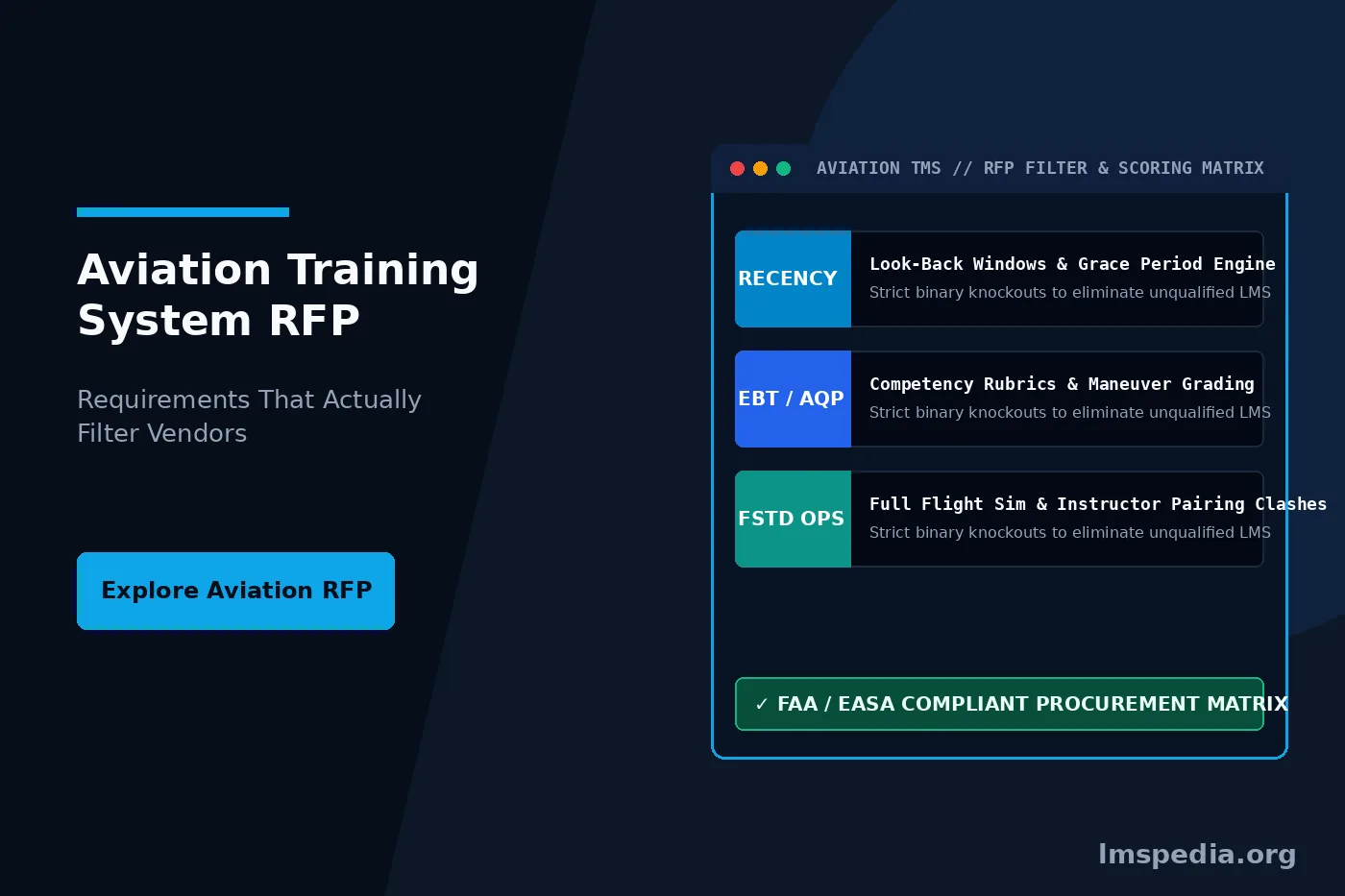
1. Dynamic Recency, Look-Back Windows, and Grace Periods
Fundamentally, aviation regulations enforce strict calendar and operational recency rules. For example, flight crew members must maintain active currency across instrument approaches, night landings, aircraft type ratings, and route checks. Therefore, your RFP must explicitly demand automated logic for regulatory look-back windows. Under FAA Part 121, Part 135, and international guidelines established by the International Air Transport Association (IATA), qualification expirations vary. Specifically, certain qualifications expire at the end of the calendar month, while others expire on an exact day.
Consequently, the software must automatically support grace month rules, which are frequently referred to as base month, eligibility month, and grace month. In practice, this means a pilot can complete recurrent training one month before or one month after the designated base month. Crucially, they must do this without altering the original anniversary date. Ultimately, a platform lacking native calendar logic for grace periods will rapidly cause crew scheduling non-compliance.
2. AQP, EBT, and CBTA Grading Architecture
Nowadays, modern airlines and sophisticated training organizations have migrated away from traditional hours-based training models. Instead, they operate under Advanced Qualification Program (AQP), Evidence-Based Training (EBT), or Competency-Based Training and Assessment (CBTA) frameworks. Accordingly, these methodologies require instructors to evaluate flight crew performance against granular behavioral markers and core competencies during complex simulation events.
Therefore, your RFP must specify that the system natively supports non-linear grading rubrics, line operational simulations, and maneuver performance validations. Additionally, it must handle automated statistical data exports for regulatory quality control analysis. Finally, for technical insights into how maintenance teams manage practical certifications alongside operational training, review our guide on aircraft maintenance training software for MROs.
3. High-Value Resource Scheduling and Instructor Pairing
First and foremost, in flight training environments, the software must function as an advanced operations management engine. For instance, Level D full flight simulators represent multi-million-dollar capital investments that often operate twenty-four hours a day, seven days a week. Consequently, the system must simultaneously schedule the simulator bay and match qualified instructor pilots with appropriate aircraft type rating qualifications. Furthermore, it must assign trainee pairs, such as captain and first officer, and factor in mandatory simulator maintenance blocks.
In addition, if an instructor qualification or medical certificate is scheduled to lapse mid-training footprint, the software must intervene. Specifically, the system must automatically block the scheduling assignment. Ultimately, generic calendar tools simply cannot resolve these multi-dependent resource constraints.
4. Tamper-Proof Digital Signatures and Electronic Flight Bags (EFB)
Frequently, check airmen and designated examiners conduct evaluations directly within flight simulator cockpits or line flights where physical internet connectivity is non-existent. Therefore, the training platform must provide native offline tablet applications. Specifically, these tools must allow instructors to grade complex flight maneuvers and log practical flight times.
Moreover, the system must execute legally binding digital signatures that comply strictly with FAA Advisory Circular AC 120-78A and EASA Part-ORO requirements. Eventually, when the mobile tablet re-establishes a network connection, the application must automatically synchronize encrypted flight test records to the central server. Crucially, it must perform this sync without data loss or administrative conflict.
Essential Knockout Criteria to Include in Your RFP
Initially, to prevent your procurement committee from reviewing dozens of unsuitable responses, your document should incorporate a mandatory Knockout Criteria section on page one. Consequently, if a prospective vendor answers “No” to any of these questions, their submission is discarded without scoring. Below, you will find an optimized checklist of mandatory knockout requirements:
1. Native Aviation Regulatory Calculation Engine
The vendor must demonstrate out-of-the-box support for national aviation authority flight crew recency rules, duty time limitations, and qualification expiration logic. Importantly, they must achieve this without requiring custom software engineering or billable professional services.
2. Offline Grading and Cryptographic Record Signing
The platform must support a dedicated mobile tablet application capable of executing offline flight test grading. Additionally, it must capture instructor and trainee signatures compliant with AC 120-78A standards, syncing automatically upon network reconnection.
3. Bi-Directional Crew Scheduling and Operations Integration
The software must provide open, documented REST APIs to interface bi-directionally with commercial crew pairing and dispatch systems, such as Jeppesen, Sabre, or NetLine. Consequently, it must automatically publish qualification block flags to prevent uncertified crew members from being assigned to commercial revenue flights.
4. Flight Simulator Resource Optimization Engine
The system must feature a dedicated multi-variable resource management module. Specifically, this module must be capable of resolving complex constraints across full-flight simulators, classrooms, instructors, and student pairings simultaneously.
5. Certified Audit Trails and Role-Based Permissions
The platform must preserve an immutable, historical ledger of every qualification change, grade submission, and manual override. Furthermore, it requires granular permissions distinguishing between flight instructors, check airmen, system administrators, and regulatory inspectors. Finally, to verify how administrative roles are structured at scale, review our technical breakdown on how to architect secure LMS user roles and permissions.
Comparing Leading Training Operations and Management Solutions
Generally, navigating the training management landscape requires understanding how different platforms position their core capabilities. Therefore, procurement teams must evaluate solutions across operational flexibility, resource coordination, and compliance depth.
| Platform Solution | Primary Focus | Key Architectural & Operational Strength |
|---|---|---|
| SimpliTrain | Versatile training operations and resource scheduling. | Excels at complex multi-resource scheduling, instructor allocation, and comprehensive back-office operational workflows across enterprise training environments. |
| MINT TMS | Specialized airline and aviation training management. | Deeply established flight crew scheduling, AQP/EBT grading integration, and direct electronic connection to major airline crew pairing systems. |
| CAE Rise | Advanced simulator telemetry and pilot analytics. | Leverages direct simulator sensor data to provide objective, data-driven insights during flight training maneuvers and recurrent assessments. |
Ultimately, by mapping your operational workflows against these specific architectural strengths, your evaluation team can identify the ideal software. Specifically, they can determine which platform tier aligns best with your organizational structure and flight training volume.
Structuring the RFP Scoring Aviation Training Matrix
First, a rigorous evaluation process requires a mathematically defensible scoring model. However, many aviation procurement teams make the mistake of weighing technical capabilities and software costs equally from the initial review. Unfortunately, this approach often results in selecting a cheaper platform that ultimately requires millions of dollars in custom development to reach basic regulatory compliance. Instead, a mature rfp scoring aviation training matrix should follow a weighted multi-tier distribution.
Specifically, the evaluation matrix must heavily weight operational and regulatory compliance before evaluating secondary factors:
Tier 1: Regulatory and Compliance Architecture (35% Total Weight)
Mainly, this tier evaluates native support for AQP/EBT, regulatory look-back logic, and grace period calculations. Additionally, it checks electronic signatures, audit trail immutability, and automated civil aviation reporting capabilities.
Tier 2: Resource Scheduling and Operational Usability (25% Total Weight)
Primarily, this section measures simulator bay management, instructor pairing algorithms, and offline mobile tablet grading interfaces. Furthermore, it assesses clash detection and user experience for check airmen in high-pressure environments.
Tier 3: Enterprise Integration and API Architecture (20% Total Weight)
Here, the matrix assesses RESTful API coverage, bi-directional crew dispatch synchronization, and webhook capabilities. Moreover, it examines single sign-on integration and performance under heavy query loads. To assist with this, review our guide on LMS load testing and performance benchmarking to learn how to test integration and database stability during high-volume periods.
Tier 4: Total Cost of Ownership and Vendor Stability (20% Total Weight)
Finally, this tier calculates the fully loaded five-year cost. Specifically, this includes software licensing, cloud hosting fees, recurring customer support tiers, data migration expenses, and implementation services. Additionally, for a complete catalog of strategic inquiry frameworks, consult our comprehensive list of LMS buyer guide vendor questions.
Managing Implementation and Regulatory Certification
Indeed, selecting the winning software platform is only the midpoint of a successful modernization project. Importantly, aviation training systems must be certified by civil aviation authorities before they can legally serve as the primary system of record for flight operations. Therefore, your RFP must explicitly clarify the vendor role in supporting this regulatory certification process.
To begin with, the selected vendor must commit to providing full technical documentation, data dictionary specifications, and cybersecurity audit reports. Ultimately, these assets assist your quality assurance team during regulator presentations. Furthermore, the implementation schedule must account for an extensive parallel run phase lasting between ninety and one hundred eighty days. During this validation period, flight crew training records must be maintained concurrently in both the legacy environment and the new platform. As a result, this proves data integrity and recency accuracy to aviation inspectors.
Conclusion
In conclusion, modernizing an aviation training operation requires a highly specialized procurement methodology. Specifically, it must reflect the technical complexity and safety imperatives of flight operations. Conversely, relying on generic enterprise software templates leaves training centers and airlines highly vulnerable to inadequate platforms. In reality, these generic systems cannot handle the realities of simulator scheduling, regulatory grace periods, and complex competency evaluations.
However, by defining explicit knockout criteria, demanding verified proofs of native compliance architecture, and enforcing a weighted scoring matrix, aviation organizations can succeed. Essentially, they can eliminate unqualified vendors early in the procurement lifecycle. Therefore, drafting a technically stringent RFP ensures that your institution selects a truly capable digital training infrastructure. Ultimately, this infrastructure will satisfy civil aviation authorities, streamline complex flight training logistics, and maintain the highest standard of aviation safety for years to come. Finally, to explore how enterprise systems automate these operational pipelines across regulated sectors, examine our detailed review of the best training management software.
FAQ
Q1. Why can standard corporate LMS platforms not support commercial airlines?
Standard learning platforms are built for passive course completion tracking and lack the complex relational data models needed for multi-variable flight simulator scheduling, pilot recency tracking, AQP/EBT grading rubrics, and regulatory grace period management.
Q2. What is the difference between an aviation LMS and an aviation TMS?
An aviation LMS (Learning Management System) primarily delivers and tracks self-paced digital content, ground school theory, and web-based tests. An aviation TMS (Training Management System) manages the entire operational lifecycle of flight training, including flight simulator scheduling, instructor pairing, offline practical grading, and real-time integration with airline crew dispatch systems.
Q3. What are regulatory grace periods, and why must an aviation training system calculate them?
Under civil aviation regulations (such as FAA Part 121 and EASA Part-ORO), recurrent flight crew training is assigned an annual base month. Regulations allow pilots to complete training in the month before or after the base month without changing their original anniversary date. Training systems must calculate these windows automatically to prevent scheduling non-compliance.
Q4. How should an aviation RFP evaluate offline mobile grading?
The RFP should require proof of a native tablet application that operates without internet connectivity inside flight simulator bays and cockpits. The tool must capture granular maneuver scores and compliant electronic signatures, syncing data automatically upon reconnecting to the network.
Q5. What role does civil aviation authority approval play in selecting an aviation training system?
Before a digital training system can become the primary system of record for flight crew qualifications, it must be validated by relevant civil aviation authorities (such as the FAA or EASA). The RFP must mandate that the vendor provides technical support, system documentation, and audit logging required for regulatory certification.