

Understanding how people actually learn, not just memorize, is fundamental to effective education and training. Cognitive learning focuses on the brain’s active processes of thinking, understanding, and problem-solving rather than passive information absorption.
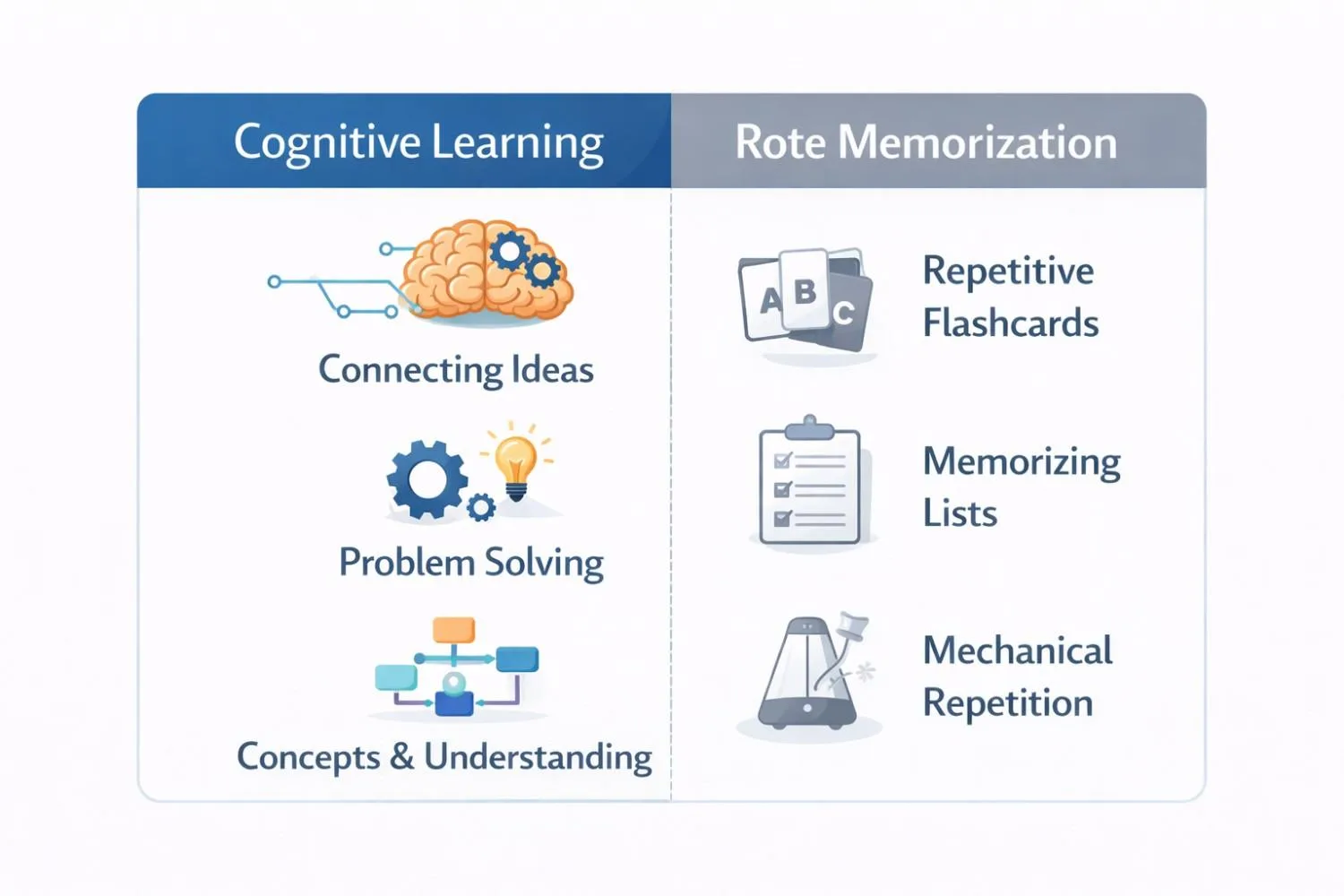
Unlike rote memorization where facts are repeated until retained, cognitive learning emphasizes comprehension and the ability to apply knowledge in new situations. This approach matters in both traditional education and modern workplace training because it produces learners who can reason through unfamiliar problems rather than just recall predetermined answers.
This distinction becomes critical in corporate training environments where employees must adapt knowledge to changing business contexts, and in educational settings where students need to transfer learning across subjects. Cognitive Learning Theory explains why some training sticks while other training is forgotten within days, and what instructional designers can do about it.
What Is Cognitive Learning?
Cognitive learning is an active style of learning that focuses on helping learners maximize their brain’s potential. It involves the mental processes of thinking, memory, and problem-solving to help the brain build “schemas” or patterns of understanding. The term “cognition” refers to the brain’s information processing mechanisms, how we perceive, interpret, organize, and retrieve what we learn. The defining characteristic: cognitive learning focuses on internal mental processes rather than observable behavior.
While behavioral learning measures what someone can do after training, cognitive learning examines how understanding develops in the mind. A learner doesn’t just know the answer, they understand why it’s the answer and can explain the reasoning.
Learning through understanding is the core principle. When someone learns cognitively, they’re building mental frameworks that connect new information to existing knowledge. A medical student doesn’t just memorize symptoms, they develop diagnostic reasoning patterns that allow them to evaluate novel patient presentations they’ve never encountered before.
This contrasts with passive learning where information is received without deep processing. Reading a policy manual cover-to-cover produces surface familiarity. Cognitively processing that manual, asking why policies exist, how they connect to business risks, when exceptions apply, produces genuine understanding that translates to better decision-making under pressure.
Connection with prior knowledge is essential. The brain doesn’t store information in isolation. New concepts anchor to existing mental structures, creating networks of understanding. An accountant learning new tax regulations connects them to existing knowledge of tax principles, business structures, and regulatory frameworks. This integration is what makes the knowledge retrievable and applicable months later.
How Cognitive Learning Works
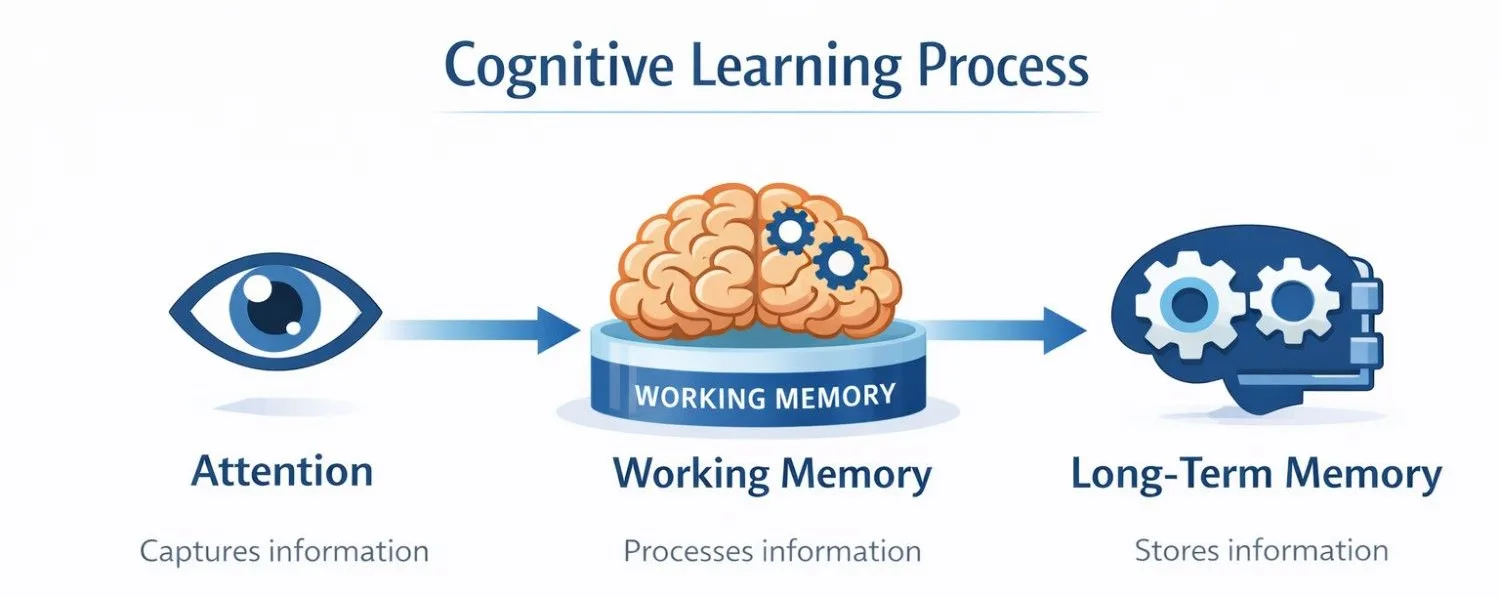
Cognitive learning involves three interconnected brain processes that transform raw information into usable knowledge. Think of it as a pipeline: Attention → Working Memory → Long-Term Memory.
Attention: The Entry Gate
Attention is the entry point. The brain filters thousands of stimuli constantly, only information that captures attention enters the learning process.
Why engagement matters:
- A learner mentally checked out during training isn’t learning poorly, they’re not learning at all
- Information never makes it past the attention filter without active focus
- Cognitive load theory (John Sweller, 1988) explains that attention is finite
- Overloading learners fragments attention across competing inputs
- Design principle: One concept at a time, clear visual hierarchy, minimal distraction.
Memory: The Processing Bottleneck
Information must be processed in working memory before it’s stored in long-term memory.
The two-stage system:
- Working memory: Temporary workspace, limited capacity (4-7 items), duration of seconds
- Long-term memory: Essentially unlimited, but requires successful encoding from working memory
The challenge: Working memory is where understanding happens, but it’s the bottleneck.
Solutions that work:
- Chunking: Group information into meaningful units (phone number 314-159-265 vs 3-1-4-1-5-9-2-6-5)
- Spaced repetition: Review at increasing intervals (1 day, 3 days, 1 week, 1 month)
Each repetition reinforces neural pathways, making retrieval more automatic
Schema Formation: Building Mental Frameworks
Schemas are organized knowledge structures that help learners interpret new information. (Jean Piaget first described these cognitive frameworks in the 1920s.)
What schemas do:
- Organize related concepts into patterns of understanding
- Enable rapid pattern recognition in familiar situations
- Allow experts to process information faster than novices
Example: An experienced project manager has schemas for:
- Risk assessment patterns
- Stakeholder management approaches
- Resource allocation strategies
When encountering a new project, they activate relevant schemas to quickly categorize the situation and identify appropriate responses. Novices lack these schemas, they process each interaction as unique, making decisions slower and more effortful.
The Core Theories Behind Cognitive Learning
Five foundational theories underpin modern cognitive learning practice. Understanding these frameworks transforms abstract concepts into actionable instructional design.
Bloom’s Taxonomy (1956, Revised 2001)
Bloom’s Taxonomy organizes learning objectives into six hierarchical levels of cognitive complexity.
The six levels:
- Remember — Recall facts and basic concepts
- Understand — Explain ideas or concepts
- Apply — Use information in new situations
- Analyze — Draw connections among ideas
- Evaluate — Justify a decision or course of action
- Create — Produce new or original work
Why this matters for training: Most compliance training operates at Level 1-2 (Remember/Understand) when it should target Level 3-4 (Apply/Analyze). A sexual harassment training that only asks learners to recall policy definitions is Bloom Level 1. A training that presents realistic scenarios and asks “What should you do and why?” targets Level 3-4, and produces actual behavior change.
Vygotsky’s Zone of Proximal Development
The Zone of Proximal Development (ZPD) is the space between what a learner can do independently and what they can do with guidance.
Key concept: Learning happens most effectively when training targets just above current competence, not at it, not far beyond it. Training that’s too easy produces no growth. Training that’s too difficult overwhelms working memory and produces frustration.
Scaffolding is the support structure that allows learners to operate in their ZPD. In workplace training, this might be a mentor walking a new sales rep through their first client call, progressively removing support as competence builds.
Baddeley’s Working Memory Model (1974)
Baddeley’s model replaces the vague “4-7 items” with a precise understanding of working memory’s structure.
Three components:
- Phonological loop: Processes verbal and auditory information
- Visuospatial sketchpad: Processes visual and spatial information
- Central executive: Allocates attention between the two systems
Training application: Audio narration + visual diagrams outperform text-only content because they use both the phonological loop and visuospatial sketchpad simultaneously, doubling effective working memory capacity. This is why well-designed eLearning never presents walls of on-screen text with identical narration (same system, wasted capacity).
Dual Coding Theory (Paivio, 1971)
Information encoded both verbally and visually creates two retrieval pathways instead of one.
When you see a diagram of a sales process while hearing an explanation, your brain stores both a visual representation and a verbal representation. Later retrieval can access either pathway, if you forget the verbal explanation, the visual diagram might trigger recall, and vice versa. Every procedural training module in LMS should pair step-by-step text with annotated screenshots or process diagrams. The redundancy isn’t wasted, it’s doubling retrieval success probability.
Mayer’s Multimedia Learning Principles (2001)
Richard Mayer identified 12 evidence-based principles for designing multimedia instruction. Four are especially critical for corporate LMS content:
- Coherence Principle: Remove extraneous content. Decorative graphics, background music, and tangential stories reduce learning by consuming cognitive resources without adding meaning.
- Segmenting Principle: Break continuous lessons into learner-controlled segments. A 20-minute video produces worse outcomes than four 5-minute segments with pause points for reflection.
- Modality Principle: Narration + animation outperforms on-screen text + animation. The phonological loop processes narration while the visuospatial sketchpad processes animation, using both systems. On-screen text + animation both compete for the visuospatial system.
- Signaling Principle: Highlight essential information. Use arrows, color coding, and verbal cues (“The critical point here is…”) to direct attention to what matters.
- Research backing: Mayer’s 2001 meta-analysis across 50+ studies found multimedia designed with these principles produced learning gains 50-90% higher than traditional text-based instruction.
Key Principles of Cognitive Learning
Five principles define how cognitive learning operates in practice.
1. Active Learning
Learners actively construct knowledge rather than passively receiving it. The brain isn’t a recording device, it’s a meaning-making system. Simply presenting information doesn’t guarantee learning. The learner must engage with the material: questioning, connecting, organizing, applying.
Active learning strategies include:
- Problem-solving exercises
- Case analysis
- Peer discussion and teaching
- Self-explanation (pausing to summarize in your own words)
This effortful processing strengthens encoding far more than passive reading or listening.
2. Meaningful Learning
Learning improves when new knowledge connects to existing knowledge. Isolated facts are fragile, easily forgotten because they lack retrieval cues. Meaningful learning integrates new information into existing schemas, creating multiple pathways for recall.
Example: Teaching data privacy regulations to a marketing team works better when connected to existing knowledge of customer trust, brand reputation, and competitive positioning. The regulation isn’t just a compliance rule; it’s understood as a mechanism protecting the customer relationships the team already values.
3. Knowledge Organization
Information is stored as interconnected structures rather than isolated facts. The brain naturally seeks patterns and relationships. Expert knowledge isn’t just more information, it’s better organized information.
What experts do differently:
- Chunk details into higher-order categories
- See connections novices miss
- Retrieve relevant knowledge efficiently through logical structure
Concept maps, hierarchies, and categorization exercises help learners build organized knowledge structures.
4. Metacognition
“Thinking about thinking” is the ability to monitor and regulate one’s own learning. Metacognitive learners assess what they know and don’t know, select appropriate learning strategies, and evaluate their understanding accuracy. This self-regulation distinguishes effective learners from those who mistake familiarity for mastery.
Metacognitive strategies:
- Self-testing (retrieving information to check understanding)
- Reflecting on what made a problem difficult
- Adjusting study approaches based on performance
- Recognizing when you understand concepts but struggle with application
5. Problem-Solving and Critical Thinking
Cognitive learning promotes reasoning beyond memorization. The goal isn’t just knowing facts, it’s applying knowledge to novel situations. This requires critical thinking: evaluating information, identifying assumptions, recognizing patterns, and generating solutions.
Problem-based learning exemplifies this principle: learners encounter problems first and discover principles through guided problem-solving. The struggle to solve creates deeper encoding than passively receiving the solution.
Benefits of Cognitive Learning
- Deeper understanding emerges because learners comprehend why, not just what. This depth makes knowledge more flexible, applicable across contexts rather than bound to the original learning situation.
- Improved problem-solving follows from understanding principles. Learners can approach unfamiliar problems by applying underlying concepts rather than searching memory for a matching procedure they were taught.
- Stronger knowledge retention results from meaningful encoding. Information connected to existing schemas and retrieved through active practice persists longer than isolated facts rehearsed through repetition.
- Adaptability in real situations is perhaps the most valuable outcome. The workplace doesn’t present problems labeled with the chapter they came from. Cognitive learning prepares people to recognize which knowledge applies, adapt it to the situation, and reason through gaps.
These benefits explain why corporate training increasingly emphasizes scenario-based learning, case studies, and spaced practice over traditional lecture-and-test formats. The goal shifted from coverage (presenting all the information) to retention and transfer (ensuring learners can actually use what they learned three months later).
How LMS Platforms Support Cognitive Learning
Modern Learning Management Systems incorporate cognitive learning principles through specific design features.
- Microlearning modules respect working memory limitations by breaking content into focused segments. A 5-minute module on one concept allows complete cognitive processing before moving to the next topic, more effective than a 45-minute module covering nine concepts with fragmented attention.
- Spaced repetition quizzes leverage the spacing effect. Instead of one comprehensive test at the end, learners encounter retrieval practice at intervals throughout the course and afterward. Each retrieval strengthens long-term encoding while revealing gaps requiring review.
- Interactive learning paths adapt to learner performance, directing additional practice where understanding is weak and accelerating through mastered content. This personalization optimizes cognitive load, neither overwhelming nor boring the learner.
- Knowledge reinforcement through scenario-based assessments requires application, not just recall. Instead of “Which of these is the correct policy?” the assessment presents a realistic situation: “An employee reports this scenario, what should you do and why?” This retrieval practice from long-term memory strengthens schema activation patterns used in real work.
- Discussion forums and peer collaboration support social cognitive learning, observing others’ reasoning, explaining concepts to peers, and receiving feedback all strengthen understanding through active processing.
Why Cognitive Learning Matters
Cognitive learning explains how understanding develops in the mind, through active mental processing, meaningful connections, and organized knowledge structures. This isn’t just educational theory; it’s the foundation of effective training design. In education, cognitive learning shifts focus from content delivery to comprehension. Students don’t just pass tests, they develop reasoning abilities that transfer across subjects and into careers.
In workplace training, cognitive learning principles determine whether employees can actually apply what they learned or just vaguely remember attending a training session. The difference between compliance theater and genuine risk reduction, between product training that creates quota-carrying sales reps versus ones who can’t handle objections, cognitive learning principles explain these outcomes.
The brain learns through understanding, not exposure. Designing learning experiences around how cognition actually works—attention, memory, schema formation, active processing—produces training that sticks and transfers. That’s why cognitive learning matters: it’s the difference between learning that happens and learning that lasts.