
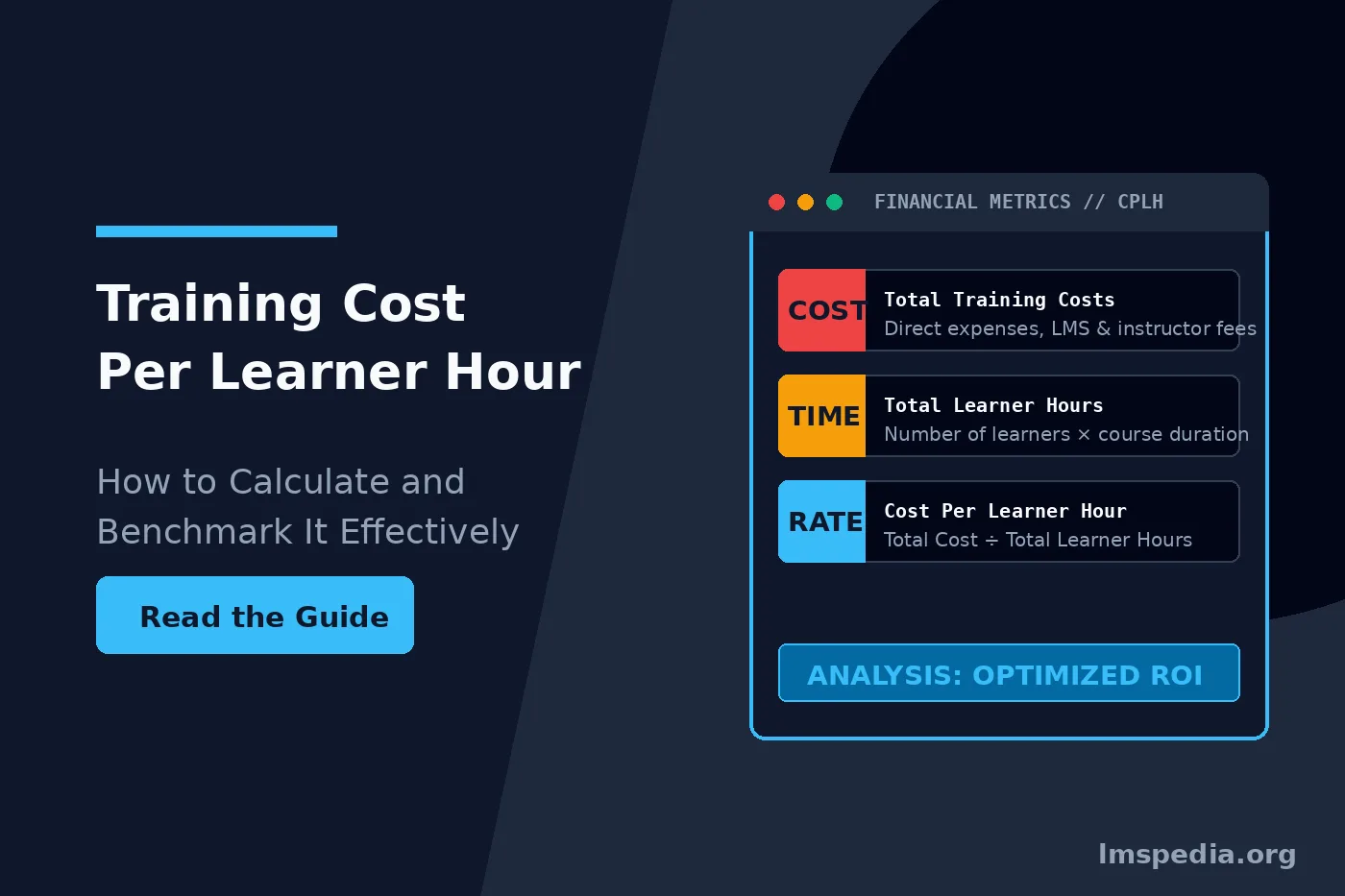
The cost per learner hour is the absolute baseline financial metric used to evaluate corporate educational efficiency continuously. It represents the exact total dollar amount required to educate one single employee for exactly sixty minutes. You calculate this critical number by dividing your total operational training expenses by the total number of educational hours consumed by your workforce. Consequently, understanding this specific baseline metric allows executives to evaluate learning and development cost metrics instantly. Without knowing this exact number, your corporate department operates completely blind financially. Therefore, mastering this foundational mathematical calculation is absolutely mandatory for every single instructional leader today.
In this highly detailed operational guide, we will explore exactly how to perform a rigorous training unit cost calculation securely. First, we will define the core mathematical formula clearly. Next, we will identify all hidden operational expenses perfectly to prevent massive accounting errors. Furthermore, we will establish a highly reliable cost per training hour benchmark for your specific industry. Finally, we will discuss how specialized software automates these massive financial calculations entirely. To align your overall corporate planning correctly before diving into advanced mathematics, review our foundational guide. Please read our detailed training business plan template securely today.
Key Takeaways

The Baseline Financial Metric:
The cost per learner hour represents the exact financial expenditure required to train one single employee for exactly one hour. It remains the absolute most critical efficiency metric for modern corporate education departments globally.
Include All Hidden Expenses:
You cannot simply divide the instructor salary by the class duration. You must include venue rental costs, software licensing fees, and the hourly wages of the employees attending the session perfectly.
Differentiate by Modality:
Digital video courses always produce a vastly lower unit cost than live physical workshops. You must calculate these specific delivery modalities completely separately to maintain accurate corporate data continuously.
Calculate Participant Averages:
Understanding the training cost per participant allows you to project future departmental budgets securely. It reveals exactly how much capital you need to onboard one hundred new corporate hires next year.
Deploy Automated Calculators:
Manual spreadsheet calculations cause massive financial errors constantly. You must deploy modern enterprise software to track these complex learning and development cost metrics without human intervention natively.
The Core Mathematical Formula Explained
Calculating your precise unit cost requires a highly rigid mathematical approach continuously. You cannot guess your corporate expenses blindly. The fundamental mathematical formula remains incredibly straightforward conceptually. However, gathering the completely accurate data to feed that formula is exceptionally difficult natively.
The strict formula is: Total Training Cost divided by Total Consumed Learner Hours. To calculate the Total Consumed Learner Hours, you simply multiply the total number of attending participants by the exact duration of the course in hours. For example, if ten employees take a two hour course, you have twenty total consumed learner hours completely. This basic calculation forms the absolute foundation of your entire corporate financial strategy.
Identifying Direct and Indirect Operational Costs
The biggest mistake administrators make is ignoring massive hidden corporate expenses continuously. When performing a strict training unit cost calculation, you must capture absolutely every single dollar spent natively. You must divide your expenses into two distinct commercial categories securely.
Calculating Direct Expenses
Direct expenses are highly visible and incredibly easy to track constantly. These include the hourly invoice paid directly to a freelance safety instructor securely. Furthermore, direct costs include the physical venue rental fee and the printed paper workbooks distributed to the classroom. You simply add these standard vendor invoices together perfectly.
Uncovering Hidden Indirect Expenses
Conversely, indirect expenses remain completely invisible to careless administrators constantly. The largest indirect expense is always lost employee production time securely. When a corporate salesperson sits in a classroom for four hours, they are not closing lucrative corporate deals. Therefore, you must calculate their lost hourly wages and add that massive number to your total cost calculation permanently. Furthermore, you must include a proportional fraction of your annual software licensing fees natively.
Track Development Time Rigorously
You must include the massive salary costs of your internal instructional designers continuously. If a designer spends forty hours building a digital course, their specific hourly wage for that entire week must be factored into the final unit cost calculation perfectly. Ignoring development time artificially lowers your reported expenses dangerously.
Calculating the Training Cost Per Participant
While the hourly metric provides incredible granular detail, executive boards often prefer a slightly different view natively. They frequently request the exact training cost per participant continuously. This specific metric reveals how much capital the corporation spends on one single employee annually.
To calculate this specific number perfectly, you divide your entire annual departmental budget by your total corporate headcount natively. If your total departmental budget is one million dollars, and you employ one thousand workers, your cost per participant is exactly one thousand dollars. Executive leaders use this highly specific number to project future hiring costs securely. If they plan to hire five hundred new workers next year, they know they must increase your budget by five hundred thousand dollars instantly.
Establishing a Cost Per Training Hour Benchmark
Calculating your internal numbers means absolutely nothing without external commercial context. You must compare your internal efficiency against broader industry standards continuously. Therefore, establishing a reliable cost per training hour benchmark is absolutely vital for corporate survival natively.
Analyzing Different Delivery Modalities
You cannot compare a live physical leadership workshop directly to a digital safety video completely. Live physical events always generate incredibly high hourly costs due to expensive travel and premium catering natively. Conversely, digital courses scale infinitely with almost zero additional variable costs securely.
Sourcing Accurate Industry Data
Therefore, you must benchmark your specific delivery modalities separately continuously. The average digital learning hour might cost fifty dollars internally. However, a live physical executive workshop might cost five hundred dollars per hour instantly. To review the exact commercial demand data and topical authority strategies driving these specific benchmarks, please consult image_250da3.png thoroughly today. Furthermore, to see how these massive benchmarks impact broad corporate planning securely, review our detailed guide. Read our comprehensive analysis regarding corporate training budgets 2026 benchmarks today.
The Massive Impact of Generative Artificial Intelligence
Modern technology continues to alter these historical financial benchmarks aggressively today. Historically, building a one hour digital course required exactly forty hours of human labor natively. That massive labor cost drove the baseline unit price incredibly high continuously.
However, the recent explosion of automated digital tools changes this financial reality completely. Modern systems can generate highly accurate video scripts and digital voiceovers in exactly three minutes securely. Consequently, the total development cost plummets drastically instantly. This massive reduction in human labor hours lowers your overall corporate unit cost beautifully. To explore the absolute best digital creation software available today, review our dedicated technology guide. Read our detailed analysis covering generative AI tools thoroughly.
Connecting Baseline Costs to Ultimate ROI
Executive leaders will appreciate your strict efficiency metrics initially. However, simply proving that your courses are incredibly cheap is absolutely never enough natively. You must eventually prove that those highly efficient courses generate massive corporate revenue securely.
Therefore, the unit cost calculation represents only the very first half of the massive mathematical equation completely. Once you know exactly how much the course cost, you must measure the resulting business impact securely. If your cheap sales course generates zero new closed deals, it remains a terrible corporate investment entirely. To master the second half of this massive financial equation perfectly, read our advanced mathematical guide. Review the highly complex training ROI formula securely today.
Automating Financial Calculations with Enterprise Systems
Managing these incredibly complex learning and development cost metrics manually is completely impossible for massive global enterprises today. You simply cannot track thousands of hidden employee wages using basic paper spreadsheets natively. A single data entry mistake destroys your entire financial report instantly.
Therefore, modern commercial providers rely exclusively on highly advanced enterprise software platforms continuously. Powerful digital systems calculate these massive mathematical formulas dynamically in real time securely. They track exact course durations and multiply them by precise user completion data automatically natively. Consequently, your corporate administrators never touch a manual calculator again.
Choosing the absolute correct enterprise platform dictates your financial reporting accuracy completely. Some massive platforms handle these complex budgetary calculations natively, while others require expensive external integrations securely. To evaluate the leading enterprise options perfectly, you must review our highly detailed commercial software comparison. Read the definitive SimpliTrain vs Cornerstone OnDemand 2026 comparison features pricing verdict immediately.
Strategies for Reducing Your Unit Costs
If your internal baseline benchmark remains terribly high, you must take immediate corrective action natively. Executive boards will slash your corporate budget aggressively if you operate inefficiently continuously. You must find highly creative ways to deliver premium education vastly cheaper securely.
First, transition all basic compliance content from live physical classrooms to digital video modules instantly. You absolutely do not need an expensive live instructor to teach basic ladder safety perfectly. Second, implement strict self service portals for corporate managers natively. When managers register their own employees digitally, you eliminate massive administrative salaries completely. This highly strategic digital shift reduces your baseline operational costs incredibly fast.
Conclusion
Mastering complex financial mathematics remains completely mandatory for modern educational leaders globally today. The cost per learner hour provides the absolute baseline visibility required to run a highly profitable corporate department securely. By identifying every single hidden indirect expense perfectly, administrators prevent massive catastrophic budget overruns continuously. Furthermore, separating your complex calculations by specific delivery modalities ensures your internal benchmarking remains perfectly accurate and strategically useful natively. Leveraging incredibly powerful automated software eliminates dangerous human spreadsheet errors completely instantly. Ultimately, proving intense operational efficiency secures your massive departmental budget, protects your highly valuable corporate reputation, and ensures long term organizational survival perfectly.
FAQ
How do you calculate cost per learner hour?
You calculate this metric by dividing your total operational training cost by your total consumed learner hours. To find the consumed hours, simply multiply the total number of learners by the exact duration of the specific course in hours.
What is included in a training unit cost calculation?
A highly accurate calculation must include both direct and indirect expenses perfectly. Direct expenses include vendor invoices and physical venue rentals. Indirect expenses must include the hourly wages of the internal instructional designers and the lost production wages of the employees attending the class.
What is a good cost per training hour benchmark?
Benchmarks vary massively based entirely on the specific delivery modality. Digital self-paced courses typically cost vastly less per hour than highly complex, live physical executive workshops. You must establish separate internal benchmarks for virtual and physical delivery to maintain accurate corporate data.
How do you calculate training cost per participant?
You find this specific number by dividing your total annual departmental budget by your total corporate employee headcount natively. Executive leaders use this highly specific metric to accurately project the exact financial cost of onboarding massive groups of new corporate hires next year.
What are essential learning and development cost metrics?
The most critical baseline metrics include the cost per learner hour, the total cost per participant, and the total administrative overhead ratio. However, these efficiency metrics must eventually connect directly to a massive positive return on investment to prove ultimate corporate value natively.