
Key Takeaways

An LMS for compliance training exists to produce audit-defensible evidence, not just completion records. Regulators require immutable timestamps, content version control, and proof that training could not be bypassed or altered.
Completion dashboards do not satisfy audit investigations. During regulatory reviews, auditors request employee-specific, time-bound training evidence linked to the exact content version in effect at the time of an incident.
General LMS platforms support compliance only within evidentiary limits. Without forensic-grade audit trails, organizations must manually reconstruct records during audits, increasing legal and financial risk.
Automation improves compliance coverage but fails at edge cases. Leave status, role changes, contractors, and multi-jurisdiction rules often expose gaps that auditors treat as control failures.
The right LMS model depends on regulatory exposure, not feature breadth. Highly regulated industries require compliance-focused LMS platforms, while lower-risk environments can rely on configured general LMS systems.
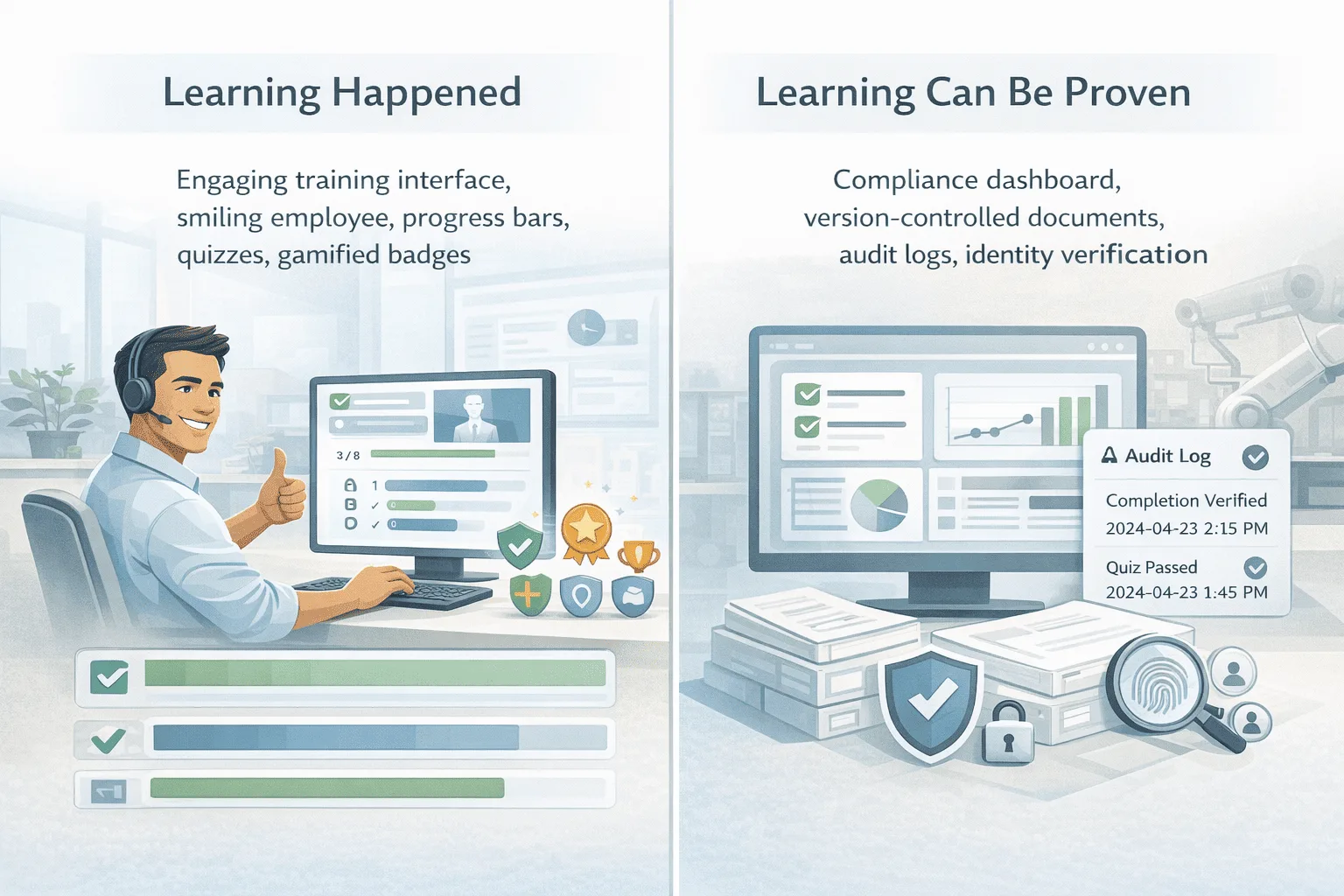
Most LMS platforms fail during regulatory audits not because training didn’t happen, but because the evidence wasn’t forensic-grade. An employee completed harassment prevention training six months ago, but can you prove the assessment wasn’t bypassed? That the completion timestamp wasn’t backdated? That the training content matched the version required when the violation occurred? LMS for compliance training serves an evidentiary function first. The structural difference between “learning happened” and “we can defend that learning happened” determines whether systems satisfy regulators or create liability. This article examines how compliance training platforms differ in their approach to defensibility and where those differences matter during audits.
Why Compliance Training Is Structurally Different from Other Training
Corporate compliance training exists because legal or regulatory consequences follow violations. Unlike skills training aimed at performance improvement, employee compliance training serves a defensive purpose: proving to external authorities that training obligations were fulfilled.
When learning for improvement (engagement, retention) conflicts with training for defensibility (documentation, evidence preservation), organizations prioritize defensibility. A tedious program producing legally defensible records survives audits better than an engaging program lacking timestamped completion records.
What an LMS for Compliance Training Is Expected to Do (in Practice)
Regulators don’t typically prescribe specific LMS features, but they expect evidence during investigations. That shapes what compliance training software must deliver:
- Completion records document who completed which training and when. Every LMS tracks this.
- Defensible evidence proves training actually occurred, learners didn’t merely click through, and records haven’t been altered. This requires audit trails, version control, and tamper-evident timestamping.
- Forensic readiness appears in highly regulated industries: can the system produce evidence that withstands legal scrutiny during compliance violations investigations? Organizations facing regulatory audits need exportable records with chain-of-custody documentation, not just dashboard completion rates.
Core Comparison Dimensions Across Compliance Training LMS Approaches
| Feature/Dimension | General-Purpose LMS | Compliance-Specific LMS |
|---|---|---|
| Compliance Objective | Acknowledgment tracking | Risk mitigation & forensic evidence |
| Training Cadence | Periodic, scheduled | Continuous, event-triggered |
| Assessment Rigor | Basic quizzes | Competency verification with audit trails |
| Certification Tracking | Manual or add-on | Automated expiry alerts & recertification |
| Automation Logic | Role-based assignment | Risk-based + regulatory triggering |
| Audit Trail Depth | Basic activity logs | Forensic-grade timestamps, version control |
| Integration Requirements | HRIS, SSO | HRIS + compliance databases + regulatory systems |
| Content Governance | Admin-controlled | Compliance team oversight with change logs |
| Evidence Format | Internal dashboards | Regulator-specific export formats |
| Failure Point | Defensibility gaps during audits | Scope limitations for non-compliance training |
Major LMS Approaches Used for Compliance Training
- General-Purpose LMS: Platforms like Moodle Workplace, Docebo, or Absorb LMS adapted through configuration. Designed for diverse learning with compliance as one workload.
- Compliance-Focused LMS: Platforms like Litmos that foreground regulatory compliance training workflows. Prioritizes evidence preservation and audit reporting over flexibility.
- Industry-Specific Platforms: Solutions for healthcare (HIPAA), financial services (FINRA), or manufacturing (OSHA) that embed regulatory requirements. Maps training to specific industry regulations.
- Hybrid Approach: General LMS for delivery plus licensed compliance content from third-party vendors. Separates infrastructure from content creation.
Automation, Assignment Logic, and the Illusion of Control
How does LMS help with compliance training? Automation: systems assign mandatory training programs based on job roles, trigger recertification before certifications expire, and escalate non-compliance to managers. Rule-based automation works when compliance maps to trackable attributes: job title, location, hire date. Risk-based automation, assigning training based on incidents or audit findings, requires extensive customization.
Real-World Audit Failure
In a 2025 manufacturing audit, an organization’s compliance LMS showed 98% completion for OSHA training. The audit failed because the system didn’t account for “Leave of Absence” status, 12% of employees on medical leave were marked “non-compliant” while the remaining workforce appeared trained. The auditor questioned whether the organization could distinguish between genuine non-compliance and system limitations. The lack of LOA exception handling created a 12% evidence gap that cost the organization $180,000 in penalties.
Automation breaks down at edge cases: role changes mid-cycle, contractors versus employees, multi-jurisdiction workers, and manager escalation when the manager is also non-compliant. Automated compliance creates oversight dependencies; someone must monitor whether automation functions correctly and handle exceptions. Role-based training assignment reduces manual work but doesn’t eliminate compliance team responsibility.
Tracking, Reporting, and Audit Defensibility
The disconnect between claimed reporting capabilities and satisfaction lies in the difference between internal dashboards and external audit evidence. Internal dashboards show completion rates and identify non-compliant employees. External audit evidence requires exportable records with specific attributes: learner identity verification, content version control, completion timestamps, assessment scores, sometimes video evidence. Regulators may request records in specific formats or attestations that records haven’t been altered.
Completion records and employee training records serve different evidentiary standards. A “95% complete” dashboard satisfies internal stakeholders. An auditor investigating a violation wants timestamped proof that the specific employee completed the specific training version in effect when the incident occurred. This evidence chain expectation is under-explained in platform marketing.
Engagement vs Evidence – A Persistent Compliance Trade-Off
Instructional designers advocate microlearning, mobile delivery, and gamification. Compliance teams worry these create audit complications.
Does completion of five 3-minute modules constitute the same audit evidence as one 15-minute course?
Does training on personal devices during commute time meet the same evidentiary standards as training on company systems during work hours?
Do gamified quizzes verify competency or gameplay skill?
Organizations in highly regulated industries report conservative approaches to engagement tactics because audit readiness constrains instructional innovation.
The 2026 Compliance Middle Ground: How to Have Both
- Use xAPI wrappers for microlearning: Track each micro-module as a discrete “statement” with timestamps. Aggregate completion requires all statements, creating the same evidentiary weight as monolithic courses while enabling engagement-friendly chunking.
- Implement nested assessments: Gamified practice quizzes for engagement, followed by proctored or time-controlled final assessments for compliance verification. The LMS logs both but only the final assessment counts toward regulatory completion.
- Mandate on-network completion for high-stakes training: Allow mobile access for awareness training (ethics, diversity) but require VPN or on-site completion for regulatory training (FDA, FINRA) where device verification matters for audit defense.
- Use adaptive learning with audit checkpoints: Allow learners to skip familiar content but require all learners to complete specific “compliance checkpoints” that verify critical knowledge regardless of their learning path.
Contextual Suitability – Where Each Model Tends to Fit
Highly regulated industries governed by 21 CFR Part 11 (Life Sciences), FINRA (Financial Services), or HIPAA (Healthcare) often use compliance-focused platforms. These regulations demand forensic-grade audit trails and specific evidence formats that justify specialized systems. Organizations pursuing SOC2 compliance, ISO 27001 certification, or general GDPR readiness often use general-purpose LMS configured for compliance. The regulatory burden exists but standard completion tracking and basic audit trails typically suffice.
Frontline-heavy workforces in retail, hospitality, or construction face delivery challenges- whether workers can access training without company email or regular computers -that matter more than audit trail sophistication. Multi-jurisdiction organizations navigating varying state-level OSHA requirements, EU member state privacy laws, or international labor regulations must handle different requirements by location while maintaining consolidated reporting.
How to Think About Choosing an LMS for Compliance Training
Organizations evaluating compliance learning management systems benefit from reflective questions:
- What must we prove during an audit? Determines whether standard completion tracking suffices or forensic-grade evidence is necessary
- Who owns compliance evidence? Governance misalignment creates operational friction
- How often do regulations change? Frequent changes favor platforms where vendors maintain content currency
- What fails first if adoption drops? Consequence severity shapes platform priorities
- Can we maintain specialized systems? Compliance-focused platforms require dedicated administrative capacity
These questions surface institutional constraints that determine fit.
Key LMS Vendors Used for Compliance Training
1. SimpliTrain
A unified training ecosystem combining LMS, TMS, and LXP functionality. Helps organizations centralize compliance content, assessments, and certifications while supporting blended delivery formats. Not specifically compliance-only but adaptable for regulated training and tracking needs.
2. Docebo
Cloud-based AI-enabled LMS with automated workflows, content management, and tracking. Widely used for structured compliance training, reporting, and certification management across industries, with scalable administration and integration options.
3. CYPHER Learning
Enterprise LMS with automation, adaptive learning, and analytics designed to support ongoing compliance programs. It offers customizable compliance workflows and dashboards for tracking completion and certification status.
4. SAP Litmos
Popular with regulated teams for compliance training delivery, automated enrollment, and real-time reporting. Known for easy setup and broad content library support, helping meet basic compliance objectives.
5. 360Learning
Combines LMS and collaborative learning with compliance capabilities. Supports course creation, engagement features, and reporting, suitable for organizations prioritizing peer learning alongside compliance tracking.
Organizations approach LMS for compliance training as risk management infrastructure. The system’s value lies in producing defensible evidence when authorities demand proof of training obligations. Different models make trade-offs between flexibility, specialization, and audit defensibility. Understanding those trade-offs helps match capabilities to institutional constraints.
FAQ
Q1. What is an LMS for compliance training?
A learning management system designed or configured to support mandatory training required by regulations, policies, or legal obligations. Tracks completion, manages certifications, and produces audit records.
Q2. What features should a compliance training LMS have?
Minimum: timestamped completion tracking, certification expiry management, automated assignment, exportable audit reports. For 21 CFR Part 11 (FDA), FINRA, or HIPAA contexts: forensic-grade audit trails, electronic signature workflows, and regulator-specific reporting formats that satisfy inspection requirements.
Q3. How to track compliance training?
Systems track completion through timestamped records when learners finish courses or assessments. Advanced tracking includes login history, time spent, assessment attempts, and certification expiry. Audit-ready tracking preserves data in tamper-evident formats that satisfy SOC2, ISO 27001, or GDPR documentation requirements.
Q4. What are compliance training requirements?
Requirements vary by industry and jurisdiction. Common mandates include OSHA workplace safety, anti-harassment training, GDPR data privacy (for EU operations), HIPAA (healthcare), 21 CFR Part 11 (pharmaceutical/medical device), FINRA (financial services), and SOX (publicly traded companies).