

Organizations rarely migrate from SCORM to xAPI because they are excited about a new standard. In most cases, migration conversations begin when something stops working. Mobile tracking fails. Simulation data never appears in dashboards. Leadership asks for behavioral insight, and the only metric available is “Completed: Yes/No.”
When teams research how to migrate from SCORM to xAPI, they are usually trying to fix a reporting limitation, not modernize for appearance. The move represents a structural shift in how learning data is captured and governed. It affects content logic, identity management, reporting pipelines, and infrastructure. Understanding the options requires examining trade-offs, not just conversion steps.
Why Organizations Migrate from SCORM to xAPI
SCORM (both 1.2 and 2004) remains effective for structured eLearning. It tracks course launches, completion status, scores, and session data within a browser-based environment. For compliance-heavy programs, this functionality is often sufficient. The challenge emerges when learning extends beyond the browser.
Mobile-first microlearning, VR simulations, field-based task confirmations, and cross-platform training ecosystems require event-based tracking models. The Experience API (xAPI), developed under initiatives such as Advanced Distributed Learning, was designed to support that flexibility. Unlike SCORM’s predefined data model, xAPI allows systems to send structured “actor–verb–object” statements to a Learning Record Store (LRS). This enables tracking across devices and environments.
In one migration audit I reviewed, the decision to move to xAPI was triggered by a simple reporting gap: mobile learners were completing modules offline, but none of that activity appeared in quarterly compliance dashboards. The LMS technically functioned, yet executives were making decisions based on incomplete data. Migration was less about replacing SCORM and more about restoring reporting accuracy.
What Are Your Options When Migrating from SCORM to xAPI?
In practice, three structural approaches dominate migration discussions:
- SCORM-to-xAPI wrapper (translation layer)
- Republishing content as native xAPI
- Converting SCORM packages to cmi5
Each carries different implications for effort, data depth, and long-term architecture.
Migration Model Comparison -Migrate from SCORM to xAPI
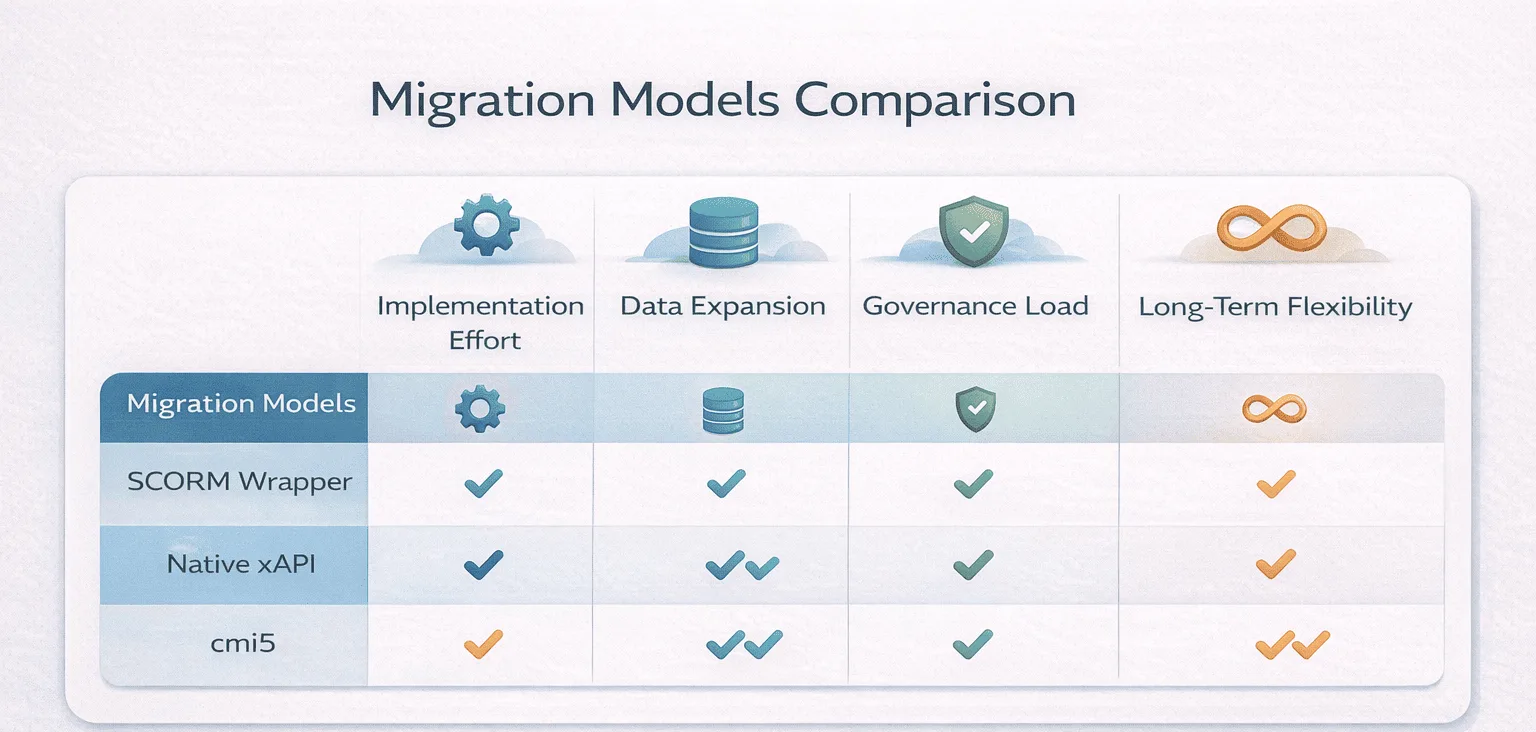
| Model | Implementation Effort | Data Expansion | Governance Load | Long-Term Flexibility |
|---|---|---|---|---|
| Wrapper | Lower | Limited (mirrors SCORM) | Moderate | Transitional |
| Native xAPI | Higher | Significant | High | Strong |
| cmi5 | Moderate | Moderate–High | Moderate | Structured |
No model is universally superior. Suitability depends on what problem you are trying to solve.
Is a SCORM Wrapper the Fastest Way to Migrate?
A wrapper intercepts SCORM API calls and emits equivalent xAPI statements. The underlying course remains unchanged, while a translation layer converts data into xAPI format. Organizations often choose this approach because it allows quick deployment. Resources from Rustici Software frequently discuss translation-based migration models for this reason.
However, wrappers typically mirror SCORM logic. If the original course only captured completion and score data, the resulting xAPI statements will reflect that same limitation. I’ve seen teams deploy wrappers in under two weeks, celebrate the migration milestone, and then discover months later that their dashboards looked identical to before. Technically, the system had upgraded. Strategically, nothing had changed.
What Does Republishing as Native xAPI Really Involve?
Republishing requires reopening source files in an authoring tool and exporting them as xAPI or cmi5 packages. Tools such as Articulate and Adobe support these export formats. But export alone does not guarantee richer insight. Meaningful migration involves redesigning interaction triggers, defining verbs intentionally, and deciding which learner behaviors warrant tracking. Without that redesign, the new xAPI package simply reproduces SCORM logic in a different container.
I’ve reviewed migrations where leadership proudly announced a shift to xAPI, only for the statement logs to reveal the same binary pass/fail tracking model as before. The format changed. The insight did not. Republishing offers the greatest long-term flexibility, but it demands governance discipline.
Where Does cmi5 Fit?
cmi5 is often positioned as a structured bridge between SCORM and xAPI. It preserves course launch control while using xAPI for tracking. In regulated or government environments where launch governance is critical, cmi5 can provide continuity. However, it introduces additional specification requirements and depends on LMS compatibility. It is not a shortcut, but rather a structured compromise between legacy control and modern tracking.
The Identity Problem That Breaks Reporting -Migrate from SCORM to xAPI
Migration discussions often mention “actor fragmentation.” The operational impact is rarely explained. In one enterprise rollout, the LMS identified learners using internal numeric IDs, the HR system used employee numbers, and xAPI statements were configured to use email addresses. Within days, the LRS showed multiple profiles for the same individual.
- One profile contained course completions.
- Another contained simulation activity.
- A third held assessment attempts.
- Executive reports became unusable.
The resolution required halting ingestion, mapping all statements to a consistent IRI format (mailto: in that case), and rebuilding reporting queries. The delay extended the migration timeline by several weeks. The lesson is clear: define a Single Source of Truth for learner identity before sending the first xAPI statement.
Governing Verb Consistency
xAPI’s flexibility is both strength and risk. Without a controlled vocabulary, verbs drift. In practice, verb variation rarely happens intentionally. It occurs when multiple instructional designers publish content over time without a shared registry. Months later, analytics teams notice inconsistent completion trends, only to discover that “completed,” “finished,” and “passed” were recorded as separate events. Establishing a documented verb registry before scaling migration prevents fragmentation. Governance must be proactive, not reactive.
What Happens to Historical SCORM Data?
SCORM data does not disappear during migration. Most organizations maintain historical LMS records while new xAPI data flows into an LRS. This creates a transitional period of parallel reporting. Completion logic, certification rules, and transcripts may reference both datasets until reporting stability is achieved. Migration is phased, not instantaneous.
When Migration May Not Be Necessary
Not every organization benefits equally from xAPI adoption. In one compliance-focused environment I observed, 95% of training consisted of linear modules with pass/fail assessments. After migrating to xAPI, the organization gained more granular event data, but leadership continued relying on completion reports. The added infrastructure introduced complexity without altering decision-making behavior. If training strategy remains static and compliance-driven, SCORM may remain sufficient. xAPI expands what you can measure. It does not automatically improve what you understand.
How to Think About Your Migration Path
Instead of asking which migration model is “best,” consider:
- Are we solving mobile or simulation tracking gaps?
- How large is our SCORM catalog?
- Do we have governance capacity for identity and verb control?
- Are we seeking rapid analytics enablement or long-term architectural evolution?
Migrating from SCORM to xAPI is not a file conversion exercise. It is a redesign of how learning data is structured and interpreted. Handled deliberately, it enables cross-platform visibility and deeper insight. Approached casually, it simply relocates incomplete data into a more flexible container. The difference lies not in the standard, but in the discipline applied during migration.