

Key Findings at a Glance

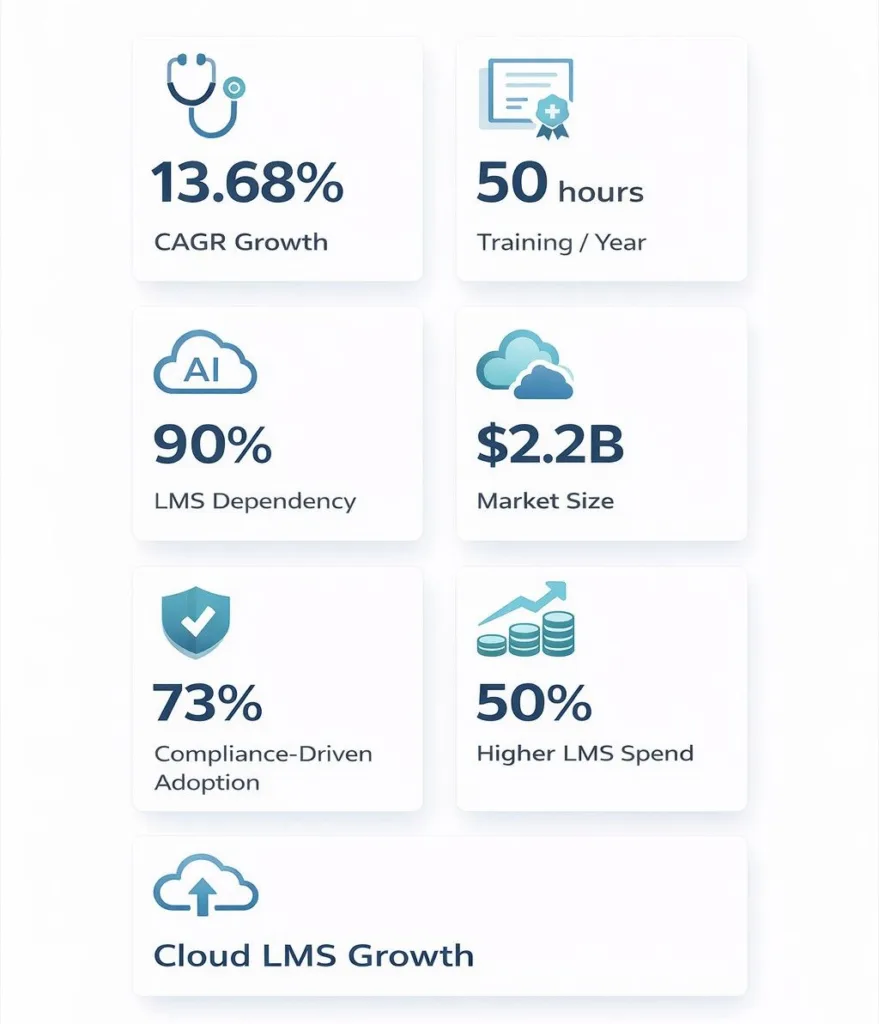
13.68% CAGR: Healthcare and pharmaceuticals are the fastest-growing LMS vertical globally, outpacing all other end-user segments (Mordor Intelligence, 2026).
50 hours/year: Healthcare has the highest annual training hours per employee of any industry tracked – nearly double the cross-industry average (Atrixware, 2026).
90% LMS dependency: According to Brandon Hall Group, 90% of organizations surveyed rely on an LMS as their primary platform for compliance training delivery
$2.2B healthcare LMS market by 2026: The healthcare-specific LMS segment was projected to reach $2.2 billion in 2026, at a CAGR of 24.7% from 2021 (IndustryARC).
73% compliance-driven: Compliance is the number-one driver of LMS adoption, cited by approximately 73% of organizations across regulated sectors (Atrixware, 2026).
50% higher LMS spend: Regulated industries including healthcare, finance, and energy spend approximately 50% more on LMS than cross-sector averages (Atrixware, 2026).
Cloud-first shift: Cloud-based LMS deployments in healthcare are expected to reach $1.3 billion by 2026, expanding at a 29.2% CAGR – the fastest deployment sub-segment in the vertical (IndustryARC).
Here is a number most healthcare L&D leaders are not prepared for: healthcare reports the highest training hours per employee of any industry – approximately 50 hours per year – yet as recently as 2024, fewer than half of all U.S. organizations had mandatory compliance training fully deployed online. That gap between training volume and digital infrastructure is the defining tension shaping LMS adoption in healthcare right now.
The pressure to close that gap is intensifying from every direction simultaneously – tightening regulatory mandates, rapid clinical technology turnover, workforce shortages demanding faster onboarding, and a post-pandemic institutional memory of what happens when training delivery fails at scale. Add a healthcare LMS vertical growing at a 13.68% CAGR – the fastest rate of any end-user segment in the broader LMS market – and the case for examining this space closely becomes self-evident.
This report compiles data from 7 sources – including Mordor Intelligence, Grand View Research, IndustryARC, Atrixware’s 2026 LMS Statistics Report, Brandon Hall Group, G2 market data, and ATD L&D benchmarks – to provide buyers, L&D decision-makers, and procurement teams inside healthcare organizations with a clear, evidence-based view of where the market stands in 2026 and what the data actually means for platform selection.
The analysis that follows is organized around six findings, each examined for both the data behind it and the operational implications for healthcare buyers. The report closes with an original editorial synthesis – LMSpedia’s take on what this data, read together, reveals that no individual source captures on its own.
Finding 1: Healthcare Is the LMS Market’s Fastest-Growing Vertical
The global LMS market is large and growing across all verticals. Grand View Research places the market at $28.58 billion in 2025 and projects $123.78 billion by 2033, at a 20.2% CAGR. But within that expansion, healthcare and pharmaceuticals are accelerating faster than any other end-user segment.
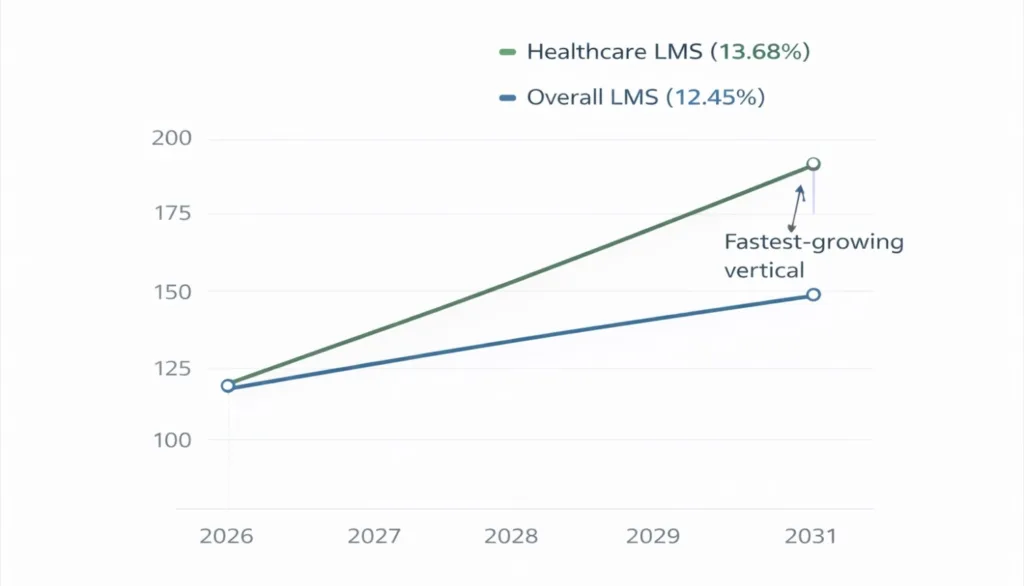
According to Mordor Intelligence’s January 2026 market report, healthcare and pharmaceuticals represent the fastest-growing LMS vertical at a 13.68% CAGR, driven specifically by continuing professional development (CPD) mandates and evolving compliance requirements across EU and North American regulatory regimes. The LMS market overall is growing at 12.45% CAGR over the same 2026–2031 window, meaning healthcare is outpacing the market average.
The IndustryARC healthcare LMS report reinforces this. The healthcare-specific LMS segment alone was forecast to reach $2.2 billion by 2026, growing at a 24.7% CAGR from a 2021 baseline – a growth rate that substantially exceeds nearly every adjacent software category in health IT.
What this means for buyers:
Vendor investment in healthcare-specific LMS features – HIPAA compliance architecture, CME/CNE credit tracking, clinical role-based learning paths – is accelerating. Buyers who evaluated the healthcare LMS landscape 18–24 months ago are likely looking at a meaningfully different product set today. A fresh evaluation is warranted before any renewal decision.
Finding 2: Compliance Is Not a Feature – It Is the Product
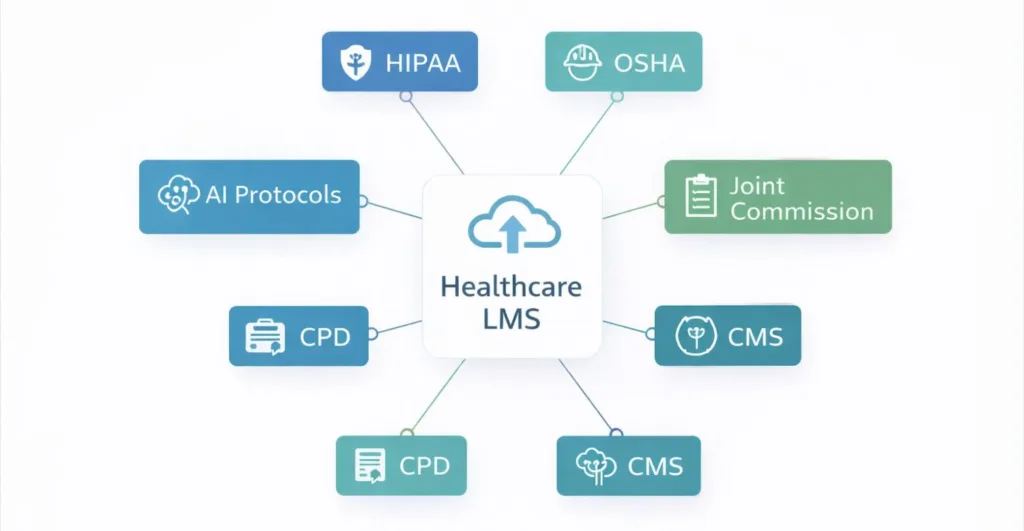
Across regulated industries, compliance is the number-one driver of LMS adoption, cited by approximately 73% of organizations in Atrixware’s 2026 benchmark data. In healthcare specifically, the compliance surface is unusually wide: HIPAA training, OSHA certifications, Joint Commission standards, state licensure CPD requirements, CMS Conditions of Participation, and increasingly, AI-in-care-delivery protocols.
Brandon Hall Group’s survey, conducted in partnership with Litmos, found that 90% of respondents are using an LMS to support compliance training – a figure that underscores how thoroughly LMS has moved from a training convenience to a compliance infrastructure asset. The same study identified the most common failure point: organizations using multiple disconnected platforms struggle to maintain consistent audit trails, a critical gap when regulators arrive.
The financial stakes of compliance failure in healthcare are severe. Atrixware’s data notes that poor compliance training is associated with average error costs of approximately $62,000 per incident. Separately, OSHA fines for serious violations can exceed $150,000 per violation. Healthcare LMS buyers are not making an L&D investment – they are managing operational liability.
Modern platforms have responded accordingly. As CYPHER Learning’s 2026 compliance training guide documents, leading healthcare LMS solutions now offer automated certification renewal, role-based course assignment tied to job function, and audit-ready reporting that exports in regulator-specified formats.
What this means for buyers:
Evaluate LMS platforms on audit-trail depth, not just course completion rates. Ask vendors specifically: Can this system export a timestamped, role-linked compliance record for an individual employee in the format your accrediting body requires? If the answer requires a workaround, that is a disqualifier for most healthcare environments.
Finding 3: Healthcare Has the Highest Training Volume – and the Least Margin for Error
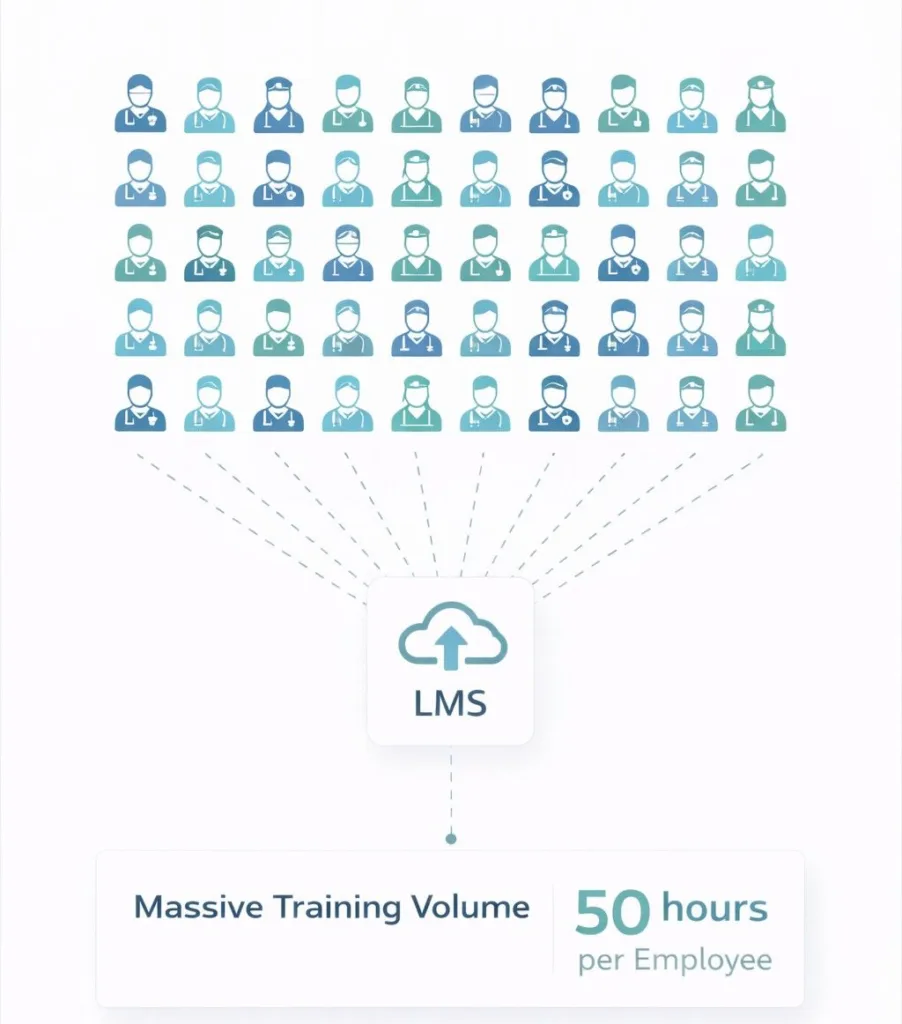
Healthcare logs more employee training hours than any other sector. Atrixware’s 2026 LMS statistics benchmark places the figure at approximately 50 hours per employee per year – nearly double the cross-industry norm of roughly 32–34 hours in most corporate sectors. This volume is not discretionary. It reflects the layered certification landscape healthcare workers navigate annually: clinical skills validation, infection control, patient safety, privacy training, and role-specific competency modules.
The operational implication of this training volume is significant. A healthcare organization with 2,000 staff delivering 50 hours of required annual training is managing the equivalent of a full-time corporate university – but typically without dedicated instructional design resources, LMS administrators, or L&D infrastructure. The platform must carry the weight that a staffed L&D team would carry elsewhere.
This explains why regulated industries including healthcare spend approximately 50% more on LMS than cross-industry averages – and why the investment calculus is fundamentally different. Healthcare LMS buyers are not optimizing for engagement scores. They are managing risk, certification deadlines, and workforce readiness at a volume that has direct patient safety implications.
What this means for buyers:
At 50 training hours per employee per year, administrative automation is not a nice-to-have – it is the entire ROI story. Look for platforms where enrollment, reminders, recertification, and reporting are automated by default. Any platform requiring significant manual administration at scale will erode the time savings it was acquired to create.
Finding 4: Cloud Deployment Is Winning – But Security Concerns Are Reshaping the Conversation
Cloud-based LMS solutions are the dominant and fastest-growing deployment model across all industries, with cloud deployments expanding at a 14.22% CAGR globally as enterprises prioritize elastic infrastructure and API integration (Mordor Intelligence, 2026). In healthcare specifically, the cloud LMS segment was projected to reach $1.3 billion by 2026, growing at a 29.2% CAGR – faster than the overall healthcare LMS market.
However, healthcare’s shift to cloud is complicated by a data security environment that is deteriorating. According to Knowi’s 2026 healthcare analytics report, healthcare data breaches cost an average of $7.42 million per incident in 2025 – and breaches involving third-party vendors doubled in a single year, from 15% to 30% of all incidents, per the Verizon 2025 Data Breach Investigations Report. Any cloud-hosted system that handles employee training records touching PHI must meet HIPAA Business Associate Agreement (BAA) requirements.
This is reframing vendor selection in a specific way. Healthcare buyers are not rejecting cloud – they are demanding that cloud LMS vendors demonstrate compliance-grade data architecture, not just compliance-themed marketing. The distinction matters enormously in procurement conversations.
What this means for buyers:
Require any cloud LMS vendor to produce a signed BAA, a SOC 2 Type II audit report, and a documented data residency policy before advancing to contract. These are non-negotiable baseline requirements in healthcare, not advanced due diligence.
Finding 5: AI Is Entering Healthcare LMS – But Readiness Is Uneven
Artificial intelligence has moved from a vendor roadmap feature to a deployed capability in the LMS market. SAP SuccessFactors released a compliance-training module tailored specifically for EU healthcare providers in November 2025, integrating automated CPD tracking and GDPR-compliant data handling. Docebo has introduced AI-based personalization for healthcare learning paths. Multiple platforms now use AI to identify learners at elevated risk of compliance gaps based on assessment performance patterns – and to trigger automated interventions before deadlines pass.
Across the broader industry, 49% of U.S. HR teams now use AI to personalize learning recommendations (Atrixware, 2026). And in healthcare, where AI adoption across the enterprise reached 85% by end of 2024, the pressure on LMS vendors to ship meaningful AI-native features – not just AI branding – is intensifying.
Yet readiness gaps are real. Per HIMSS research cited in Knowi’s healthcare analytics benchmark, only 18% of healthcare organizations are actually prepared to deploy AI in care delivery. The barriers: lack of tool maturity, financial constraints, and regulatory uncertainty. These same barriers apply to AI-powered LMS features when patient data or clinical records intersect with training workflows.
What this means for buyers:
Treat AI-powered LMS features as a capability spectrum, not a binary. The meaningful question is not ‘Does this platform have AI?’ but rather: ‘Which specific AI features are production-ready today, which are in beta, and where does patient or employee data flow when AI features are enabled?’ Demand clarity on the last question before signing any contract with AI processing in scope.
Finding 6: Platform Fragmentation Remains the Operational Liability Healthcare Has Not Solved
Brandon Hall Group’s compliance training survey uncovered a persistent problem: many organizations use multiple LMS platforms or a combination of disconnected technologies. In healthcare, this fragmentation often looks like a legacy LMS for nursing compliance, a separate CE/CME tracking system for physicians, a vendor-provided onboarding tool, and a standalone HIPAA training module – none of which share a data model or produce a unified compliance audit trail.
This fragmentation is not an LMS problem per se – it is the accumulated consequence of procurement decisions made across departments, over years, without a governing architecture. But it becomes an LMS problem when a Joint Commission surveyor or a CMS auditor asks for a consolidated compliance status report and the answer requires manually reconciling four systems.
The market’s response is the LMS-LXP-TMS convergence. Platforms are now marketing themselves as unified learning infrastructure – a single system managing compliance training, skills development, and instructor-led scheduling. As Doctors Management’s healthcare compliance training analysis notes, modern LMS platforms are evolving “from simple content delivery platforms to sophisticated ecosystems that support personalized learning paths, real-time progress tracking, and predictive analytics.” The convergence creates a new evaluation question: can a single platform replace the stack?
What this means for buyers:
Before evaluating any individual LMS, map your current learning technology stack. Count the number of systems generating training records. If the number is three or more, the consolidation ROI case for a unified platform will almost certainly be significant enough to justify a formal business case – even before calculating per-seat licensing savings.
LMSpedia Analysis: What This Data Means for Buyers
Reading each finding in isolation produces a useful picture of the healthcare LMS market. Reading them together produces a different, less comfortable conclusion that the individual data points do not surface.
Healthcare LMS selection is being made under the wrong framework. Most procurement teams evaluate LMS platforms as training tools – scoring them on content library size, mobile UX, and pricing per seat. The data in this report suggests a different frame entirely: healthcare LMS is compliance infrastructure. The platforms being selected need to be evaluated the way an organization evaluates an EHR system, not the way it evaluates a corporate training tool.
The evidence for this reframe is embedded throughout the findings. The 50-hours-per-year training volume does not exist because healthcare organizations love learning – it exists because regulators require documented proof of competency. The 50% premium healthcare spends on LMS does not reflect a culture of generous L&D investment – it reflects the cost of managing certification liability at scale. The surge in cloud LMS adoption is running directly into a third-party data breach environment that has doubled in severity in a single year. These are not training department concerns. They are operational risk concerns that happen to live inside training systems.
The non-obvious implication: most healthcare organizations are under-resourced in LMS administration relative to the compliance burden they are managing. A 2,000-person hospital system managing 100,000 training completions annually, across four regulatory frameworks, with a part-time LMS administrator and a legacy platform, is not running a training program. It is running a compliance liability that has not yet been audited closely enough to reveal itself. The buyers who will get the most from the next generation of healthcare LMS are not the ones who buy the most features – they are the ones who go into the evaluation knowing exactly which regulatory obligations they need the platform to absorb, and who hold vendors accountable for delivering on those specifics.