

What if the biggest difference between two Learning Management System (LMS) platforms wasn’t features, AI, or integrations, but how much your bill grows every time your company grows? That’s the central question when comparing SimpliTrain vs Docebo.
Both of these platforms are great at what they do, they offer modern learning management capabilities, AI-powered features, and enterprise-ready infrastructure. However, under the hood, the pricing structure of both the platforms is entirely different along with some of the features they offer.
As per the Brandon Hall Group, the learning technology budget for the organizations have increased by 65% in the past three years and is expected to increase more. Now large enterprises can handle these costs, but it becomes hard for mid-market companies owing to the increasing long term-cost of the LMS. Therefore, it also becomes important to understand the LMS Pricing Models.
Therefore, today we are comparing two of the biggest platform Docebo and Simplitrain, while both of them have something different and extra to offer, this blog will help you in deciding the best LMS for your corporate needs. This guide breaks down SimpliTrain vs Docebo across features, pricing, implementation, and long-term value so you can clearly determine which platform aligns with your organization’s growth, training complexity, and budget strategy in 2026.
Platform Overview: SimpliTrain vs Docebo at a Glance
The LMS market has consolidated around two distinct philosophical camps: platforms built for enterprise depth-at-any-cost, and platforms built for operational unification with predictable economics. Docebo represents the former, a well-funded, AI-rich enterprise giant deployed at over 3,900 organizations globally.
SimpliTrain represents the latter, a modern, unified LMS+TMS+LXP built for organizations that want every training capability in one place, without watching costs compound as headcount grows. SimpliTrain is currently used by 400+ organizations all around the world.
| Attribute | SimpliTrain | Docebo |
|---|---|---|
| Founded | 2015 (by Mundrisoft) | 2005 (Turin, Italy) |
| Headquarters | Global (distributed) | Toronto, Canada |
| Primary Market | SMB to mid-market; training providers; multi-location orgs | Mid-market to enterprise; technology, finance, manufacturing |
| Pricing Model | Flat-rate subscription — unlimited users | Quote-based, per active user annually |
| Deployment | Cloud SaaS | Cloud SaaS |
| SCORM / xAPI | Yes (both) | Yes (both) |
| G2 Rating | 4.2 / 5 · 746 reviews | 4.3 / 5 · 746 reviews |
| Best For | Orgs wanting one platform to replace TMS + LMS + LXP; cost-conscious scaling | Enterprises needing deep AI automation, 400+ integrations, and social learning |
Feature Comparison: What Each Platform Does Better
This table evaluates 17 capabilities relevant to mid-market L&D buyers. The verdict column reflects LMSpedia’s editorial assessment based on public user reviews, vendor documentation, and data from various user lead review platforms, not vendor-provided claims alone. You can also check out LMS Vendor Evaluation Checklist.
Feature |
Key SimpliTrain Features | Key Docebo Feratures | Verdict |
|---|---|---|---|
| Unified LMS + TMS + LXP | Native single platform, all three in one subscription | LMS core; LXP via add-on modules; TMS limited | SimpliTrain |
| AI-powered features | AI-driven assessments, content recommendations | Industry-leading: auto-tagging, enrollment automation, AI Creator, generative course builder | Docebo |
| Course creation / authoring | Built-in SimpliAuthor (multimedia, self-paced, ILT, vILT) | Docebo Creator + 30,000+ marketplace courses; generative AI authoring | Draw |
| ILT / TMS management | Full TMS: scheduling, resource allocation, multi-location, instructor management | ILT supported; session-level enrollment automation still limited per reviews | SimpliTrain |
| Multi-location / franchise mgmt | Core differentiator; built for global multi-site orgs and franchise networks | Supported via branches and domains; strong but secondary focus | SimpliTrain |
| White-label/branding | Full white-label: logo, colors, custom domain | Branded portals; custom mobile app branding available | Draw |
| Reporting & analytics | Configurable reports, transcript-level learner tracking, admin dashboards | Strong suite; advanced reporting can be unintuitive per G2 reviewers | SimpliTrain |
Social & community learning |
Discussion boards, community clubs, mentored sessions, peer learning | Coach & Share, Teams social learning, channels; a recognized strength | Docebo |
| Gamification | Gamification features included | Robust gamification; auto-tagging & badges praised by reviewers | Docebo |
| Mobile learning | Mobile-responsive platform | Dedicated mobile app with custom branding; praised for flexibility | Docebo |
| Integrations | Salesforce, Zoom, Adobe Connect, HubSpot, API available | 400+ integrations; Docebo Connect low-code automation; Microsoft Teams, BambooHR | Docebo |
| Compliance & certification | Compliance tracking, configurable certification | Strong compliance; certification deadline management requires support per reviews | Draw |
| Multilingual support | English, Spanish, German; multilingual interface | 40+ languages including Arabic, Japanese, Korean, Vietnamese | Docebo |
| Learner experience / UX | Personalized learning paths, adaptive delivery, microlearning | Widely praised UI; drag-and-drop page builder; G2 leader in learner UX | Docebo |
| Customer support | Dedicated support team per customer; phone, chat, email, knowledge base | CSM included on most tiers; responsiveness cited as weakness by some reviewers | SimpliTrain |
| Training monetization | Monetization-ready; training-as-marketing tools built in | Shopify, BigCommerce, WooCommerce integrations; 100/100 per SelectHub | Draw |
| Pricing predictability | Flat-rate, no surprises as you scale | Per-active-user, costs rise with adoption and headcount | SimpliTrain |
Summary: Docebo leads on AI capabilities, social learning, mobile apps, language depth, and integration breadth. SimpliTrain leads on ILT/TMS capability, multi-location management, pricing predictability, and consolidated platform value. For buyers evaluating total capability per dollar, the calculus shifts significantly toward SimpliTrain.
Pricing Comparison: Total Cost of Ownership Analysis
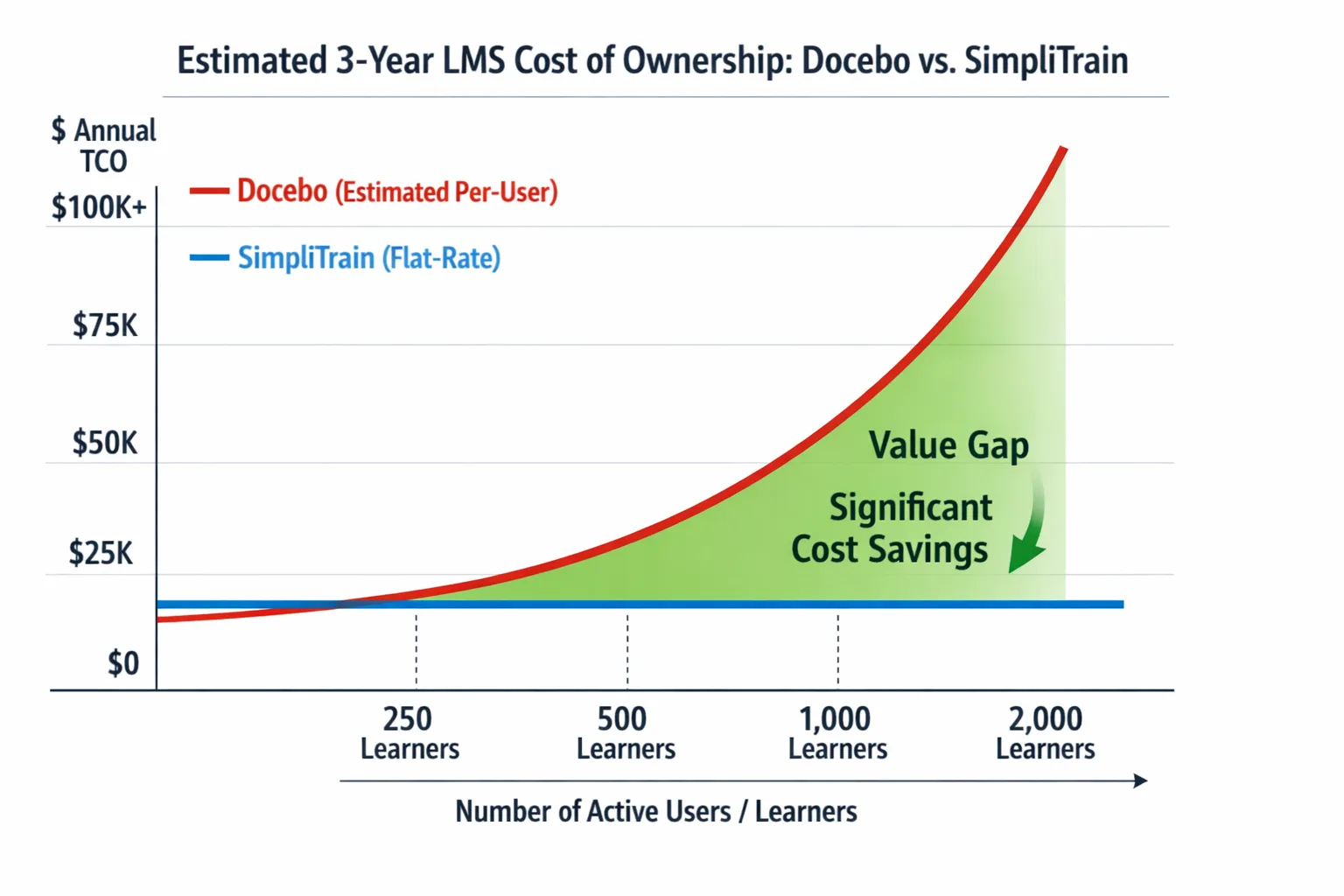
Pricing is where this comparison becomes most consequential. Docebo’s model is quote-based and charges per active user annually, with third-party analysis suggesting a starting cost of around $25,000/year for baseline deployments. SimpliTrain operates on a flat-rate subscription model, the price does not change as your learner count grows. For organizations in a growth phase, this is not a marginal difference.
How the Models Differ Structurally
- Docebo’s per-active-user model means that every new employee, partner, or customer you onboard increases your annual invoice. For an organization scaling from 250 to 1,000 learners, you can expect your LMS cost to grow proportionally, often 3–4×, unless you negotiate aggressive volume tiers upfront.
- SimpliTrain’s flat-rate model means your licensing cost is fixed regardless of how many users log in. Customer testimonials reference a 25% cost reduction within the first year, attributable in part to eliminating per-seat fees across multiple legacy systems.
Estimated Cost Scenarios (Annual)
Note: Docebo does not publish per-user rates publicly. Figures use the $25,000 base cited by SelectHub and analyst-estimated per-user scaling of $25–$35/active user/year for mid-market contracts. Always validate with vendor quotes.
| User Count | SimpliTrain (est.) | Docebo (est.) | Key Takeaway |
|---|---|---|---|
| 250 learners | ~Customised Flat Rate | ~$25,000+ (estimated minimum) | Significant SimpliTrain advantage at entry |
| 500 learners | ~Flat rate (no change) | ~$35,000–$45,000 (per-user scaling) | Gap widens as users grow |
| 1,000 learners | ~Flat rate (no change) | ~$50,000–$75,000+ (volume negotiated) | Potential 3–5× difference |
Hidden Cost Factors
Beyond licensing, the total cost of ownership includes:
- Implementation fees: Docebo can require technical support for advanced configurations. SimpliTrain provides migration support included.
- Integration costs: Docebo’s 400+ integrations are powerful but some require Docebo Connect setup or third-party middleware.
- Add-on modules: Docebo’s Coach & Share and Skills modules may carry separate fees.
- Admin overhead: Reviewers flag that Docebo’s advanced settings require technical expertise, adding labor cost.
For organizations replacing multiple siloed tools, a standalone TMS, a separate LMS, and an LXP, SimpliTrain’s unified model offers a structural cost reduction that compounds over a 3-year contract cycle.
Implementation and Onboarding: Time to Value Comparison
Implementation Timeline
- Docebo’s implementation timeline varies widely based on configuration complexity. Some users report going live in under a week for basic deployments; others cite extended timelines for multi-audience setups, SSO configuration, and custom branding. Advanced workflow automation and reporting configuration frequently require technical expertise or professional services.
- SimpliTrain’s onboarding is designed around assisted migration, including transfer of training materials, user data, and historical reports from legacy systems such as Cornerstone LMS. Customer feedback refers to the migration experience as “having an extra team member by our side,” suggesting a higher-touch, lower-DIY implementation model. For organizations without a dedicated LMS admin, this dramatically reduces time-to-value.
Technical Complexity
- Docebo’s admin interface is frequently praised for its clean layout, but some reviewers (across G2, Capterra, and Gartner Peer Insights) consistently note that graphic-level customizations require HTML/CSS knowledge, and some advanced automation flows require technical configuration. Legacy pages within the platform can make routine admin tasks more laborious. Organizations without an internal IT resource should budget for professional services or extended onboarding.
- SimpliTrain is positioned as low-admin-overhead by design. Its unified architecture means L&D teams are not stitching together separate TMS, LMS, and LXP configurations; the workflows are pre-integrated.
Support Quality
- Docebo includes customer success management (CSM) on most tiers, and the community and help desk are widely appreciated. However, several users noted delayed responses and workarounds for issues that should be natively solvable.
- SimpliTrain markets a dedicated per-customer support team model, a meaningful differentiator for organizations that cannot afford long support resolution cycles during rollout.
Who Should Choose SimpliTrain vs Docebo
We’ll be direct: neither platform wins for every buyer. Here is our honest segmentation.
Choose SimpliTrain if… – SimpliTrain Pros
- You’re scaling headcount and can’t afford escalating per-seat costs. If you expect your learner base to grow from 300 to 800+ over the next two years, flat-rate pricing protects your L&D budget and eliminates contract renegotiation friction.
- You manage instructor-led training across multiple locations. SimpliTrain’s TMS layer, scheduling, resource allocation, multi-site oversight, is built for organizations running franchise networks, regional training centers, or blended programs at scale. Docebo’s ILT tools exist but are secondary.
- You’re replacing 2–3 siloed systems and want operational simplicity. If you currently pay separately for a TMS, an LMS, and an LXP, SimpliTrain’s unified model reduces vendor count, eliminates integration maintenance, and typically lowers total cost immediately.
Choose Docebo if… – Docebo Pros
- AI-powered automation is a strategic priority. Docebo’s AI Creator, auto-tagging, enrollment automation, and generative content tools are genuinely industry-leading. If your L&D team is small and relies heavily on automation, Docebo’s AI layer provides measurable admin time savings.
- You need deep integration with a complex enterprise tech stack. With 400+ native integrations, Docebo Connect low-code automation, and Microsoft Teams social learning, Docebo is the better fit for enterprises whose LMS must talk to Salesforce, BambooHR, Shopify, identity providers, and custom internal systems simultaneously.
- Global, multilingual deployment is a day-one requirement. Docebo’s 40+ language support and proven global enterprise track record (3,900+ customers) make it the safer choice for organizations deploying to teams across Asia-Pacific, LATAM, and EMEA in native languages from launch.
Our Verdict: SimpliTrain Wins on Value; Docebo Wins on AI and Scale
Docebo is a genuinely excellent platform. Its G2 rating of 4.3/5 across 746 reviews reflects consistent user satisfaction, and its AI capabilities, integration depth, and social learning tools are hard to match in the mid-market. If you’re a large enterprise with a complex tech stack, global multilingual requirements, and budget headroom above $50,000/year for LMS alone, Docebo is a credible, future-proof choice.
2026 Verdict
For mid-market organizations, particularly those managing blended, instructor-led, and multi-location training programs, SimpliTrain delivers superior operational value. The unified LMS+TMS+LXP architecture eliminates tool fragmentation. The flat-rate pricing model ensures that as your organization grows, your LMS investment scales with strategy, not with invoices. The dedicated support model reduces implementation risk that smaller teams cannot absorb.
The buyers for whom SimpliTrain wins most clearly: training companies and L&D teams running 250–2,000 learners across multiple sites or delivery formats, who need a single system that handles scheduling, delivery, and learner experience, without watching software costs compound as adoption improves. If Docebo’s pricing model works for your contract scale and your primary needs are AI automation, enterprise integrations, or global language coverage, Docebo remains a valid choice. But if you’re paying more per-user every time you succeed at getting people into training, that’s a structural problem worth solving before you sign a multi-year contract.