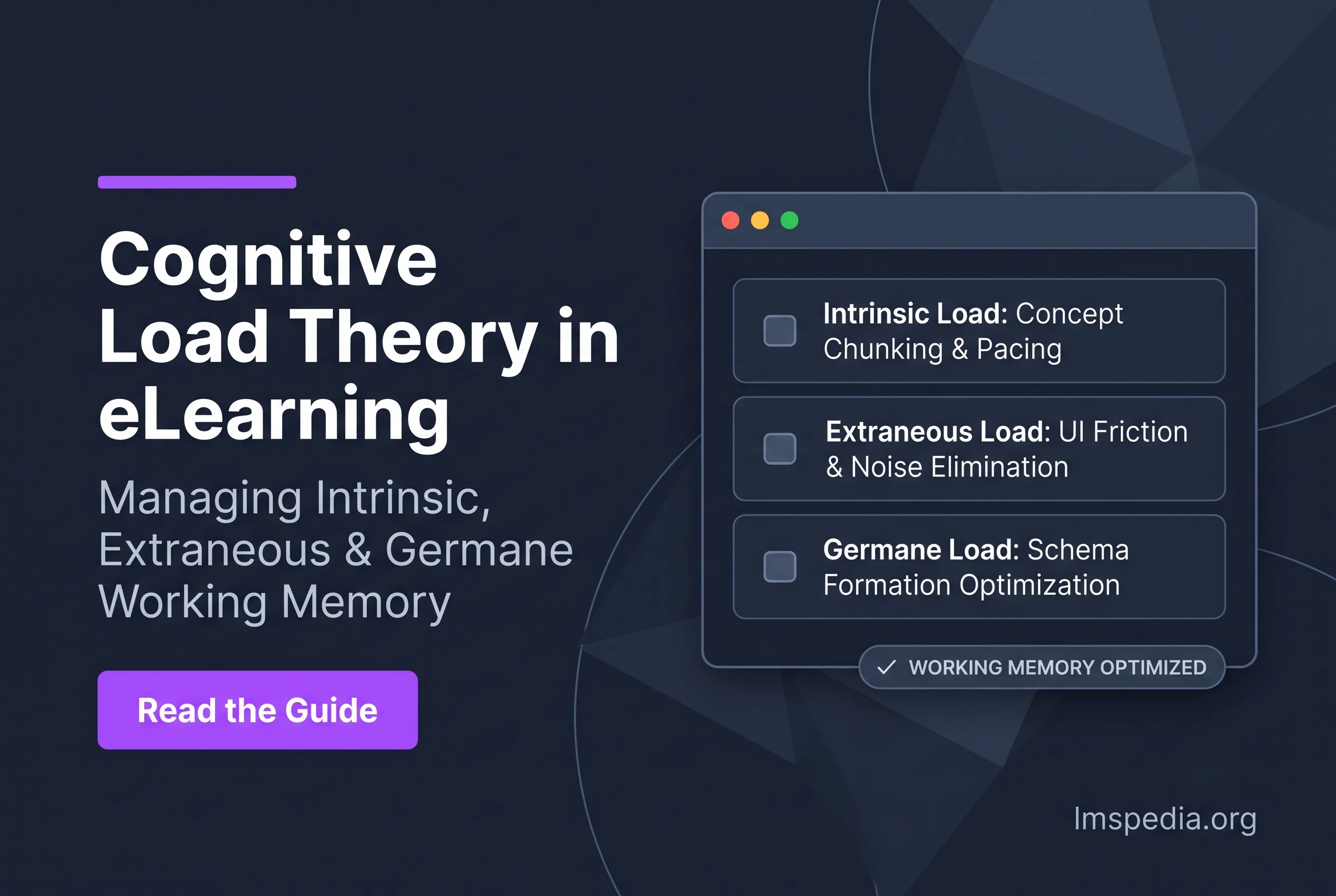
First, corporate training frequently overwhelms modern employees globally. Specifically, instructional designers often pack digital courses with excessive multimedia and heavy text. Consequently, this intense visual bombardment completely destroys actual knowledge retention. Therefore, mastering cognitive load theory elearning principles remains absolutely essential for developers. Historically, educational psychologists studied exactly how the human brain processes complex information. Ultimately, digital designers must actively respect these biological limits to build effective courses.
Furthermore, ignoring these psychological principles creates massive financial waste for organizations. Specifically, employees spend hours clicking through training modules without actually learning anything. Consequently, this directly translates to poor job performance and massive compliance risks. To dive deeper, you can explore foundational psychology concepts safely via our cognitive processes in learning guide. Ultimately, designing for the human brain guarantees a much higher training return on investment.
Key Takeaways

Human Working Memory is Highly Limited: Adult learners can absolutely only process and effectively retain roughly four to seven distinct pieces of entirely new information simultaneously before catastrophic cognitive overload rapidly occurs.
Extraneous Load Completely Destroys Retention: Confusing software navigation, annoying background music, and entirely irrelevant decorative graphics forcefully force the human brain to completely waste critical processing power on totally useless visual information.
The Redundancy Effect Severely Harms Learning: Displaying highly dense text directly on a screen while a narrator simultaneously reads that exact text verbatim overloads the brain completely; use spoken audio to narrate highly simple graphics instead.
Germane Load Actively Drives Real Learning: By aggressively eliminating completely unnecessary digital distractions, professional instructional designers actively free up vital mental capacity, safely allowing the learner to dedicate their full brainpower to actual memorization and permanent schema building.
Clean LMS Interfaces Absolutely Matter: A highly cluttered, overly complex Learning Management System introduces massive extraneous load before the actual educational course even formally launches; therefore, organizations must highly prioritize completely clean, totally minimalist software interfaces globally.
Understanding Sweller Cognitive Load Basics
Fundamentally, the human brain simply cannot process unlimited data simultaneously. Specifically, the pioneering concept of sweller cognitive load perfectly explains this biological bottleneck. In the late 1980s, educational psychologist John Sweller identified strict structural limits within human working memory. Consequently, he discovered that overloading this temporary memory bank halts learning entirely.
Furthermore, Sweller realized that traditional educational methods frequently caused massive mental fatigue. Specifically, asking learners to solve highly complex problems without prior knowledge guarantees failure. Therefore, he proposed a radical new framework for instructional design. For authoritative background, you can carefully review his foundational psychological research through the American Psychological Association (APA). Ultimately, his incredible research changed digital education forever.
The Architecture of Human Memory
Initially, instructional designers must understand the basic architecture of human memory. First, sensory memory briefly holds visual and auditory inputs for mere milliseconds. Next, the brain selectively moves highly relevant information into the working memory workspace. Consequently, this active workspace processes the new data and attempts to categorize it.
Finally, successful processing transfers the information permanently into long-term memory. However, this delicate transfer completely fails if the working memory becomes overloaded. Therefore, developers must carefully guard the working memory gateway at all times. Ultimately, flooding the senses directly prevents permanent memory formation.
The Strict Limits of Working Memory
Essentially, working memory acts as a temporary mental workspace for adult learners. However, this incredibly limited workspace only holds roughly four to seven distinct pieces of information at once. Furthermore, this highly vulnerable information degrades rapidly without active mental rehearsal.
Therefore, optimal working memory training design must intentionally prevent mental overflow completely. Specifically, you cannot present ten new technical concepts on a single digital slide. Consequently, if a corporate training module exceeds these rigid biological limits, the learner simply stops paying attention. Ultimately, their brain actively shuts down to protect itself from mental exhaustion.
The Three Types of Cognitive Load
Importantly, modern cognitive science explicitly divides overall mental effort into three distinct categories. Specifically, instructional designers must actively balance these three specific loads to ensure educational success. Consequently, ignoring any single category destroys the overall learning experience.
By understanding these specific categories, you can rapidly identify structural flaws in your existing curriculum. Furthermore, you can surgically redesign your modules to maximize actual knowledge retention. Below, we thoroughly explore exactly how to manage each specific cognitive load type effectively.
Managing Intrinsic Load
First, intrinsic load actively represents the inherent difficulty of the actual subject matter. For example, calculating advanced aerospace physics naturally demands more intrinsic load than learning basic addition. Consequently, instructional designers absolutely cannot completely eliminate intrinsic load from a curriculum. Instead, they must actively manage it by breaking highly complex topics into much smaller chunks.
Furthermore, teaching foundational vocabulary before explaining complex processes drastically lowers this specific load. Specifically, this technique allows learners to grasp simple parts before tackling the complex whole. Ultimately, this highly careful sequencing allows learners to actively master foundational concepts before advancing to harder material.
Reducing Extraneous Load
Next, extraneous load involves completely unnecessary mental effort caused strictly by poor instructional design. Specifically, confusing navigation menus, chaotic background animations, and distracting background music generate massive extraneous load. Consequently, the brain wastes vital processing power trying to understand the messy interface.
Therefore, reducing extraneous load absolutely serves as the primary goal of modern e-learning development. Crucially, you must ruthlessly eliminate any graphical element that does not directly support the learning objective. To learn how to properly balance learner engagement and visual simplicity, review our detailed guide on how to create interactive training modules.
Maximizing Germane Load
Finally, germane load represents the highly productive mental effort required to actively build permanent mental schemas. Essentially, this positive load measures the actual active process of learning and permanent memorization. Therefore, instructional designers actively want to maximize germane load throughout the course.
Specifically, asking learners to solve practice scenarios dramatically increases this positive mental friction. By eliminating distracting extraneous elements entirely, you rapidly free up valuable working memory capacity. Consequently, the learner can safely dedicate their full brainpower strictly to germane processing. Ultimately, this directly creates lasting behavioral changes within your workforce.
Concrete Cognitive Load Examples in Training
Naturally, theoretical psychology absolutely requires practical corporate application to become genuinely useful. Specifically, developers need concrete examples to truly understand these complex psychological concepts. Consequently, examining real-world design failures perfectly highlights the dangers of mental overload.
Below, we explore highly specific cognitive load examples that frequently plague corporate training environments globally. Specifically, deeply understanding these common pitfalls actively helps developers avoid catastrophic instructional failures.
Visual Distractions and the Split-Attention Effect
Often, novice course builders place dense text directly next to complex animated graphics. Consequently, the learner frantically attempts to actively read the text and watch the animation simultaneously. Biologically, the visual processing channel of the human brain quickly overloads and shuts down completely.
Instead, highly skilled designers physically integrate critical text directly into the graphic itself. Alternatively, they entirely remove the text and narrate the animation using clear spoken audio. Ultimately, this brilliant structural redesign safely splits the processing burden across both visual and auditory channels.
The Danger of the Redundancy Effect
Similarly, providing identical text and spoken audio simultaneously actively harms learning retention. For instance, if a voiceover narrator reads the exact text currently displayed on the screen verbatim, problems arise. Specifically, the brain wastes massive energy processing both identical inputs simultaneously to see if they match.
Consequently, this totally unnecessary comparison rapidly exhausts the limited working memory workspace. Therefore, you should display a simple conceptual graphic and use audio narration to explain it instead. For broader technical standards on multimedia learning architecture, consult the official glossary published by the Association for Talent Development (ATD).
Advanced Multimedia Principles for Load Management
Furthermore, cognitive psychologist Richard Mayer expanded heavily upon Sweller’s original theories. Specifically, Mayer developed strict multimedia design principles perfectly aligned with human biology. Consequently, adopting these specific principles completely transforms boring corporate training into highly effective digital learning.
Therefore, instructional design teams absolutely must memorize these vital layout guidelines. Ultimately, these specific rules actively dictate exactly where to place graphics, text, and audio.
Applying the Spatial Contiguity Principle
First, the spatial contiguity principle dictates that related text and graphics must sit physically close together. Specifically, placing a diagram on page one and the explanatory text on page two creates massive mental friction. Consequently, the learner must constantly flip back and forth to understand the basic concept.
Therefore, designers must place labels directly next to the specific parts of the diagram they describe. Ultimately, eliminating physical distance on the screen absolutely eliminates unnecessary mental search efforts.
Enforcing the Coherence Principle
Next, the coherence principle explicitly demands the total removal of irrelevant multimedia elements. Specifically, designers absolutely love adding decorative stock photos to make dry courses look prettier. However, these entirely irrelevant photos actively generate massive extraneous cognitive load instantly.
Consequently, the brain automatically tries to connect the random photo to the complex technical material. Therefore, you must ruthlessly delete any graphic, sound, or text that does not directly support the learning objective. Ultimately, a stark, highly minimalist design always creates vastly superior educational outcomes.
Utilizing the Signaling Principle
Additionally, the signaling principle involves using highly visible visual cues to guide learner attention directly. For example, highlighting a critical vocabulary word in bright red text instantly draws the human eye. Similarly, using bold arrows to point at a specific machine part rapidly focuses learner attention.
Consequently, these simple visual cues prevent the learner from wasting energy scanning the entire screen. Therefore, the brain immediately knows exactly where to direct its limited processing power. Ultimately, intelligent signaling dramatically accelerates the actual speed of knowledge acquisition.
Measuring Cognitive Overload in Learners
Crucially, instructional designers must actively verify that their courses do not overwhelm employees. Specifically, guessing about mental fatigue frequently leads to disastrous corporate training rollouts. Consequently, administrators need concrete methodologies to actively measure cognitive friction within their digital curriculum.
Therefore, observing user behavior provides massive insights into the actual structural design quality. Ultimately, catching these specific design flaws early saves the organization thousands of wasted payroll hours.
Identifying Behavioral Warning Signs
First, administrators must closely monitor digital completion rates and specific module dropout times. Specifically, if eighty percent of learners abandon a course on slide four, slide four likely contains massive extraneous load. Consequently, this massive drop-off rate serves as a blaring alarm for instructional designers.
Furthermore, incredibly low quiz scores on a highly specific topic indicate severe intrinsic load mismanagement. Therefore, designers must immediately revisit that specific section and chunk the complex material further. Ultimately, basic data analytics quickly highlight exactly where the human brain is breaking down.
Utilizing Direct Learner Feedback
Additionally, simply asking learners about their mental effort yields incredibly valuable structural data. Specifically, post-course surveys should include questions specifically targeting mental fatigue and course clarity. For instance, asking if the background music distracted them provides immediate, highly actionable design feedback.
Consequently, developers must actively swallow their pride and listen to this critical end-user feedback. Therefore, if learners constantly complain about a confusing navigation menu, you must redesign it immediately. Ultimately, the subjective experience of the learner perfectly dictates the absolute reality of the cognitive load.
Comparing LMS Platforms for Cognitive Optimization
Crucially, delivering perfectly optimized educational content requires a remarkably clean, distraction-free Learning Management System. Specifically, cluttered software interfaces instantly generate massive extraneous load before the actual course even begins. Consequently, a bad platform totally ruins a perfectly designed educational module.
Therefore, enterprise organizations must intentionally procure highly streamlined digital training platforms. Ultimately, the software itself must actively fade into the background during the learning process.
| Platform / Solution | Primary Focus | Cognitive Load Management Strength |
|---|---|---|
| SimpliTrain | Versatile training operations and resource scheduling. | Features an exceptionally clean, distraction-free learner interface that actively reduces extraneous navigational load. |
| Docebo | Global enterprise learning and AI delivery. | Utilizes personalized, widget-based dashboards to highlight only immediately relevant training tasks for users. |
| TalentLMS | Accessible, cloud-based corporate training. | Offers a highly minimalist, intuitive user interface designed specifically for rapid onboarding and low technical friction. |
Ultimately, selecting the correct enterprise software fundamentally guarantees a frictionless user experience from login to completion. To completely explore exactly how complex administrative configurations impact end users, review our guide on how to architect secure LMS user roles and permissions.
Strategic Implementation for Instructional Designers
Undoubtedly, truly optimizing adult learning requires continuous organizational commitment and strict quality assurance. First, learning organizations must proactively evaluate their entire current curriculum libraries for severe neurological bottlenecks. Specifically, they must rapidly identify outdated legacy courses currently suffering from severe cognitive overload.
Consequently, rewriting these bloated legacy courses represents a massive initial financial investment. To accurately diagnose these critical organizational skill gaps and design flaws, utilize highly modern training needs assessment tools. Ultimately, this strategic audit dramatically improves overall organizational competence and safety.
Conducting Extraneous Load Audits
Furthermore, training directors must legally mandate strict multimedia guidelines for all internal course developers. Specifically, every single new corporate module must undergo a rigorous extraneous load audit prior to live deployment. Consequently, a senior designer must review the module specifically to hunt for and delete irrelevant graphics.
Therefore, this mandatory peer-review process prevents overly enthusiastic junior developers from cluttering the screen. Ultimately, this strict internal quality assurance protocol ensures absolute consistency across the entire corporate training library.
Standardizing Corporate Navigation
Additionally, multimedia designers must strictly utilize completely consistent navigation layouts across all corporate modules. Specifically, the “Next” button must always reside in the exact same physical location on every single slide. Consequently, learners rapidly build a mental schema for how to operate the specific training software.
Therefore, highly predictable software interfaces actively prevent learners from wasting precious brainpower figuring out how to click the final submission button. To clearly see exactly how massive global enterprises securely manage these digital assets, deeply review the best training management software solutions.
The Role of Microlearning in Load Management
Crucially, the overall length of the training session drastically impacts cognitive fatigue. Specifically, staring at a computer screen for an hour actively depletes working memory capacity completely. Consequently, the learner physically cannot absorb any new information during the final twenty minutes.
Therefore, modern organizations actively utilize microlearning strategies to strictly manage session duration. Ultimately, breaking massive courses into tiny pieces perfectly respects the biological limits of the human brain.
Breaking Content into Modules
First, instructional designers must aggressively chop hour-long lectures into highly specific five-minute modules. Specifically, each tiny module must cover exactly one distinct learning objective perfectly. Consequently, the learner can fully dedicate their working memory to mastering that single concept rapidly.
Furthermore, this modular approach allows learners to take natural mental breaks between distinct technical topics. Therefore, the brain gains vital time to transfer the new knowledge securely into long-term memory. Ultimately, microlearning absolutely represents the most effective practical application of cognitive load theory.
Optimizing Corporate Learning Outcomes
In reality, the human brain absolutely remains the ultimate gatekeeper of all corporate training success. While flashy 3D graphics and highly complex interactive games look incredibly impressive to executive stakeholders, they frequently destroy actual knowledge transfer. Therefore, professional instructional designers must actively function as fierce, completely uncompromising protectors of learner working memory.
By ruthlessly eliminating extraneous graphical distractions, organizations actively empower employees to focus entirely on productive learning. Furthermore, carefully sequencing highly complex technical topics correctly completely manages the inherent difficulty of the difficult subject matter. Ultimately, deeply respecting the rigid biological limits of cognitive science entirely ensures your digital training programs deliver measurable, permanent behavioral change.
Finally, truly mastering these psychological principles perfectly elevates your entire training department from an administrative burden into a massive strategic corporate asset. For a much deeper dive into the incredible neurological science of permanent memory formation, deeply consult the peer-reviewed clinical research published by the National Institutes of Health (NIH).
FAQ
Q1. What exactly is Cognitive Load Theory in eLearning?
Fundamentally, Cognitive Load Theory serves as an advanced instructional design framework based entirely on the rigid biological limits of human memory. Specifically, it explicitly suggests that actual learning completely degrades if the educational material aggressively overwhelms the highly limited capacity of working memory. Therefore, professional course creators must incredibly carefully design e-learning modules to actively minimize absolutely all unnecessary mental friction.
Q2. What is the exact difference between intrinsic and extraneous cognitive load?
Essentially, intrinsic load relates strictly to the inherent, totally unavoidable technical difficulty of the highly specific subject matter being taught. Conversely, extraneous load directly refers to entirely avoidable, useless mental effort caused purely by completely bad instructional design. For example, actively teaching complex aerospace mathematics creates heavy intrinsic load, while placing a totally confusing navigation menu on the final math test creates massive extraneous load.
Q3. How exactly does psychologist John Sweller define rigid working memory limits?
In his incredible foundational research, John Sweller successfully identified that working memory actively acts as a highly restrictive, temporary mental bottleneck. Specifically, it can absolutely only hold a remarkably small amount of completely novel information at any one specific time. Furthermore, if instructional designers forcefully push too much visual information through this tight bottleneck simultaneously, the learner experiences complete cognitive overload and immediately stops absorbing data.
Q4. How can professional instructional designers actively reduce dangerous extraneous load?
Primarily, skilled designers rapidly reduce this heavy burden by ruthlessly removing absolutely all unnecessary decorative graphics, annoying background music, and overly complex interface animations. Additionally, they absolutely should precisely align related text and specific images physically incredibly close together directly on the digital screen. Ultimately, totally eliminating the dangerous “split-attention effect” actively prevents the exhausted learner from completely wasting mental energy frantically scanning back and forth across the computer monitor.
Q5. Why is reading text aloud verbatim considered extremely bad for digital e-learning?
Biologically, simultaneously presenting the exact same critical information via written text and spoken audio immediately triggers the dangerous redundancy effect. Consequently, the human brain completely wastes vital cognitive energy desperately attempting to simultaneously process and reconcile both completely identical inputs at once. Instead, modern instructional design best practices strictly dictate using highly concise spoken audio to solely narrate a heavily simplified visual graphic.