

Most people assume that if someone attends a training session, learning automatically happens. In reality, that assumption is wrong. During the past few years working with digital learning content and training programs, I’ve repeatedly seen the same pattern: companies invest heavily in training programs, yet employees forget most of what they learned within weeks. The reason usually isn’t lack of effort. It’s the learning model being used. Many training systems still rely heavily on behavioral learning, repetition, quizzes, and rewards, while ignoring cognitive learning processes such as understanding, mental models, and knowledge integration. This is where the debate around cognitive learning vs behavioral learning becomes important.
Both theories explain how humans learn, but they approach the problem from completely different perspectives. Understanding the difference can help educators, trainers, and learning designers build far more effective learning systems.
What Is Cognitive Learning?
Cognitive learning focuses on how the brain processes information. Instead of seeing learning as a reaction to external stimuli, cognitive theory views learning as an active mental process involving thinking, understanding, and memory organization. Psychologists such as Jean Piaget, Jerome Bruner, and Lev Vygotsky developed this perspective by studying how people build internal knowledge structures. In simple terms, cognitive learning is about understanding ideas rather than memorizing actions.
A Real Observation From Teaching Technical Skills
When I’ve coached junior developers or content strategists, I’ve noticed something interesting. People who learn through pure repetition (for example memorizing syntax, formulas, or templates) tend to struggle when a problem changes slightly. But learners who understand why something works, the logic behind the system, adapt quickly. That difference reflects the core principle of cognitive learning: learning happens through understanding relationships between ideas.
Common Cognitive Learning Processes
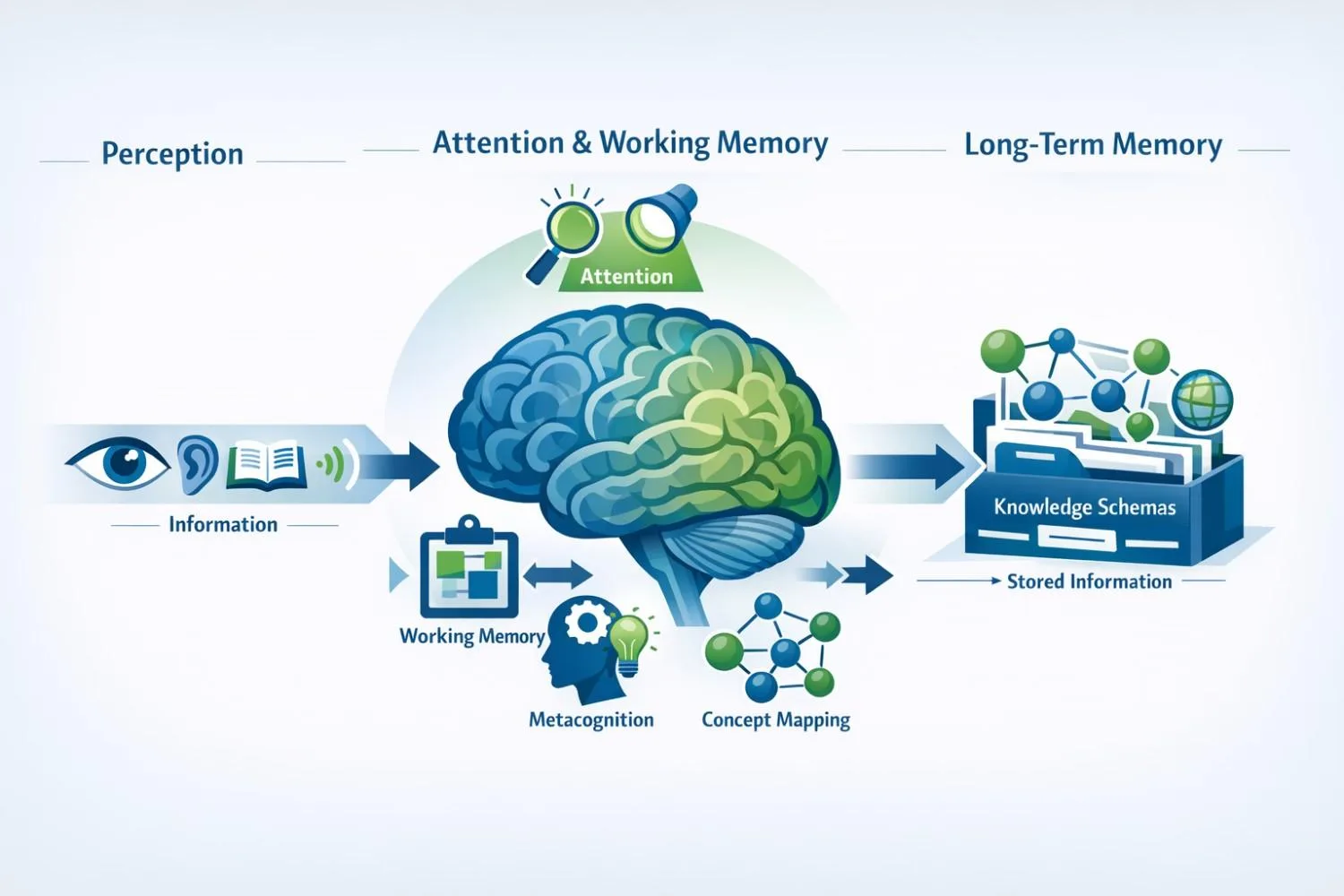
Cognitive learning involves several mental processes:
- Information processing – The brain organizes and interprets incoming information.
- Schema formation – Knowledge is stored in structured mental frameworks called schemas.
- Metacognition – Learners become aware of how they think and adjust their learning strategies.
- Conceptual integration – New knowledge connects with existing knowledge.
These processes explain why cognitive learning tends to produce deeper long-term understanding.
What Is Behavioral Learning?
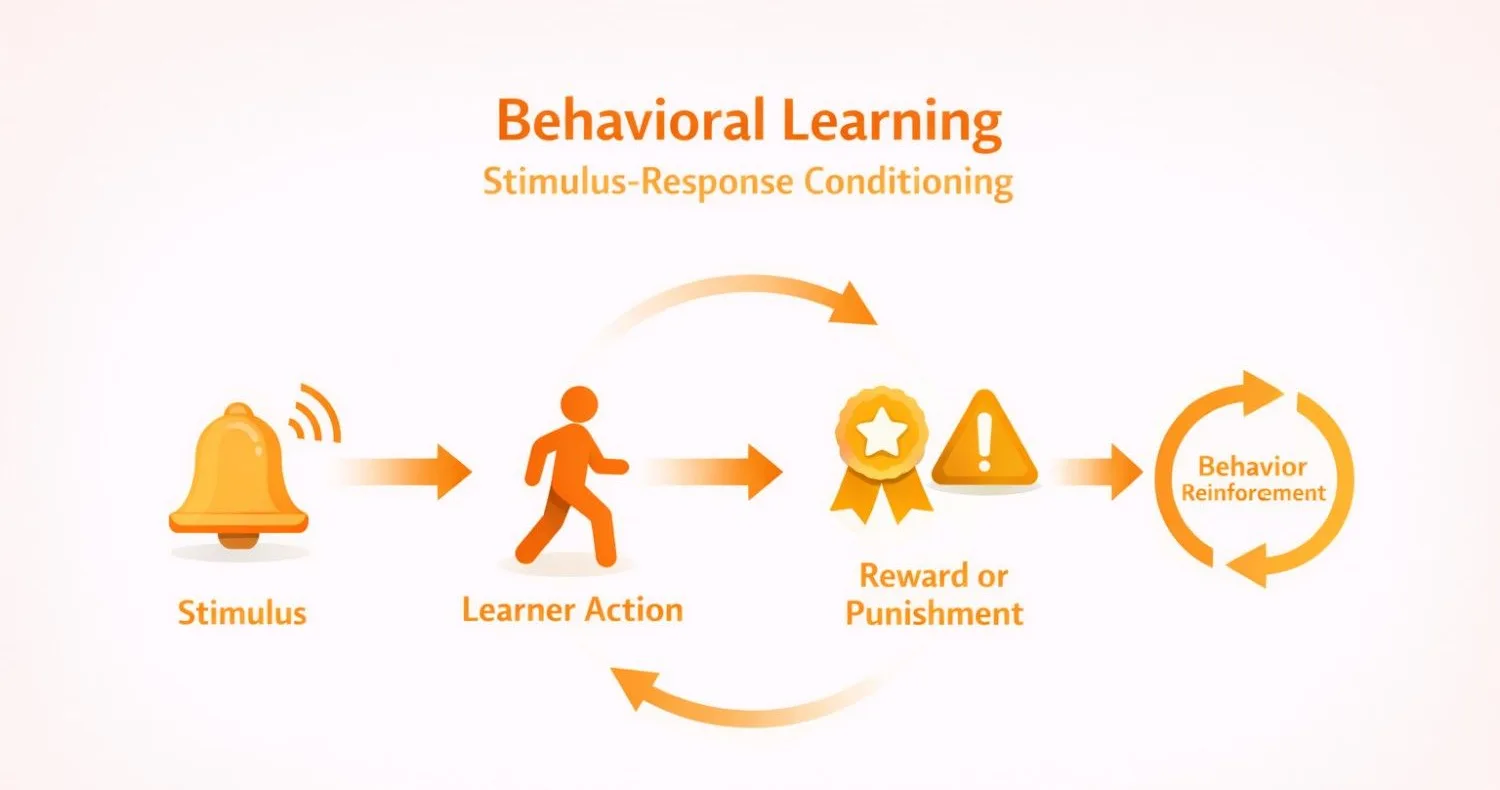
Behavioral learning, also called behaviorism, takes a completely different approach. Instead of studying internal mental processes, behaviorism focuses on observable behavior. According to behavioral theory, learning occurs when behavior changes due to reinforcement, punishment, or conditioning. This theory became influential through psychologists such as:
- Ivan Pavlov
- John Watson
- B.F. Skinner
Their research demonstrated how behavior can be shaped through stimulus-response associations.
Example: Workplace Compliance Training
Behavioral learning works particularly well in structured environments. For example, when training employees on safety procedures, organizations often rely on:
- step-by-step instructions
- repetition
- feedback
- rewards for correct behavior.
Over time, these mechanisms reinforce consistent behavior. The goal isn’t necessarily deep understanding, it’s reliable execution.
Cognitive Learning vs Behavioral Learning: Key Differences
To understand how these approaches differ, it helps to compare them directly.
| Dimension | Cognitive Learning | Behavioral Learning |
|---|---|---|
| Focus | Internal thinking processes | Observable behavior |
| Learning mechanism | Information processing | Stimulus-response conditioning |
| Learner role | Active thinker | Passive responder |
| Teaching style | Exploration & problem solving | Repetition & reinforcement |
| Measurement | Conceptual understanding | Behavioral outcomes |
| Example tools | Knowledge management systems | Gamified training apps |
Real-World Applications of Both Learning Models
Cognitive Learning in Problem-Solving Environments
Cognitive learning is essential in fields where understanding and adaptability matter. For example:
- programming
- strategic planning
- academic research
- design thinking.
In these environments, learners must build mental models that allow them to solve unfamiliar problems.
Behavioral Learning in Skill Automation
Behavioral learning excels when the goal is consistent performance. Examples include:
- manufacturing procedures
- safety compliance
- medical protocols
- athletic training.
Here the goal is automatic behavior, not theoretical exploration.
The 2026 Hybrid Reality: Why Pure Behaviorism Is Failing in Remote Work
One of the biggest shifts happening today is the transition to remote and AI-assisted work environments.
In distributed teams, employees are constantly required to:
- solve unfamiliar problems
- collaborate asynchronously
- integrate knowledge from multiple tools.
- In these situations, purely behavioral training often fails.
Employees who were trained only through step-by-step behavioral instructions struggle when the environment changes. Cognitive learning becomes critical because it equips people with mental frameworks for problem solving.
Where AI Fits Into This
Interestingly, modern Large Language Models (LLMs) operate much closer to behavioral systems than cognitive ones. LLMs predict outputs based on patterns, essentially a complex form of stimulus-response prediction. Humans, however, provide the cognitive oversight required to evaluate whether those outputs make sense. This is why modern digital literacy training increasingly emphasizes cognitive reasoning skills alongside tool usage.
When Should You Use Cognitive vs Behavioral Learning?
From a practical standpoint, choosing the right learning approach depends on the objective.
Use cognitive learning when:
- critical thinking is required
- learners must transfer knowledge across contexts
- conceptual understanding is important.
Use behavioral learning when:
- consistency matters more than creativity
- procedures must be followed precisely
- rapid skill automation is required.
The most effective learning systems combine both approaches strategically.
How Modern LMS Platforms Combine Both Approaches
Modern Learning Management Systems increasingly integrate both theories.
Behavioral elements include:
- gamification
- progress tracking
- reward systems.
Cognitive features often include:
- scenario-based simulations
- problem-solving challenges
- spaced repetition systems
- collaborative knowledge exercises.
The result is a hybrid learning environment that reinforces behavior while still encouraging deeper thinking.
Which Learning Theory Is Better?
The debate between cognitive learning vs behavioral learning is often framed as a competition, but that framing misses the bigger picture. Behavioral learning is excellent for skill automation and habit formation. Cognitive learning is essential for understanding, reasoning, and innovation. In modern education, training, and digital learning environments, the most successful programs combine both models. They reinforce correct behavior while simultaneously helping learners build mental frameworks that allow them to adapt, think critically, and solve new problems. And in an increasingly complex, AI-driven world, that balance may be more important than ever.
FAQ
Q1. What is the main difference between cognitive and behavioral learning?
Cognitive learning focuses on mental processes such as thinking, memory, and understanding, while behavioral learning focuses on observable behavior shaped through reinforcement and conditioning.
Q2. Why is cognitive learning important in modern workplaces?
Modern work environments require problem solving, critical thinking, and adaptability, all of which depend heavily on cognitive learning processes.
Q3. Is behaviorism outdated?
No. Behavioral learning remains highly effective for procedural training, skill practice, and habit formation.
Q4. Can cognitive and behavioral learning be used together?
Yes. Most modern education systems and LMS platforms combine both approaches to maximize learning effectiveness.
Q5. How do digital learning platforms use behavioral learning?
Platforms often use behavioral techniques such as gamification, points, badges, and rewards to reinforce learning behaviors.