

[key_takeaway]
What Is Cognitive Learning Theory?
Cognitive learning theory is a framework in learning psychology that explains how people acquire, process, organize, and recall knowledge. Unlike behavioral approaches that focus exclusively on observable actions, what a learner does, cognitive learning theory opens up what happens inside the learner’s mind during the learning process.
The distinction matters more than it sounds. In a behavioral model, a learner who passes a quiz has “learned.” In a cognitive model, the question is deeper: did the learner build a mental structure that allows them to apply that knowledge in a new situation? Did they connect the new information to something they already understood? Or did they simply memorize a sequence of answers long enough to clear the test?
That second set of questions is where cognitive learning theory operates. It examines the mental processes, attention, perception, memory encoding, schema formation, retrieval, that constitute the brain’s information processing system and determine whether input moves from a fleeting thought into durable, transferable knowledge. The cognitive approach to learning treats the mind not as a passive container but as an active processor, constantly interpreting, categorizing, and restructuring incoming information.
Why does this matter in the current conditions? In a knowledge economy that demands continuous upskilling, in workplaces where employees are expected to learn new systems every quarter, and in classrooms where understanding has replaced memorization as the goal, the mechanisms of how people actually think and learn are no longer abstract psychology. They are operational design principles. Every well-designed training program, every effective lesson plan, every LMS workflow that produces retention rather than completion-rate vanity metrics is, whether it knows it or not, applying cognitive learning theory.
Origins and Theoretical Foundations of Cognitive Learning Theory
Cognitive learning theory did not appear fully formed. It emerged as a corrective, a direct challenge to the behaviorist psychology that dominated the first half of the twentieth century.
Behaviorism, associated primarily with B.F. Skinner and John Watson, treated the mind as a black box. What happened between stimulus and response was unknowable and, behaviorists argued, irrelevant. Learning was a function of reinforcement: reward the desired behavior, punish the undesired one, and the organism, rat, pigeon, or student, would adapt accordingly.
This worked well enough for explaining habit formation. It worked poorly for explaining how a child who has never encountered a word before can produce a grammatically correct sentence, or how an engineer transfers problem-solving methods from one domain to an entirely unrelated one. The black box, it turned out, was doing quite a lot.
Piaget and the Architecture of Thought
Jean Piaget, working in the 1930s, built the theoretical architecture that cognitive learning theory still rests on. His core insight was deceptively simple: learners do not absorb information passively. They actively construct mental frameworks , what Piaget called schemas, that organize and interpret experience.
Schemas are not static files. They are living structures that change through two complementary processes. Assimilation is the act of fitting new information into an existing schema, a child who knows what a dog looks like seeing a new breed and filing it under “dog.” Accommodation is the more demanding process of modifying or creating entirely new schemas when existing ones cannot handle the incoming information, that same child encountering a cat for the first time and realizing that “four legs and fur” does not automatically mean “dog.”
The constant tension between assimilation and accommodation, regulated by what Piaget called equilibration, is what drives cognitive development. It is also, in practice, what makes some training programs effective and others forgettable. Training that only asks learners to assimilate, adding facts to existing mental models, is easy but shallow. Training that forces accommodation, restructuring how someone thinks about a process or concept, is harder to design, harder to deliver, and dramatically more durable.
Bruner and the Discovery Principle
Jerome Bruner, working at Harvard from the 1950s onward, pushed the cognitive framework in a more practical direction. Where Piaget described how thought develops, Bruner asked how instruction should be designed to work with those developmental processes rather than against them.
Three ideas from Bruner remain foundational. Discovery learning holds that learners build stronger, more transferable understanding when they uncover principles themselves rather than receiving pre-packaged answers. This does not mean unstructured exploration, Bruner was explicit that the teacher’s role is to guide, not to disappear. Scaffolding, a term Bruner popularized with David Wood and Gail Ross in 1976, describes the temporary, structured support a teacher provides to help a learner tackle tasks slightly beyond their current ability. As the learner gains competence, the scaffolding is withdrawn. The spiral curriculum proposes that complex subjects should be introduced simply, then revisited at increasing levels of sophistication, a structure that maps directly onto how schemas grow through successive assimilation and accommodation cycles.
Ausubel and the Priority of Prior Knowledge
David Ausubel’s contribution was simultaneously simpler and more immediately actionable than either Piaget’s or Bruner’s. His famous principle – “The most important single factor influencing learning is what the learner already knows. Ascertain this and teach him accordingly”, reoriented instructional design around a single variable: prior knowledge.
Ausubel drew a hard line between meaningful learning and rote learning. Meaningful learning occurs when new information connects substantively to existing cognitive structures. Rote learning memorization without connection, can produce short-term recall, but the information has no anchor and deteriorates rapidly. Ausubel called this “obliterative subsumption”: without meaningful connections, learned material is gradually absorbed back into the general cognitive structure until it becomes indistinguishable and unrecoverable.
To bridge the gap, Ausubel developed the concept of advance organizers: introductory materials presented at a higher level of abstraction than the content to follow, designed to activate relevant prior knowledge and create a mental framework for new information. In corporate training environments, this is the difference between launching into a software tutorial with no context and beginning with a brief explanation of why the software exists, what problem it solves, and how it connects to tools the learner already uses. The advance organizer costs three minutes of instructional time and can double retention.
Notably, Ausubel was a critic of Bruner’s discovery approach, arguing that well-organized reception learning (direct instruction) is more efficient for most educational contexts. This tension , discovery versus direct instruction, remains one of the active debates in learning science, and in practice, the most effective instructional designs tend to use both strategically.
Core Principles of Cognitive Learning Theory
Active Learning
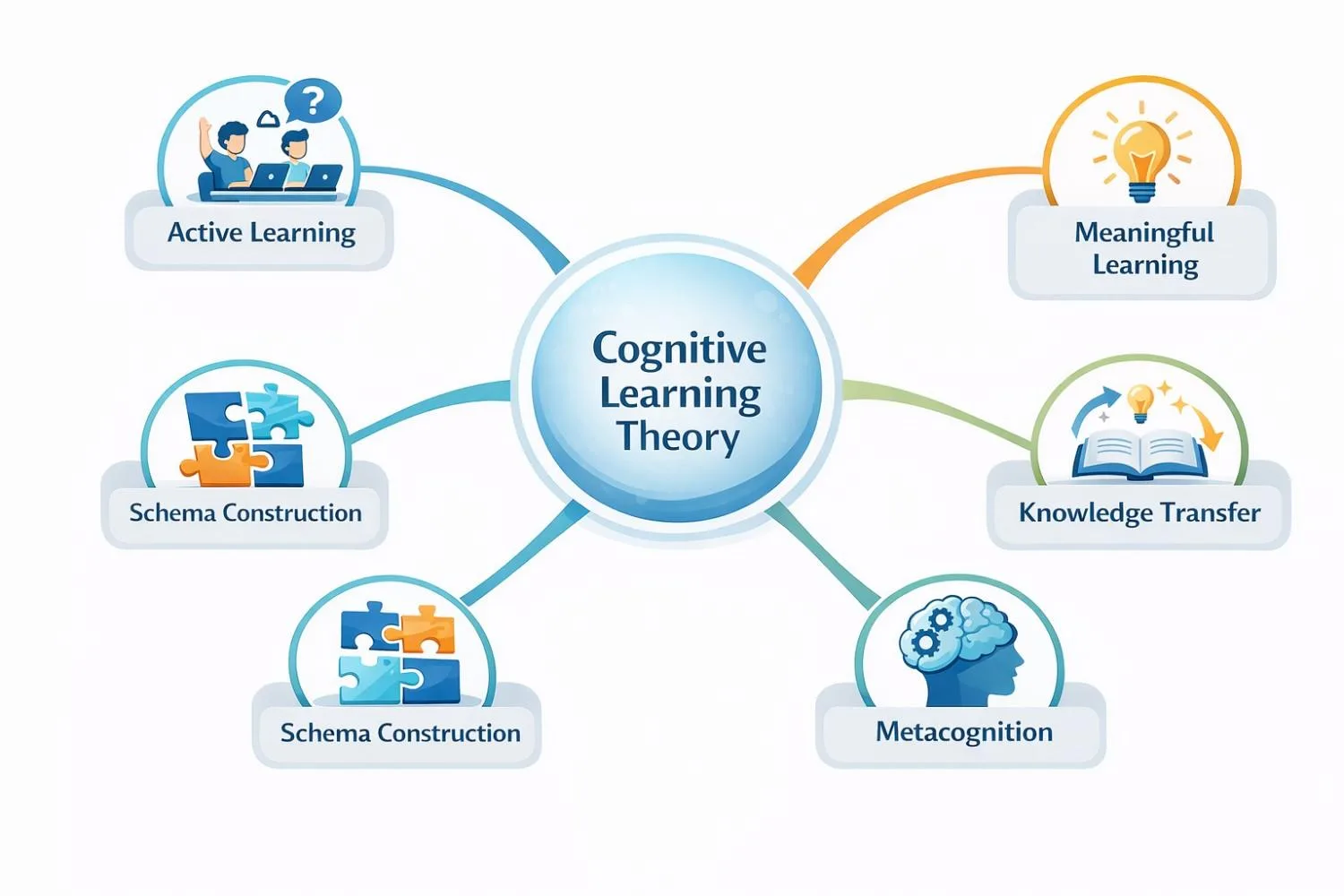
The term is overused, but the cognitive definition is precise: active learning means the learner’s cognitive processes, not just their hands or their mouths, are engaged. A student sitting silently in a lecture who is comparing what they hear to what they already know, identifying contradictions, and mentally reorganizing their understanding is more cognitively active than a student in a group activity who is going through physical motions without processing the content.
Educational psychology research consistently supports the impact. A meta-analysis by Mayer (2004) found that students who actively constructed meaning through assimilation and accommodation retained 67% more content than those receiving purely passive instruction. The implication for instructional design is that the format matters less than the cognitive demand: a well-designed lecture that provokes schema restructuring can outperform a poorly designed “interactive” exercise.
Meaningful Learning
Ausubel’s principle in practice: for new information to persist in long-term memory, it must connect to existing knowledge structures. Learning designers working in corporate L&D environments encounter this constantly. An employee with ten years of experience using one CRM system can learn a new CRM system in a fraction of the time a novice would require, not because they are smarter, but because they have existing schemas (data fields, pipeline stages, reporting logic) that the new information can attach to.
The practical implication is that instruction should explicitly activate prior knowledge before introducing new content. In classroom settings, this might take the form of pre-lesson questions or concept maps. In corporate settings, it might mean beginning a training module with a brief “what you already know” review that anchors the new material to existing workflows.
Knowledge Organization: Schemas
Schemas are the structural currency of cognitive learning. They are not individual facts but organized clusters of related information that allow a learner to interpret, predict, and respond to situations efficiently. The difference between a novice and an expert in any domain is primarily a difference in schema richness and interconnection; experts have more schemas, more complex schemas, and more links between them.
This has direct implications for how content should be organized. Information presented in isolated, disconnected units, as is common in compliance training, produces isolated, disconnected schemas that are difficult to retrieve and apply. Information organized around central concepts with explicit connections produces integrated schemas that transfer to novel situations.
Metacognition
Metacognition, thinking about thinking, is where cognitive learning theory produces some of its most measurable outcomes. The Education Endowment Foundation rates metacognitive strategies at seven additional months of progress for learners, making it one of the highest-impact interventions available.
In practice, metacognition involves three capabilities: planning (how will I approach this task?), monitoring (is my current approach working?), and evaluating (did my strategy produce the result I wanted?). Training programs that teach learners to ask these questions, rather than simply delivering content, produce learners who can regulate their own development beyond the training environment.
Problem-Solving and Transfer of Knowledge
The ultimate test of cognitive learning is transfer: can the learner apply what they learned in one context to a different, novel situation? This is what separates someone who passed a training quiz from someone who can actually use the knowledge when the situation does not match the quiz questions.
Transfer depends on schema quality. Well-organized, deeply connected schemas transfer more readily than isolated facts. Problem-based learning, where learners encounter realistic problems before receiving instruction, builds schemas that are inherently structured around application rather than recall.
Cognitive Processes Involved in Learning
Attention
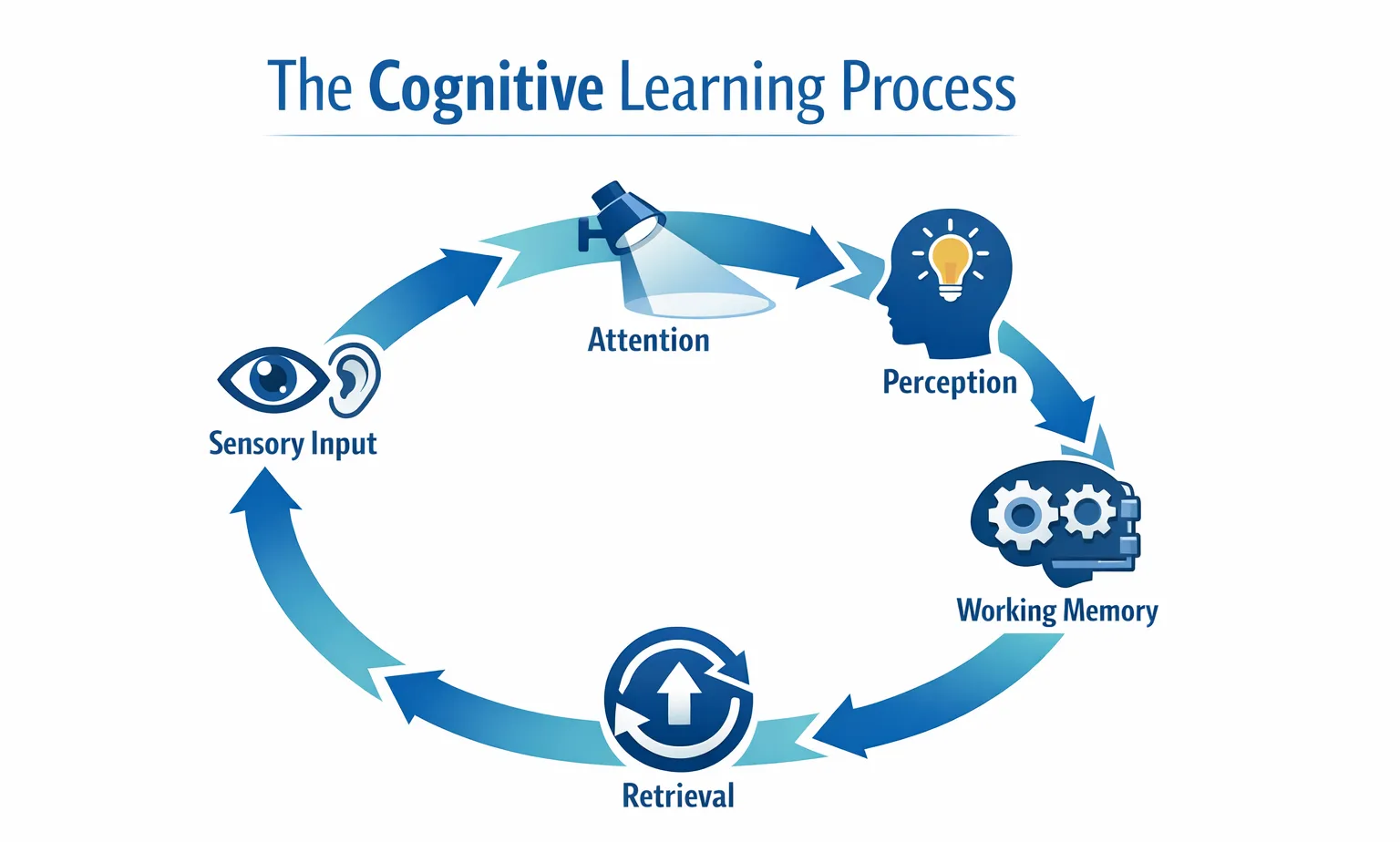
Attention is the gateway process. Sensory memory receives an enormous volume of input, visual, auditory, tactile, and filters the vast majority of it out within milliseconds. Only information that passes the attention filter reaches working memory for processing. In instructional design, this means that anything competing for attention with the core content, cluttered slides, irrelevant animations, background noise, directly reduces learning by diverting the filter.
Perception
Once information passes the attention filter, perception organizes and interprets it. Crucially, perception is not objective. It is shaped by existing schemas. A learner with prior experience in project management perceives a new project methodology through the lens of what they already know, automatically comparing, contrasting, and categorizing. A learner without that foundation perceives the same information as an undifferentiated mass of new terms. This is why prior knowledge assessment is not optional in effective instructional design, it determines how learners will perceive the material, not just whether they will remember it.
Memory: Working, Short-Term, and Long-Term
Working memory is the bottleneck. Its capacity is severely limited, research consistently points to roughly four chunks of information that can be processed simultaneously, with a duration of approximately twenty seconds without active rehearsal. This is the physiological constraint that cognitive load theory is built on.
Long-term memory, by contrast, has virtually unlimited capacity and duration. The challenge is not storage space but encoding, the process of converting working memory contents into long-term memory structures. Effective encoding requires meaningful connection to existing schemas (Ausubel), manageable processing demands (Sweller), and active engagement with the material (Piaget, Bruner).
Retrieval – accessing stored information when needed, is not a simple playback process. Each act of retrieval strengthens the memory trace, which is why retrieval practice is one of the most effective learning strategies available. Conversely, information that is stored but never retrieved gradually becomes less accessible, even though it remains in long-term memory. The forgetting curve, first documented by Hermann Ebbinghaus in 1885, shows that memory decays rapidly without reinforcement — but each spaced retrieval resets and flattens the curve.
Cognitive Learning Theory vs. Other Learning Theories
Understanding where cognitive learning theory sits relative to other frameworks helps practitioners choose the right approach for specific learning objectives. No single theory covers every situation. For a comprehensive side-by-side analysis, see our learning theories comparison guide.
Cognitive vs. Behavioral Learning Theory
| Dimension | Cognitive Learning Theory | Behavioral Learning Theory |
|---|---|---|
| Focus | Internal mental processes | Observable behavior |
| Learning mechanism | Schema construction and reorganization | Stimulus-response reinforcement |
| Role of the learner | Active processor of information | Responder to environmental stimuli |
| Assessment emphasis | Understanding and transfer | Demonstrated behavioral change |
| Best suited for | Complex problem-solving, conceptual understanding, knowledge transfer | Procedural skills, compliance behaviors, habit formation |
| Limitation | Requires sophisticated instructional design | Does not develop deep understanding or transferability |
In practice, the choice is not either-or. A compliance training program might use behavioral reinforcement for procedural steps (lock-out/tag-out sequences, for instance) while using cognitive strategies for the underlying safety reasoning that enables judgment in unexpected situations.
Cognitive vs. Social Learning Theory
Social cognitive theory, developed primarily by Albert Bandura, emphasizes that learning is inherently social. People learn by observing others, modeling behavior, and adjusting based on perceived consequences, not just their own experience but the experience they see others having.
The overlap with cognitive learning theory is substantial: both acknowledge internal mental processing. The distinction is that social cognitive theory adds the environment and social context as central variables. In L&D applications, this translates to strategies like peer modeling, collaborative learning environments, and mentorship programs, all of which leverage social observation to accelerate schema development.
Cognitive vs. Constructivist Learning
This is the most nuanced comparison because the two frameworks share roots in Piaget’s work. Both emphasize internal knowledge construction and reject the idea that learners are blank slates. The operational difference matters for instructional designers. Cognitivists accept that meaningful learning can occur through well-designed direct instruction, lectures, readings, and demonstrations. Constructivists insist that learners must actively construct knowledge through experience, collaboration, and reflection. In the classroom, this translates to a different tolerance for teacher-directed instruction: a cognitivist is comfortable with an excellent lecture followed by application exercises; a constructivist is more likely to begin with the application and build understanding through structured reflection.
Cognitive Load Theory and Its Role in Learning
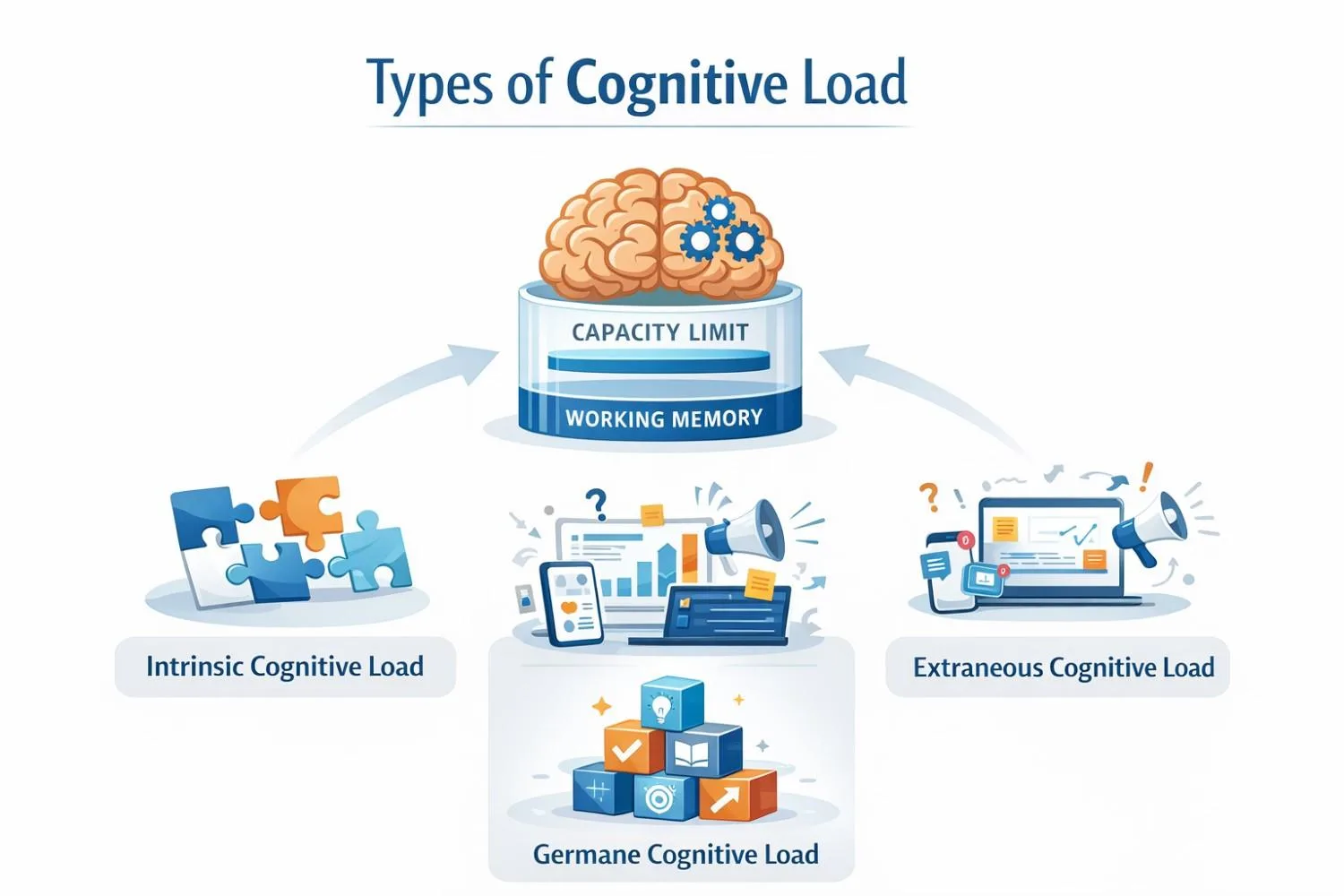
Cognitive load theory, developed by John Sweller beginning in the late 1980s, takes the working memory constraints identified by cognitive psychology and turns them into actionable instructional design principles. It is arguably the most practically influential branch of cognitive learning theory for anyone designing training or educational content.
The central premise: working memory has a hard capacity limit. When the total cognitive demand of a learning experience exceeds that capacity, learning breaks down, not because the material is too hard, but because the presentation has overwhelmed the processing system.
Sweller distinguished three types of load. Intrinsic cognitive load is the inherent difficulty of the material, determined by how many elements interact with each other and the learner’s prior knowledge. You cannot reduce the intrinsic complexity of differential calculus, but you can break it into sub-components that are learned separately before being combined. Extraneous cognitive load is processing demand created by poor instructional design, text-heavy slides, split-attention formats, irrelevant information. This is entirely under the designer’s control and should be minimized ruthlessly. Germane cognitive load is the processing devoted to schema construction, the actual learning. The goal of instructional design, in cognitive load terms, is to reduce extraneous load so that more of the learner’s limited working memory is available for germane processing.
The implementation principle is straightforward even if the execution requires skill: present information in a way that the learner’s working memory can actually handle. Chunk complex material. Integrate text and visuals rather than separating them. Eliminate content that does not directly serve the learning objective. Sequence material so that each new element builds on the previous one. These are not aesthetic preferences, they are engineering constraints imposed by the architecture of human cognition.
Cognitive Learning Strategies
These are the applied techniques derived from cognitive learning theory that have the strongest empirical support. Each one maps directly to one or more cognitive mechanisms described above. For a deeper exploration of each technique with implementation guides, see our dedicated resource on cognitive learning strategies.
1. Scaffolding
Derived from Bruner’s work, scaffolding provides temporary support structures that are progressively withdrawn as the learner develops competence. In education, this might mean a teacher providing a partially completed concept map that students finish independently. In corporate onboarding, it might mean a “buddy system” for the first two weeks that transitions to independent work with periodic check-ins.
The key design principle: the scaffolding must be specific to the learner’s current gap. Generic support that does not address where the learner is actually stuck adds extraneous cognitive load rather than reducing it.
2. Spaced Repetition
Information reviewed at gradually increasing intervals is retained far more effectively than information crammed in a single session. This is one of the most robustly supported findings in all of learning science, hundreds of studies over more than a century confirm it.
The mechanism involves both encoding and consolidation. Each spaced retrieval event strengthens the memory trace while the increasing interval demands greater retrieval effort, which deepens encoding. Research published in Nature Reviews Psychology confirms that spacing enhances long-term retention across domains and age groups.
In corporate training, spaced repetition translates to: do not deliver a four-hour training once. Deliver four thirty-minute sessions over two weeks, with retrieval prompts in between. LMS platforms that support automated spaced retrieval notifications can operationalize this without additional instructor effort.
3. Retrieval Practice
Re-reading notes feels productive. It is not. Actively recalling information from memory without looking at the source material, produces dramatically stronger learning than passive review. This is sometimes called the “testing effect,” and it works because the act of retrieval itself strengthens the neural pathways that encode the memory.
Combined with spacing, retrieval practice becomes “spaced retrieval”, a strategy that simultaneously optimizes both encoding and consolidation processes. It is one of the most efficient learning strategies available and requires no special technology to implement. A simple end-of-module quiz that asks learners to recall key concepts, followed by the same questions embedded in subsequent modules at increasing intervals, is spaced retrieval in practice.
4. Concept Mapping
Visual representations of the relationships between ideas make abstract schema structures explicit and inspectable. Developed by Joseph Novak based on Ausubel’s theory, concept maps serve dual purposes: they function as advance organizers (preparing the learner for new material) and as review tools (consolidating schema connections after learning).
In instructional design, providing a partial concept map and asking learners to complete it is simultaneously a scaffolding technique, a retrieval practice exercise, and a schema construction activity. It is one of the few strategies that activates multiple cognitive learning mechanisms in a single exercise.
5. Problem-Based Learning
Presenting learners with a realistic problem before providing instruction creates a “need to know” that activates prior knowledge, highlights schema gaps, and provides a meaningful structure for incoming information. This is Bruner’s discovery learning principle applied to adult education and corporate contexts.
The design requirement is that the problem must be calibrated to the learner’s ability level. Too simple, and there is no accommodation, no schema restructuring. Too complex, and intrinsic cognitive load overwhelms working memory before any learning can occur. The sweet spot is Vygotsky’s zone of proximal development: problems that are solvable with effort and appropriate scaffolding but not without them.
6. Worked Examples
John Sweller’s research demonstrated that studying step-by-step solved examples produces better learning than attempting to solve equivalent problems independently, particularly for novice learners. The mechanism is cognitive load reduction: problem-solving imposes heavy extraneous load (search strategies, dead ends, managing multiple unknowns), while studying worked examples directs attention to the underlying structure and principles.
This is counterintuitive, it feels like learners should practice rather than study. The evidence is clear that for novices, this intuition is wrong. Once learners have developed sufficient schemas (moved from novice toward intermediate), the advantage of worked examples fades and practice becomes more effective. This transition is known as the “expertise reversal effect.”
Cognitive Learning Theory in Education
In classroom settings, cognitive learning theory translates into several concrete design principles that experienced educators recognize even if they do not always label them with the psychological terminology.
Lesson planning that aligns with cognitive principles begins with prior knowledge activation, not as a warmup exercise but as a diagnostic. What schemas do students bring to this topic? Where are the gaps? Where are the misconceptions that will interfere with accommodation? Effective advance organizers, a brief overview, a relevant analogy, a connecting question — prepare the cognitive ground before the content arrives.
Assessment design shifts from testing recall to testing transfer. Rather than “List the three types of cognitive load,” a cognitively aligned assessment asks: “A new employee reports feeling overwhelmed by the onboarding program. Using cognitive load theory, identify which type of load is likely too high and propose a specific design change.” This tests whether the learner has built schemas that can be applied, not just recited.
Bloom’s taxonomy, frequently used in education for decades, maps closely onto cognitive learning principles. The progression from remembering to understanding to applying to analyzing to evaluating to creating is essentially a progression in schema complexity and interconnection. Lower-order tasks (remembering, understanding) require basic schemas. Higher-order tasks (analyzing, creating) require richly interconnected schemas and metacognitive regulation.
Inquiry-based learning environments, where students investigate questions rather than receive answers, operationalize Bruner’s discovery principle. The teacher’s role in these environments is not to disappear but to scaffold, asking guiding questions, providing resources at the right moment, and structuring reflection so that discoveries are consolidated into transferable schemas.
Cognitive Learning Theory in Corporate Training and L&D
Corporate training environments present specific challenges that make cognitive learning theory particularly relevant, and particularly underused. For a broader view of how different frameworks apply to organizational learning, see our guide to corporate training learning models.
The most common failure pattern in corporate training is the “knowledge dump”: a subject matter expert pours information into a slide deck, a facilitator delivers it in a half-day session, learners complete a quiz, and the LMS records a completion. Retention one month later is near zero, because nothing in this process accounts for working memory limits, schema construction, or spaced retrieval. Redesigning this pattern around cognitive principles does not necessarily require more time or budget. It requires structural changes.
Uses in Corporate Training and L&D
Employee onboarding – benefits from scaffolding and sequencing. Rather than presenting all systems, policies, and processes in the first week, a cognitively designed onboarding program introduces foundational schemas first (organizational structure, core tools, basic workflows) and layers complexity over weeks, using advance organizers to connect each new layer to the previous one.
Compliance training is where cognitive load violations are most acute. Regulatory content is inherently high in intrinsic load (complex rules, conditional exceptions, cross-referencing requirements). When this content is delivered in dense, text-heavy modules with no schema activation and no spaced review, the result is predictable: learners pass the completion quiz using short-term memory and retain nothing.
Sales training is a natural fit for problem-based learning. Rather than presenting product features in a slide deck, a cognitively designed sales training presents realistic customer scenarios, objections, competitive comparisons, budget constraints and asks learners to develop responses. This builds schemas that are structured around application rather than recall, which is exactly what the sales floor demands.
Digital learning design across all corporate contexts should account for cognitive load principles, which are foundational to modern instructional design best practices. A well-designed e-learning module integrates text and visuals (spatial contiguity), eliminates decorative content that does not serve the learning objective (coherence), and presents information in manageable chunks with built-in retrieval opportunities.
Benefits and Limitations of Cognitive Learning Theory
Benefits of Cognitive Learning Theory
- Cognitive learning theory promotes understanding that transfers, learners do not just know facts, they build mental structures that can be applied in novel situations. This is the difference between a technician who can follow a troubleshooting checklist and one who can diagnose an unfamiliar problem by reasoning from underlying principles.
- The strategies derived from the theory, spaced repetition, retrieval practice, scaffolding, worked examples, have among the strongest empirical support of any interventions in education or training for improving knowledge retention. These are not theoretical preferences; they are experimentally validated methods with large effect sizes documented across meta-analyses.
- Metacognitive development, a core outcome of cognitive learning approaches, produces self-regulating learners capable of higher-order thinking who can manage their own development beyond the training environment. This is particularly valuable in organizational contexts where the pace of change outstrips any training department’s ability to keep curriculum current.
Limitations of Cognitive Learning Theory
- Cognitive learning theory demands more from instructional designers than behaviorist approaches. Designing for schema construction, managing cognitive load, calibrating scaffolding, and sequencing spaced retrieval requires expertise that many organizations do not have in-house. Poorly designed “active learning” can actually increase extraneous cognitive load and reduce learning compared to a straightforward lecture.
- The theory is less directly applicable to motor skills and procedural learning where behavioral repetition and muscle memory are primary. A surgeon’s hand technique, a machinist’s lathe operation, a pilot’s instrument scan, these benefit from cognitive understanding, but the skill itself is built through behavioral repetition.
- Assessment of cognitive processes is inherently indirect. You cannot observe a schema, you can only observe behavior that implies a schema. This makes it difficult to diagnose exactly where a learner is struggling and to evaluate instructional effectiveness with the precision that behaviorist metrics (did they perform the behavior or not?) provide.
- Individual differences in working memory capacity mean that instructional designs optimized for one population may overwhelm another. Cultural and socioeconomic factors influence the prior knowledge schemas that learners bring, which in turn affects how new information is perceived and processed. These variables add complexity that the theory acknowledges but does not fully resolve.
When Should You Use Cognitive Learning Theory?
Cognitive learning theory is the right framework when the learning objective requires understanding, application, or transfer rather than simple recall or behavioral compliance. If you need employees to follow a step-by-step procedure exactly as written, behavioral training with reinforcement may be sufficient. If you need employees to understand why the procedure exists so they can adapt when conditions change, cognitive approaches are necessary. Specific indicators that cognitive learning strategies should anchor the design:
- The content is conceptually complex — multiple interacting elements, conditional logic, or abstract principles that require schema construction to understand.
- The learners have variable prior knowledge — some bring relevant schemas, others do not, and the instruction must account for both.
- Transfer is the goal — learners will need to apply knowledge in situations that differ from the training examples.
- Long-term retention matters — the knowledge is not for a one-time event but for ongoing application over months or years.
- Problem-solving or judgment is required — the learner must evaluate situations, make decisions, and adapt rather than execute a fixed procedure.
In most real-world instructional design, the answer is not to choose one theory exclusively. In order to use cognitive learning theory as the foundation and incorporate behavioral, social, and constructivist elements where they serve specific objectives within the larger design.
Wrapping Up
Cognitive learning theory is not a single idea. It is an accumulation of research spanning nearly a century, from Piaget’s schemas to Sweller’s cognitive load principles to the contemporary evidence base for spaced retrieval practice, that explains how the human mind actually learns. The strategies it produces are not intuitive (retrieval practice feels harder than re-reading, and that is precisely why it works), they are not always easy to implement (managing cognitive load requires genuine design expertise), and they do not apply equally to every type of learning objective. What they are is effective. In classroom settings, in corporate training programs, in digital learning platforms, when the goal is durable understanding that transfers to real-world application, the design principles of cognitive learning theory are the most evidence-supported tools available.
The operational question for any learning designer, educator, or L&D professional is not whether cognitive principles apply to their work. They do, whether acknowledged or not, working memory is limited, schemas are real, and the forgetting curve operates regardless of anyone’s awareness of it. The question is whether to design with these constraints deliberately or to design around them accidentally and hope for the best.
FAQ
Q1. What are the main principles of cognitive learning theory?
The core principles are active processing (learners construct knowledge rather than passively absorbing it), meaningful learning (new information must connect to existing knowledge), schema-based organization (knowledge is structured in mental frameworks, not stored as isolated facts), metacognition (awareness and regulation of one’s own thinking), and transfer (the goal of learning is application in new contexts, not just recall of what was taught).
Q2. How is cognitive learning different from behaviorism?
Behaviorism focuses on observable behaviors and the external stimuli that produce them, it treats the mind as a black box. Cognitive learning theory focuses on the internal mental processes, attention, perception, memory, schema formation, that determine how information is processed and retained. Behaviorism asks “did the learner do the right thing?” Cognitivism asks “does the learner understand why it is the right thing and can they apply that understanding elsewhere?”
Q3. Is cognitive learning theory suitable for online and digital learning?
It is not just suitable, it is essential. Online learning environments face acute cognitive load challenges (screen fatigue, multitasking, absence of social cues) that make cognitive design principles critical. Chunking content, integrating text and visuals, building in retrieval practice, and using spaced repetition through automated delivery are all cognitive strategies that digital platforms can implement more easily than traditional classrooms.
Q4. What are examples of cognitive learning strategies?
The strategies with the strongest empirical support include spaced repetition (reviewing material at increasing intervals), retrieval practice (actively recalling information rather than re-reading), scaffolding (temporary support withdrawn as competence grows), concept mapping (visualizing relationships between ideas), problem-based learning (presenting problems before instruction), and worked examples (studying step-by-step solutions before attempting independent practice).
Q5. What is the relationship between cognitive learning theory and cognitive load theory?
Cognitive load theory is a specific branch of cognitive learning theory focused on working memory constraints. It translates the broader principles, schema construction, meaningful learning, encoding, into actionable instructional design rules by quantifying the processing demands that different instructional approaches impose on learners. All cognitive load theory is cognitive learning theory; not all cognitive learning theory is cognitive load theory.