

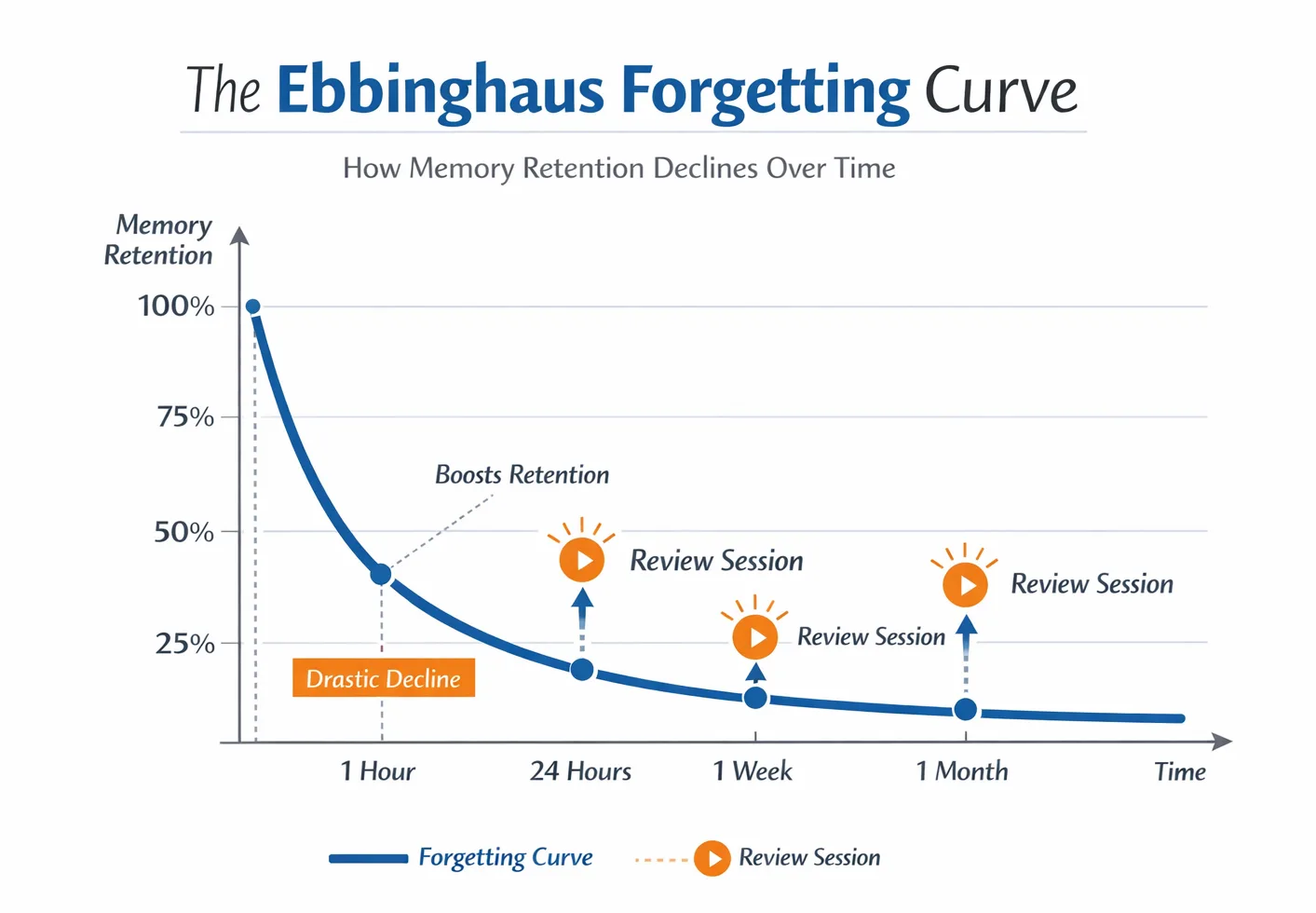
Traditional memorization, reading material repeatedly, highlighting textbooks, cramming before exams, feels productive but produces shallow learning that fades quickly. Hermann Ebbinghaus’s research on the Forgetting Curve revealed that we lose approximately 70% of newly acquired information within 24 hours without reinforcement. You finish a training course, pass the assessment, then struggle to apply that knowledge two weeks later when you actually need it at work. Cognitive learning strategies offer a different approach grounded in how the brain actually processes and retains information. These are evidence-based techniques from cognitive learning theories that help learners encode information deeply, strengthen memory pathways, and transfer knowledge to new situations rather than simply memorizing facts for short-term recall. Understanding these techniques, and why they work, enables learners, educators, and L&D professionals to design more effective learning experiences that create lasting behavioral change rather than temporary knowledge acquisition.
What are cognitive learning strategies?
Cognitive learning strategies are evidence-based techniques that improve how learners encode, store, and retrieve information to improve long-term memory and knowledge transfer.
What Are Cognitive Learning Strategies?
Cognitive learning strategies are deliberate techniques that improve how learners process, store, and retrieve information by aligning learning activities with the brain’s natural memory systems.
Quick Definition: Cognitive learning strategies are evidence-based techniques that optimize how the brain encodes, stores, and retrieves information for long-term retention and application.
Unlike passive consumption, watching videos, reading text, listening to lectures, these strategies require active mental engagement that strengthens neural pathways associated with learning.
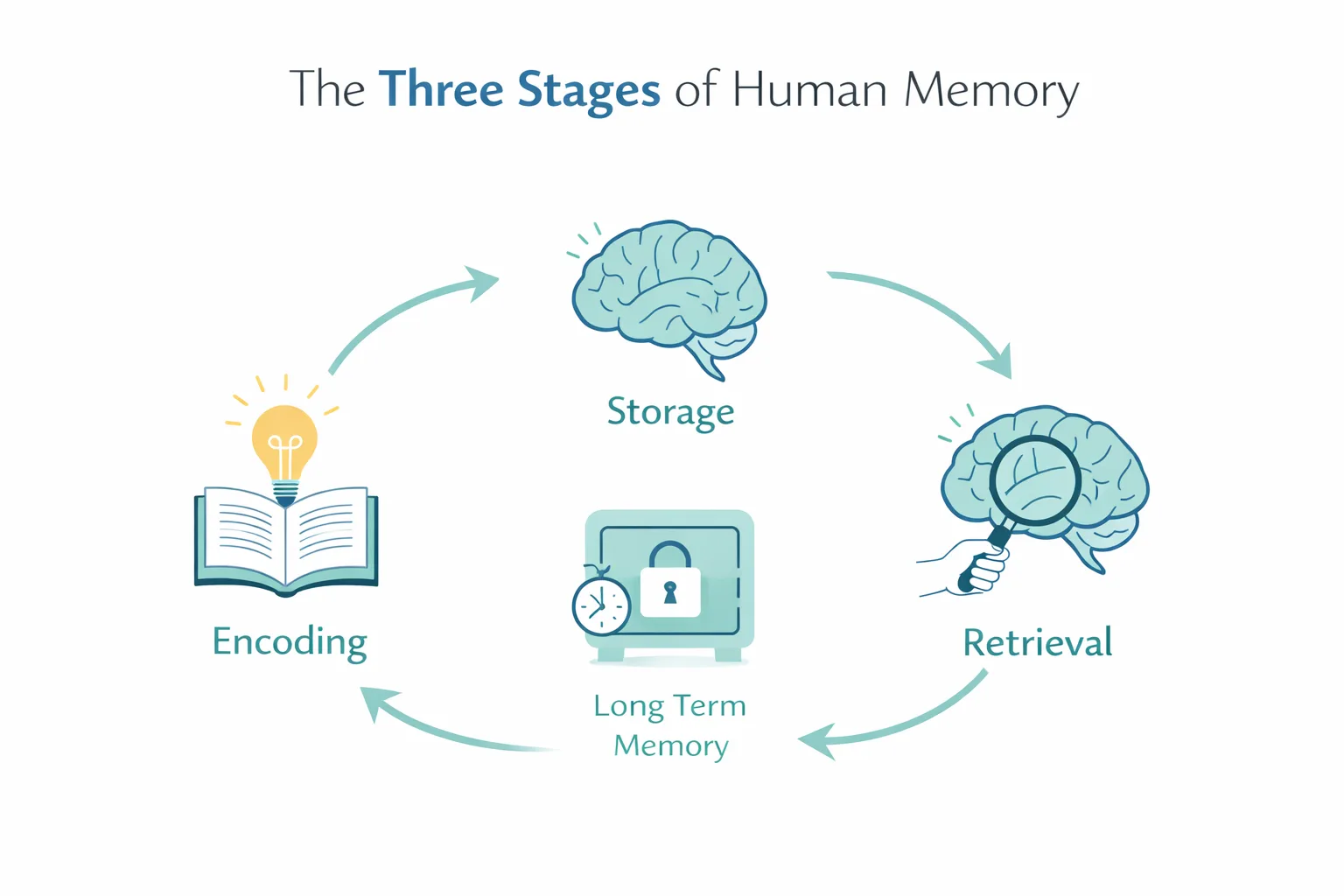
The core concept: Human memory operates through three stages:
- Encoding (transforming experiences into memory representations)
- Storage (maintaining information over time)
- Retrieval (accessing stored information when needed)
Effective cognitive learning techniques optimize each stage of this process.
- Encoding enhancement: Strategies like elaborative interrogation and dual coding create richer, more connected memory representations by linking new information to existing knowledge schemas or processing information through multiple sensory channels.
- Storage strengthening: Techniques like spaced repetition leverage the spacing effect, distributing learning over time produces stronger long-term retention than massed practice (cramming). This was first demonstrated by Hermann Ebbinghaus in 1885 and remains one of the most robust findings in cognitive psychology.
- Retrieval practice: Actively recalling information from memory, through quizzes, self-testing, or explaining concepts, strengthens memory traces more effectively than passive review. Roediger & Karpicke’s 2006 research demonstrated that students who practiced retrieval retained 50% more information after one week compared to students who spent the same time restudying material.
These cognitive learning methods contrast with surface-level strategies (highlighting, rereading) that create familiarity without deep processing. The distinction matters because familiarity feels like learning but doesn’t produce the robust knowledge structures needed for application and transfer to novel situations.
10 Cognitive Learning Strategies That Work
1. Spaced Repetition
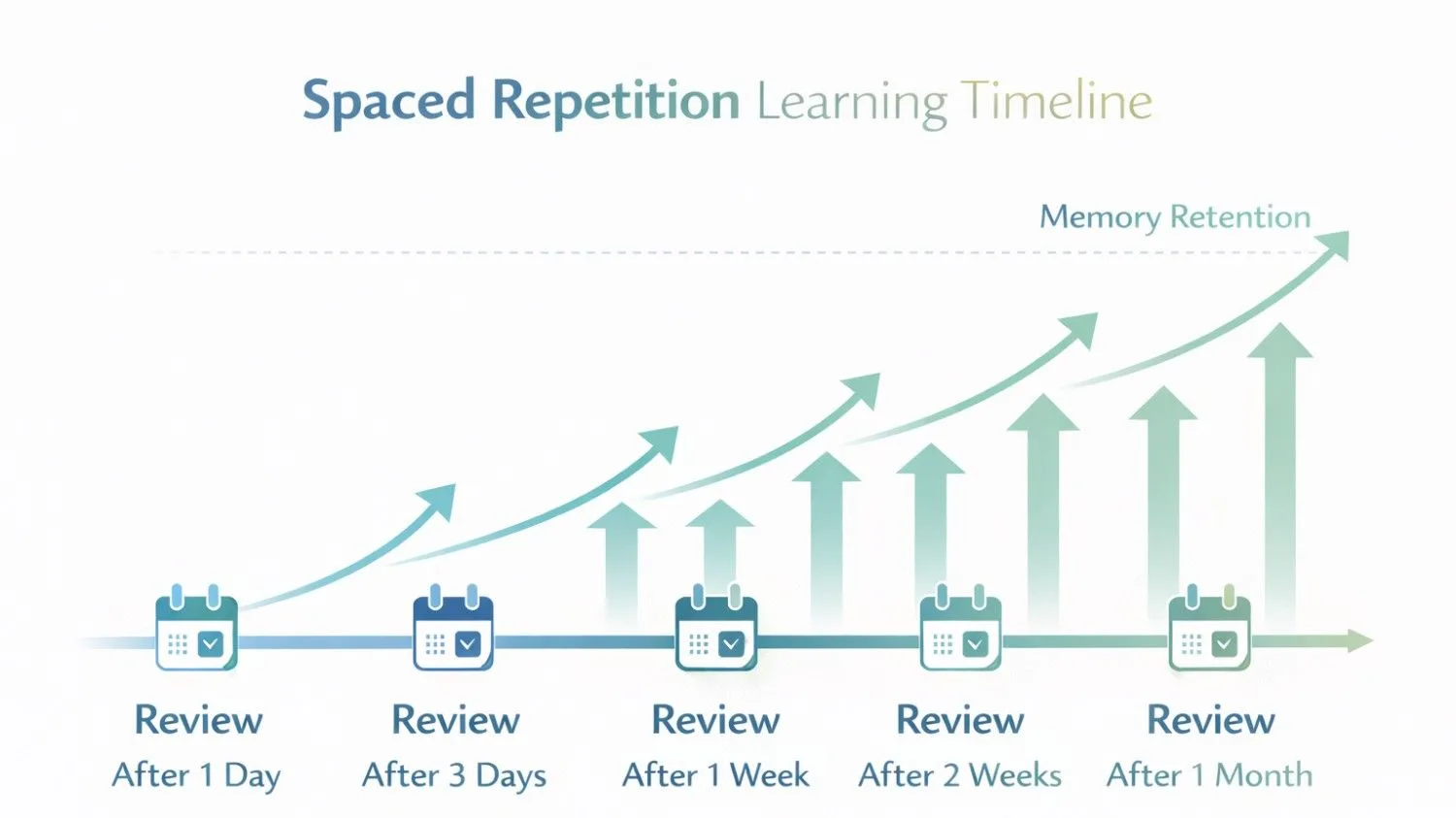
Definition: A method of reviewing information at increasing intervals to move data from short-term to long-term memory.
What it is: Distributing learning sessions over time with increasing intervals between reviews rather than concentrating practice in single sessions.
Why it works: Hermann Ebbinghaus’s Forgetting Curve research (1885) demonstrated that memory retention decays exponentially over time without reinforcement. Spaced practice forces memory retrieval after partial forgetting has occurred. This retrieval effort strengthens long-term memory encoding more effectively than retrieving information that’s still readily accessible from recent study. Using Anki’s Spaced Repetition System (SRS) algorithm for medical terminology, the software calculates optimal review intervals based on individual forgetting curves, typically starting at 1 day, then 3 days, 1 week, 2 weeks, 1 month.
How To Implement it in LMS:
- Automated review scheduling delivering refresher modules 3 days, 1 week, and 1 month after initial learning
- Adaptive algorithms adjusting spacing based on assessment performance
- Email/Slack notifications triggering “It’s time to review [topic]” at scientifically optimal intervals
- Dashboard showing upcoming review sessions with option to advance or delay based on confidence
Implementation Experience
When introducing spaced repetition to corporate learners, explicitly explain why they’re seeing “old” content again. Employees often complain about “repetitive training” not realizing the repetition is the point. I’ve found success adding a brief explainer: “This isn’t a mistake,you’re seeing this again because science shows reviewing after 3 days doubles retention.
2. Retrieval Practice
Definition: Actively recalling information from memory through testing strengthens retention more than passive review.
What it is: Actively recalling information from memory through self-testing, quizzes, or explaining concepts without reference materials rather than passively reviewing notes.
Why it works: Roediger & Karpicke’s landmark 2006 study demonstrated the testing effect, students who practiced retrieval retained 50% more information after one week compared to students who spent equivalent time restudying. Retrieval strengthens memory pathways more than recognition or review. The act of searching memory for information creates stronger associations than encountering that information during reading.
| Learning Method | Retention After 1 Week | Retention After 1 Month |
|---|---|---|
| Passive Review (rereading notes) | 40% | 20% |
| Active Retrieval (practice testing) | 60% | 45% |
LMS implementation:
- Micro-assessments after each 3-5 minute lesson segment requiring learners to recall key concepts before progressing
- Periodic “check your understanding” questions interrupting video content every 2-3 minutes
- Weekly recap quizzes aggregating questions from all previous modules
- “Explain in your own words” text entry fields forcing articulation rather than recognition
Common Pitfall
Retrieval practice feels harder than reviewing notes, so learners resist it. In one corporate implementation, 40% of employees complained that “too many quizzes” made training “unnecessarily difficult.” I had to add introductory content explaining that the difficulty is the mechanism creating retention—what cognitive scientists call desirable difficulty.
3. Concept Mapping
Definition: Visual diagrams representing relationships between concepts improve organization and reveal knowledge gaps.
What it is: Creating visual diagrams representing relationships between concepts, showing hierarchies, connections, and dependencies.
Why it works: Externalizing knowledge structures helps learners identify gaps in understanding, recognize connections between ideas, and organize information into coherent schemas. The mapping process itself—deciding what connects to what, requires deep processing that mere reading doesn’t trigger. Project managers using Miro or Lucidchart to map relationships between project phases, deliverables, stakeholder responsibilities, and risk factors before kickoff meetings. The visual representation reveals dependencies that linear documentation obscures.
LMS implementation:
- Interactive concept mapping tools allowing drag-and-drop of concepts and connection-drawing
- Peer comparison features showing how different learners organize the same information
- Auto-grading based on presence of required concepts and connections
- Export to PDF for inclusion in personal knowledge repositories
4. Elaborative Interrogation
Definition: Asking “why” and “how” questions about concepts creates deeper understanding by connecting new information to existing knowledge.
What it is: Learners generate explanations for why facts are true or concepts work by asking “why” and “how” questions, then answering from their existing knowledge.
Why it works: This method connects new information to existing knowledge schemas, creating multiple retrieval pathways. Generating explanations requires deeper processing than passive reading. When learners explain why something makes sense, they integrate it into existing mental models rather than storing isolated facts.
Example: Sales training for SaaS products asking “Why does offering a free trial before requiring credit card information increase conversion rates?” forces trainees to explain underlying psychology (reducing commitment friction, demonstrating value before risk) rather than memorizing “free trials work.”
LMS implementation:
- Embedded prompts: “Before continuing, explain in your own words why this approach works”
- Discussion forums requiring explanation-based responses rather than simple answers
- AI-powered feedback analyzing explanation quality and suggesting improvements
- Peer review where learners evaluate each other’s explanations
What Works
Provide sentence starters for elaborative interrogation: “This works because…” or “The reason this matters is…” Many learners don’t know how to self-explain without scaffolding.
5. Dual Coding
Definition: Combining visual and verbal information creates redundant memory traces improving retention.
What it is: Combining visual and verbal information processing, learning through both images/diagrams and text/spoken explanations rather than single modality.
Why it works: Allan Paivio’s Dual Coding Theory (1971) demonstrates that information processed through multiple channels creates redundant memory traces. Visual and verbal systems operate somewhat independently in the brain; encoding information in both creates two retrieval pathways. Diagrams can represent spatial relationships text describes poorly; text can clarify details images leave ambiguous.
As shown in the Dual Coding Model below:
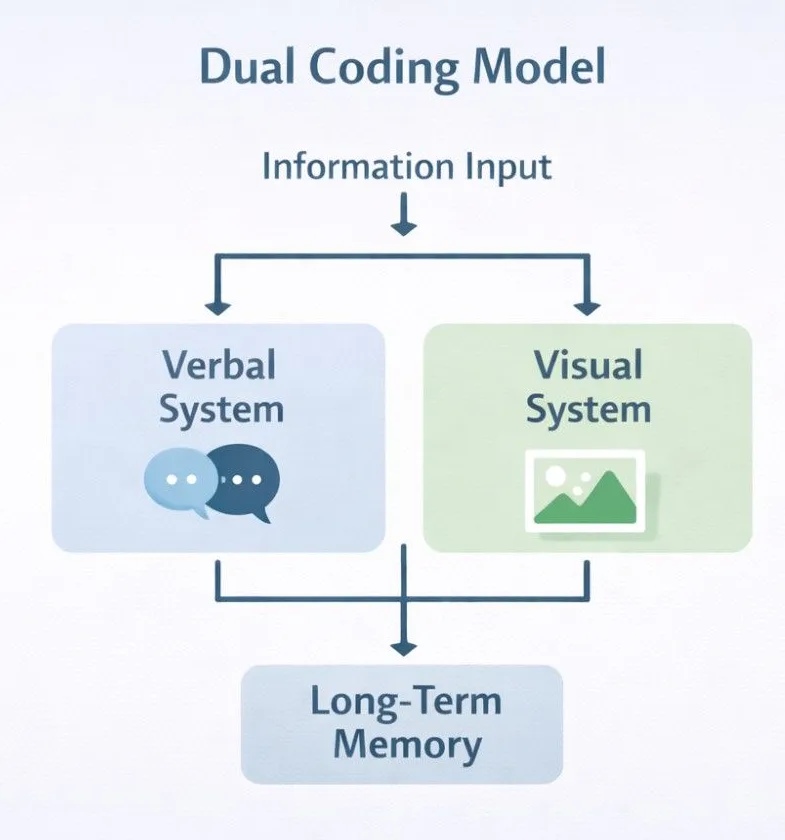
Example: Software training combining annotated screenshots showing button locations with written click-by-click instructions. Financial analysis training using both line charts showing revenue trends AND narrative explanations of what drove those trends.
LMS implementation:
- Video lessons with synchronized visual demonstrations and verbal explanations
- Infographics summarizing text-based concepts
- Interactive simulations combining visual representations with textual feedback
- Side-by-side presentation: diagram on left, explanation on right
6. Interleaving Practice
Definition: Mixing different but related topics during practice improves discrimination and flexible application.
What it is: Mixing practice across different but related concepts or problem types within single study sessions rather than blocking practice by topic.
Why it works: Interleaving forces learners to discriminate between concepts and select appropriate strategies for different problems. Blocked practice (mastering topic A completely before moving to topic B) creates fluency within single contexts but weak transfer. Interleaving builds discrimination skills and flexible application by requiring learners to identify which approach each problem requires.
Example: Customer service training alternating between handling billing questions, technical troubleshooting, and product recommendations within the same practice session rather than dedicating separate days to each topic.
LMS implementation:
- Quiz question randomization across previously covered topics rather than sequential topic-by-topic assessments
- Practice modules mixing new content with reviews of previous concepts
- Scenario simulations presenting varied problem types in unpredictable order
- Adaptive systems increasing interleaving as learner competency develops
Field Experience
Learners often feel they are learning LESS when interleaving because it’s harder than blocked practice. In post-training surveys, interleaved groups rate their learning lower than blocked practice groups despite performing better on retention tests. This is what cognitive scientists call desirable difficulty, you must warn learners that the increased challenge indicates effective learning, not teaching failure. I now include a slide explaining: “If this feels harder than expected, that’s working as intended.
7. Worked Examples
Definition: Step-by-step solutions reduce cognitive load for novices, enabling them to learn problem-solving processes.
What it is: Providing step-by-step solutions to problems before asking learners to solve similar problems independently, reducing cognitive load for beginners.
Why it works: John Sweller’s Cognitive Load Theory demonstrates that worked examples help learners understand problem-solving processes without overloading working memory. Novices benefit from seeing expert approaches before attempting independent problem-solving because their working memory is consumed by basic procedures, leaving no capacity for learning underlying principles. As expertise develops, fading worked examples (gradually removing steps) transitions learners toward independent practice.
Example: Excel training showing complete formulas with cell-by-cell annotations: =SUMIF(A2:A10, “>100”, B2:B10) with explanation “(range to check), (criteria), (sum range)” before asking learners to modify formulas for different criteria.
LMS implementation:
- Interactive worked examples allowing learners to reveal solution steps progressively
- Faded examples automatically removing more scaffolding as learners demonstrate competency through embedded assessments
- Split-attention prevention: integrating text explanations within diagrams rather than requiring looking back-and-forth
- Completion problems: partially worked examples where learners fill in missing steps
8. Instructional Scaffolding
Definition: Temporary support that gradually decreases as learner competency increases.
What it is: Providing temporary support, hints, templates, prompts, partial solutions, that gradually decreases as learner competency increases.
Why it works: Scaffolding helps learners bridge gaps between current knowledge and learning objectives without overwhelming cognitive capacity. As skills develop, reducing support forces learners to internalize processes rather than depending on external aids. This gradual release model (“I do, we do, you do”) builds independent capability systematically.
Application example: Writing instruction providing:
- Week 1: Sentence starters and paragraph templates
- Week 2: Topic sentence examples, independent body development
- Week 3: Independent composition with optional reference guides
- Week 4: Unaided writing with peer review
LMS implementation:
- Adaptive systems detecting struggle (multiple incorrect attempts) and offering contextual hints
- Progressive difficulty levels reducing available support as learners advance
- “Help” buttons providing optional scaffolding learners can access if needed
- Analytics tracking how often learners use scaffolding, informing when to reduce support
9. Reflective Learning
Definition: Evaluating one’s own thinking processes develops metacognition and improves learning strategies.
What it is: Encouraging learners to evaluate their thinking processes, identify what they understand and don’t understand, and consider how learning applies to their contexts.
Why it works: Reflection develops metacognition—awareness of one’s own thinking and learning processes. Metacognitive awareness helps learners identify when they don’t understand (avoiding illusions of competence), recognize effective learning strategies, and monitor comprehension accuracy. Reflection also supports transfer by helping learners connect abstract concepts to personal experience.
Example: Leadership development programs requiring end-of-module reflections: “What surprised you about this content? How does this relate to a challenge you currently face? What will you do differently next week?”
LMS implementation:
- Structured reflection prompts after major learning segments with text entry fields
- Peer discussion forums requiring learners to share application plans
- Learning journals with periodic prompts: “Review your entries from this month, what patterns do you notice?”
- Self-assessment tools helping learners evaluate understanding before formal assessments
10. Problem-Based Learning
Definition: Solving realistic problems before receiving instruction creates productive struggle that deepens understanding.
What it is: Presenting learners with authentic problems before providing direct instruction, allowing them to struggle with challenges that instruction will address.
Why it works: Encountering problems before solutions creates productive failure (Kapur, 2008), unsuccessful problem-solving attempts that activate relevant prior knowledge, surface misconceptions, and create awareness of knowledge gaps. Subsequent instruction addressing those gaps is more meaningful because learners recognize why it matters. Problem-based learning encourages deeper schema formation than passive content consumption by creating “need to know” before telling.
Example: Cybersecurity training presenting actual phishing emails before teaching identification techniques. Learners attempt to identify red flags, often missing subtle indicators. Subsequent instruction on domain spoofing, urgent language, and request anomalies becomes immediately relevant because learners just struggled with those exact challenges.
LMS implementation:
- Scenario-based modules presenting realistic challenges before revealing solutions
- Branching simulations allowing learners to make decisions and experience consequences before debriefing
- “Solve before study” modules where attempted solutions precede instructional content
- Group problem-solving in discussion forums before expert explanations released
Implementation Insight
Time the problem-to-instruction gap carefully. If learners struggle for 20+ minutes without progress, frustration outweighs productive failure benefits. I’ve found 5-10 minutes of struggle, followed by hints, then full instruction works best for most corporate training contexts.
Benefits of Cognitive Learning Strategies
Research consistently demonstrates that evidence-based cognitive learning techniques produce superior outcomes compared to intuitive but ineffective study habits.
- Deeper understanding: Strategies requiring explanation, connection-making, and application build conceptual knowledge rather than surface memorization. Learners understand why and how, not just what.
- Improved long-term retention: Spaced practice and retrieval strengthen memory consolidation, producing knowledge that persists months and years. In controlled studies, retrieval practice shows 50%+ retention advantage over passive review after one month (Roediger & Karpicke, 2006).
- Better knowledge transfer: Strong schemas developed through elaboration, concept mapping, and problem-based learning enable applying knowledge to novel situations. Learners recognize when concepts are relevant to new challenges rather than only applying knowledge in original learning contexts.
- Stronger critical thinking: Strategies like elaborative interrogation and reflective learning develop analytical skills, questioning assumptions, evaluating evidence, recognizing connections, transferable across domains.
- More efficient learning: While cognitive strategies may feel more effortful initially than passive review, they produce superior outcomes in less total time. Retrieval practice creates stronger memories in fewer study hours than repeated reading requiring less overall time for equivalent retention.