First and foremost, the rapid proliferation of large language models has forced enterprise Learning and Development departments to fundamentally rethink how employees access corporate knowledge. Historically, learners have navigated rigid course catalogs or utilized keyword-based search bars that frequently return irrelevant documentation. Meanwhile, generative AI promises to replace these clunky interfaces with conversational assistants capable of providing instant, context-aware answers.
However, utilizing off-the-shelf generative models for corporate training introduces a critical operational vulnerability. For instance, public models hallucinate facts, invent policies, and lack access to proprietary company documentation. Therefore, to deploy AI safely within a corporate learning environment, technical architects must implement a strict framework. Specifically, this framework must force the AI to rely exclusively on approved institutional knowledge.
Ultimately, building a highly accurate rag chatbot training content pipeline is the definitive technical solution to this enterprise challenge. Additionally, you can explore foundational system design principles by reviewing expert LMSPedia resources.
Fundamentally, Retrieval-Augmented Generation (RAG) represents a paradigm shift in how artificial intelligence interacts with proprietary databases. Instead of relying on the pre-trained memory of a language model to generate an answer, a RAG architecture works differently. Specifically, it intercepts the user prompt, searches a secure internal database for relevant corporate training materials, and feeds those specific documents to the AI to formulate a precise answer.
As a result, this creates an ai assistant on course content that is entirely grounded in factual, company-approved data. In this article, this technical engineering guide breaks down the core components of RAG architecture. Furthermore, it details how to process complex unstructured learning data into vector embeddings. Finally, it outlines the mandatory security frameworks required to protect sensitive enterprise information from prompt injection vulnerabilities.
Key Takeaways

Eliminating Hallucinations with RAG: Standard language models invent facts when they lack information. Retrieval-Augmented Generation solves this by forcing the AI to generate answers strictly based on retrieved paragraphs from your proprietary corporate training documents.
Vector Database Pipeline: Raw training manuals must be chunked into digestible text blocks and converted into mathematical embeddings. A specialized vector database stores these embeddings to enable lightning-fast semantic similarity searches.
Mandatory Security Guardrails: Enterprise AI deployments require strict system prompts, temperature controls set to zero for maximum determinism, and robust defenses against prompt injection attacks to prevent malicious data extraction.
Role-Based Metadata Access: To prevent junior staff from accessing classified executive documentation, every text chunk in the vector database must be tagged with explicit security metadata that matches the permission tier of the inquiring user.
Continuous Feedback and Auditing: Successful RAG deployments require rigorous data hygiene. Outdated documents must be automatically purged from the vector database, and user feedback loops must be monitored to constantly evaluate retrieval accuracy
What is Retrieval-Augmented Generation in Corporate Learning?
First, to understand the mechanical necessity of RAG, technical buyers must understand the limitations of standard language models. For example, imagine when a user asks a standard model a question about a specific internal company travel policy. In this scenario, the model attempts to guess the next logical word based on the public internet data it consumed during its initial training phase.
Consequently, because the model has never actually read your private corporate handbook, it will confidently generate a highly plausible but entirely fabricated travel policy. Furthermore, in a regulated industry like aviation or banking, these hallucinations create unacceptable compliance liabilities. Fortunately, RAG eliminates this vulnerability by completely changing the sequence of operations. Additionally, for a comprehensive overview of how cloud providers define this methodology, you can review the technical documentation on what is Retrieval-Augmented Generation from AWS.
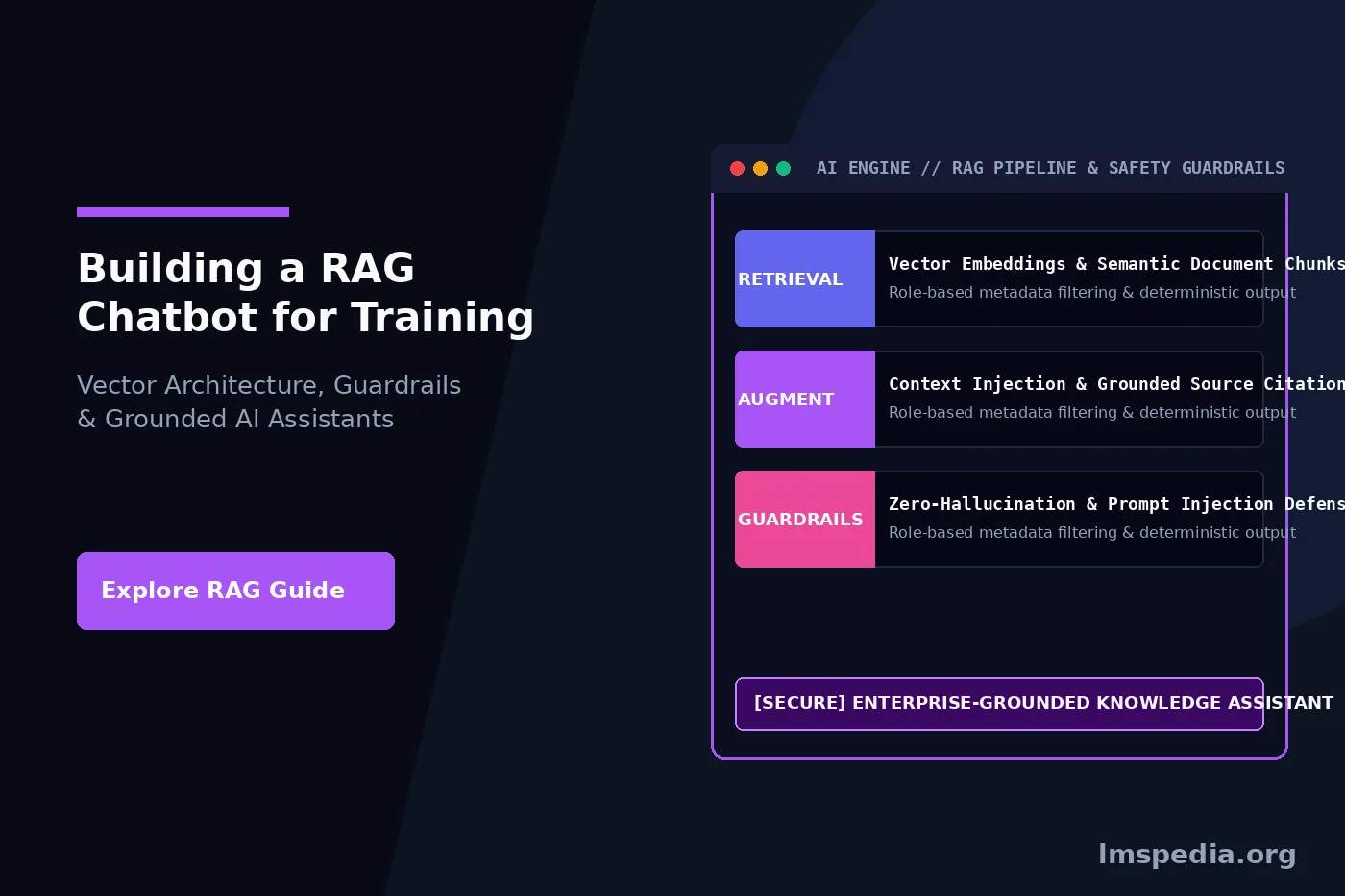
Specifically, when an organization implements a retrieval augmented generation lms, the system restricts the language model from guessing. In practice, the architecture functions like a digital librarian. First, when an employee asks a question, the system retrieves the exact relevant paragraphs from your proprietary training manuals.
Subsequently, it hands those specific paragraphs to the language model along with strict instructions to summarize only the provided text. Conversely, if the retrieved documents do not contain the answer, the model is mathematically constrained and must reply that it does not know the answer. Ultimately, this grounding process guarantees that every response generated by the chatbot is directly traceable to an approved corporate learning asset.
The Core Architecture of an AI Assistant on Course Content
Initially, building a functional RAG pipeline requires integrating several distinct data processing technologies. For instance, you cannot directly feed a raw PDF manual into a language model efficiently. Therefore, the corporate learning content must undergo a rigorous transformation process to become mathematically searchable.
1. Data Ingestion and Semantic Chunking
Specifically, the first stage of the pipeline involves extracting raw text from your existing learning management system. Typically, this content exists in disparate formats including SCORM packages, PDF compliance manuals, video transcription files, and HTML intranet pages. Next, a data ingestion script must parse these files and strip away formatting code to isolate the raw educational text.
Once extracted, the system must divide the text into smaller, digestible segments known as chunks. For example, if you feed a five-hundred-page manual to an AI simultaneously, the context window will overflow and the model will lose focus. To prevent this, developers typically utilize recursive character splitting to break documents into blocks of roughly five hundred to one thousand words, ensuring that complete paragraphs and conceptual thoughts remain intact.
2. Generating Vector Embeddings
Subsequently, once the system successfully chunks the corporate training content, it must convert the text into a format that a machine learning algorithm can understand. Specifically, developers achieve this using an embedding model. First, the embedding model evaluates each text chunk and translates its semantic meaning into a dense array of floating-point numbers known as a vector.
Essentially, these numbers represent the contextual coordinates of the text in a multi-dimensional mathematical space. For instance, paragraphs discussing fire safety will generate numerical coordinates that cluster closely together, while paragraphs discussing payroll software will plot far away. Ultimately, this mathematical translation is the foundational bedrock of all modern semantic search technologies.
3. Storing Data in a Vector Database
Traditionally, relational databases like SQL are designed to search for exact keyword matches. Consequently, they are fundamentally incapable of executing complex semantic similarity searches. Therefore, to store your newly generated numerical arrays, your IT infrastructure requires a dedicated vector database. Specifically, these specialized databases store the text chunks alongside their corresponding mathematical embeddings.
Furthermore, when selecting your infrastructure, technical teams should explore industry-leading solutions designed specifically for high-velocity AI workloads. Additionally, you can read more about this specialized storage technology in the Pinecone guide to vector databases. Ultimately, by utilizing a vector database, your RAG chatbot can instantly scan millions of documents to find the closest conceptual match to a user query in milliseconds.
4. The Retrieval and Generation Process
Finally, the last architectural step occurs when the learner interacts with the chatbot interface. First, the user types a question in natural language. Next, the system takes that specific question, runs it through the exact same embedding model used during data ingestion, and converts the question into a numerical vector.
Then, the vector database performs a mathematical operation called cosine similarity to find the stored text chunks that mathematically align closest with the question vector. Subsequently, the system retrieves the top three or four most relevant chunks and injects them into a secure prompt template. Finally, the language model reads the prompt, analyzes the injected training chunks, and synthesizes a highly accurate, natural language response for the learner.
Implementing Strict RAG Guardrails for Enterprise Compliance
While the retrieval architecture ensures the model has access to factual data, it does not inherently prevent a malicious user from manipulating the system. Therefore, corporate IT teams must implement rigorous rag guardrails to protect sensitive human resources data. Furthermore, they must prevent abusive language generation, and secure the system against adversarial attacks.
Undoubtedly, the most prominent security threat to any generative AI deployment is prompt injection. For instance, a disgruntled employee might attempt to bypass the system instructions by typing a command that forces the AI to ignore its original directives and reveal secure administrative passwords or generate inappropriate content. Consequently, to mitigate these risks, organizations must adopt defensive security postures tailored for large language models. Specifically, technical architects must consult the OWASP Top 10 vulnerabilities for Large Language Models to understand how to sanitize user inputs before they ever reach the generation engine.
Furthermore, beyond prompt injection defense, developers must implement strict system prompts that govern the persona and behavioral boundaries of the chatbot. Essentially, the system prompt is a hidden set of instructions embedded in every user interaction. Specifically, a robust guardrail prompt will explicitly state the operational parameters of the AI.
For example, it will mandate that the AI must only use the provided context, must maintain a professional corporate tone, and must immediately refuse to answer any questions related to internal salary bands, personal employee information, or topics unrelated to the training curriculum. Additionally, developers must set the temperature parameter of the language model to zero. Specifically, temperature controls the creative randomness of the AI. Ultimately, by setting the temperature to zero, you eliminate creative variance and force the model to provide highly deterministic, factual answers based strictly on the retrieved documents.
Data Privacy and Role-Based Access Controls
Moreover, a critical architectural consideration for enterprise deployments involves user permission mapping. For example, in a traditional monolithic LMS, a standard employee cannot access executive leadership training modules or proprietary financial compliance documentation. However, when building a RAG pipeline, the vector database must respect these exact same user access tiers.
Consequently, if the database lacks access controls, a junior analyst could ask the chatbot a question about impending corporate mergers and the system might inadvertently retrieve highly classified board of director meeting minutes to formulate the answer. Therefore, to prevent unauthorized data exposure, developers must apply metadata filtering during the initial data ingestion phase. Specifically, every chunk of text processed into the vector database must receive explicit security classification metadata tags.
Subsequently, when the user submits a query, the application must verify the identity and permission level of that user. Then, the system restricts the semantic search query to only scan vectors that match the authorized permission tier of the user. Additionally, to properly structure these administrative layers and ensure metadata tagging aligns with human resources directories, review our technical breakdown on how to architect secure LMS user roles and permissions.
Structuring a Knowledge Base Chatbot Training Pipeline
Fundamentally, the accuracy of your RAG chatbot is entirely dependent on the quality of the underlying documentation. For instance, if your corporate training manuals are outdated, contradictory, or poorly formatted, the AI will retrieve and generate flawed answers. Therefore, establishing a rigorous knowledge base chatbot training and data hygiene protocol is a mandatory prerequisite for success.
First, technical writing teams must audit the entire learning catalog before ingesting data into the vector database. For example, documents containing heavy visual diagrams without text descriptions will remain invisible to the semantic search engine. Furthermore, administrators must flatten complex tables or convert them into markdown format to ensure the embedding model accurately captures the relational data between rows and columns.
Moreover, organizations must implement an automated document lifecycle management system. Specifically, when a compliance officer updates a standard operating procedure document in the central repository, the RAG architecture must automatically detect the file change, delete the old vector embeddings, and instantly process the new document chunking. Ultimately, this automated synchronization ensures the AI never provides obsolete regulatory guidance to the workforce.
Comparing AI-Ready Learning Platforms and Tools
Currently, organizations evaluating the integration of generative AI into their training ecosystems face a choice. Specifically, they must decide between purchasing a specialized learning platform with native AI features or building a custom architectural stack using enterprise cloud tools.
| Platform / Infrastructure Solution | Primary AI Focus | Architectural Capabilities & RAG Integration |
|---|---|---|
| SimpliTrain | Versatile training operations and resource scheduling. | Provides intuitive back-office workflow coordination with highly flexible enterprise data management to support streamlined learning operations. |
| Docebo | Enterprise learning management and AI delivery. | Features native AI-powered search algorithms and automated content tagging designed specifically for global corporate e-learning environments. |
| Amazon Q Business | Enterprise generative AI assistant builder. | Offers a fully managed RAG architecture that connects directly to corporate data silos like AWS S3 and Microsoft SharePoint with built-in access controls. |
Ultimately, when selecting a platform, IT procurement teams must evaluate how easily the system handles rapid concurrent API requests without suffering severe latency. Furthermore, to ensure your selected infrastructure remains stable during peak usage hours, technical teams should carefully review our deep dive on LMS load testing and performance benchmarking.
The Importance of Citation
Additionally, to build user trust and ensure compliance auditability, mandate that your RAG application appends a source citation to every generated response. Specifically, the application interface should present a clickable hyperlink referencing the exact PDF title and page number the LLM utilized to generate the answer, allowing human verification.
Continuous Evaluation and Model Monitoring
Importantly, deploying a RAG chatbot is not a static software installation; it requires continuous, dynamic monitoring. Instead, IT and Learning Development teams must establish a robust feedback loop to evaluate the precision of the retrieval pipeline. For example, standard software metrics like server uptime are insufficient for AI workloads. Consequently, organizations must track semantic similarity thresholds and user interaction data.
Specifically, the application interface must include simple user feedback mechanisms, such as thumbs-up and thumbs-down buttons attached to every chatbot response. Subsequently, when a user flags an answer as incorrect, the engineering team must investigate the specific failure point.
For instance, they must determine if the vector database retrieved the wrong document chunk, if the language model ignored the prompt guardrails and hallucinated, or if the underlying training document itself was fundamentally inaccurate. Ultimately, by tracking these metrics over time, instructional designers can identify critical knowledge gaps in the corporate repository. Additionally, for strategic frameworks on identifying workforce skill deficiencies before deploying major technology upgrades, review our operational guide on utilizing training needs assessment tools.
Conclusion
In conclusion, the integration of conversational artificial intelligence into the corporate learning ecosystem represents an unprecedented opportunity to accelerate workforce competency. Specifically, by transitioning away from rigid, keyword-based course catalogs, organizations empower employees to retrieve highly contextual, immediate answers to complex operational challenges right in the flow of their daily work.
However, realizing this potential requires a steadfast commitment to technical rigor and enterprise security. For example, deploying raw, ungrounded language models exposes organizations to severe hallucination risks and compliance violations. Fortunately, by engineering a strict Retrieval-Augmented Generation architecture, implementing ironclad prompt guardrails, and enforcing role-based metadata access controls, technical teams can tame the unpredictable nature of generative AI.
Ultimately, building a closed-loop system ensures that your digital learning assistant serves not as an unreliable creative writer, but as an impeccably accurate, endlessly patient, and perfectly compliant steward of your proprietary corporate knowledge. Finally, to discover how leading organizations orchestrate these complex data pipelines and coordinate vast training resources, consult our comprehensive breakdown of the best training management software available on the market.
FAQ
Q1. What is a RAG chatbot?
A RAG (Retrieval-Augmented Generation) chatbot is an artificial intelligence application that intercepts a user question, searches a private database for relevant factual documents, and then uses a language model to read those specific documents and synthesize a highly accurate answer.
Q2. Why is RAG better than fine-tuning an LLM for corporate training?
Fine-tuning is expensive, requires massive datasets, and embeds knowledge permanently into the weights of the model. If a company policy changes, a fine-tuned model must be completely retrained. With RAG, you simply update the text file in the database, and the chatbot instantly uses the updated information.
Q3. What is vector embedding in AI?
Vector embedding is the mathematical process of converting text paragraphs into complex arrays of numbers. This allows computer algorithms to plot words in a multi-dimensional space, making it possible to search for concepts based on semantic meaning rather than relying on exact keyword matches.
Q4. How do you prevent an AI assistant from exposing confidential HR data?
Engineers must implement role-based access controls at the vector database level. When documents are processed, they receive security metadata tags. When a user asks a question, the semantic search is restricted to only return document chunks that the specific user is officially authorized to view.
Q5. What are AI guardrails?
AI guardrails are technical restrictions and hidden system instructions placed on a language model to dictate its behavior. In a corporate environment, guardrails force the AI to maintain a professional tone, refuse to answer off-topic questions, and mathematically constrain its output to prevent hallucinations.