
LMS for Employee Development (2026)
An LMS for employee development goes beyond tracking course completion. It helps organizations build workforce capability by mapping skills to roles, supporting career progression, and enabling internal mobility. Unlike training-focused LMS platforms, development systems measure success through competency growth, promotion readiness, and retention impact. The right LMS choice depends on organizational maturity, governance capacity, and long-term talent strategy, not features alone.
Organizations today know that tracking course completion is not the same as building workforce capability. A compliance-driven training system ensures employees finish required modules. An LMS for employee development goes further, it supports structured skill growth, career progression, and internal mobility. The difference matters. Development-focused platforms connect learning to performance, promotion readiness, and succession planning, not just certificates.
What Is an LMS for Employee Development?
An LMS for employee development is a learning platform designed to:
- Track competencies, not just course completions
- Map structured career progression paths
- Identify individual and organizational skill gaps
- Connect learning outcomes to performance systems
- Support succession planning and internal mobility
Unlike traditional training LMS platforms that measure success by completion rates, development systems measure success by demonstrated capability growth.
According to LinkedIn’s Workplace Learning Report, 94% of employees say they would stay longer at a company that invests in their career development. A development-focused LMS provides the infrastructure to make that investment structured and measurable.
Training LMS vs Development LMS: What’s the Difference?
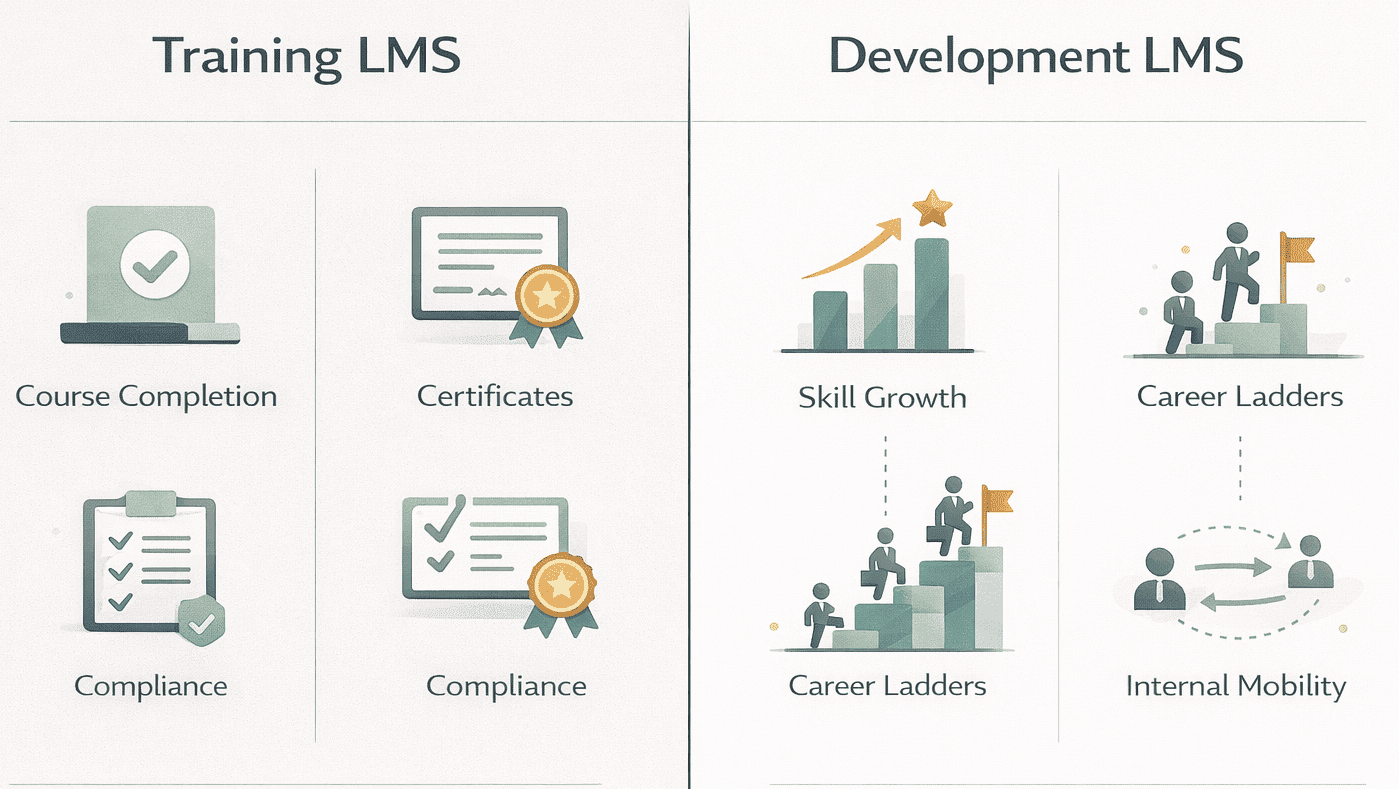
| Dimension | Training-Centric LMS | Development-Focused LMS |
|---|---|---|
| Primary Goal | Deliver courses & track compliance | Build role-based capabilities |
| Success Metric | Course completion rates | Competency progression |
| Structure | Topic-based catalog | Role-based learning paths |
| Manager Visibility | Completion dashboards | Skills profiles & readiness |
| Strategic Value | Administrative efficiency | Talent pipeline visibility |
In simple terms:
- Training LMS answers: “Did they complete it?”
- Development LMS answers: “Are they ready for the next role?”
For organizations focused on retention and succession planning, that distinction is critical.
Core Features of a Development-Focused LMS
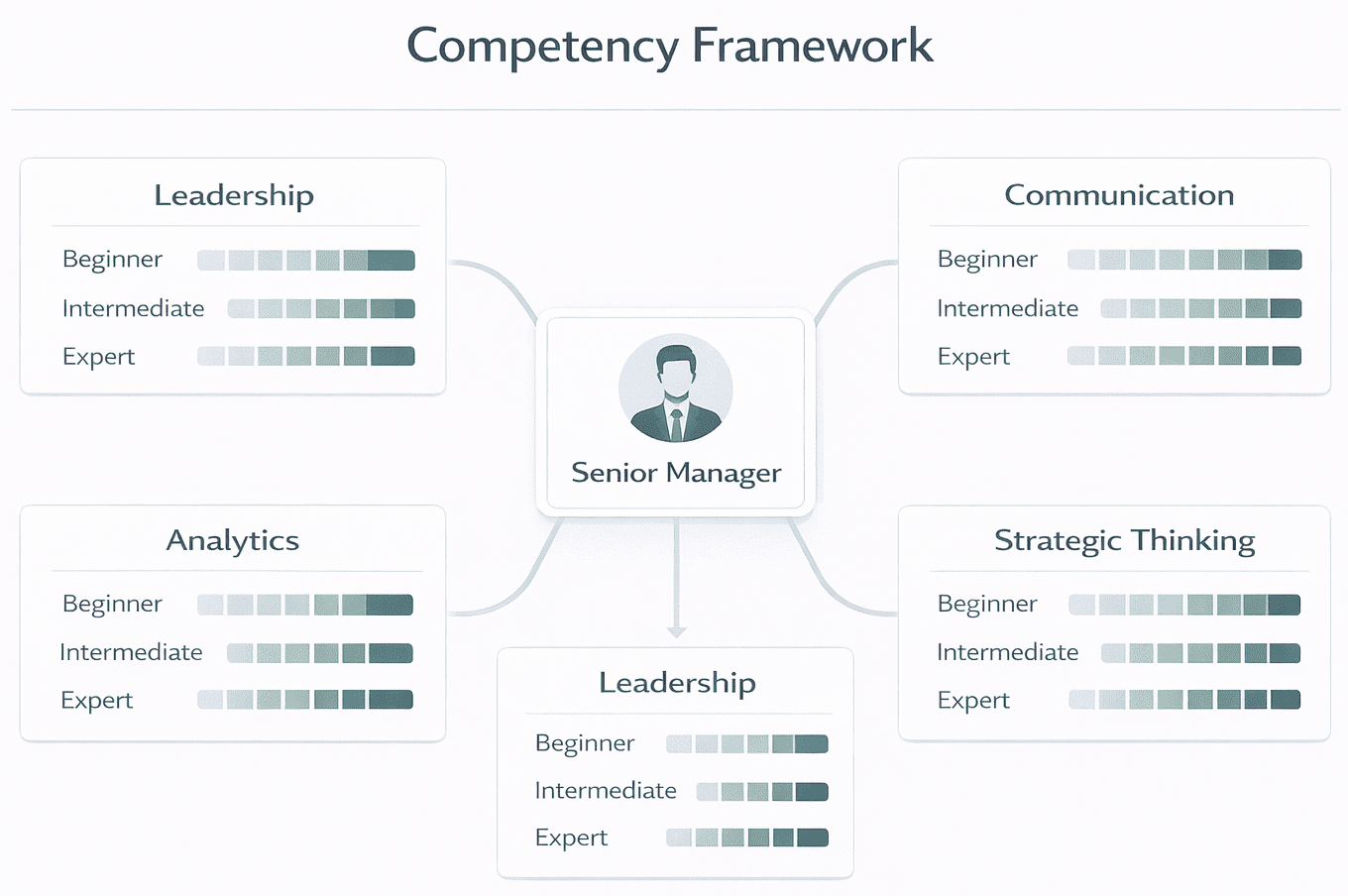
A strong corporate learning management system built for development typically includes:
1. Competency Frameworks
Defines skills by role and proficiency level (e.g., Beginner → Expert). Provides shared language for career progression.
2. Role-Based Learning Paths
Structured pathways that guide employees from current role to target role.
3. Skills Gap Analysis
Compares current capabilities with required competencies. Highlights development priorities.
4. Performance Integration
Connects training data with performance reviews to align learning with career advancement.
5. Internal Mobility Support
Shows employees which roles their skills qualify them for. Without these elements, an LMS remains primarily a content distribution tool.
The Hidden Risk: Competency Governance & Maintenance
Many organizations underestimate one reality: that development systems are only as good as the data behind them.
Common failure pattern:
- Company builds 200 roles and 800 competencies
- Business evolves
- New tools, new structures, new skill demands emerge
- Frameworks become outdated
- Employees stop trusting recommendations
This “data decay” problem reduces platform credibility.
Governance Requirements:
- Clear ownership of competency definitions
- Regular review cycles (quarterly or biannual)
- Dedicated administrative capacity
- Alignment with performance evaluation criteria
As a practical benchmark:
Organizations often need at least 1–2 dedicated learning governance roles per 5,000 employees to sustain framework accuracy. Without governance, even the best LMS underperforms.
Benefits of an LMS for Employee Development
When implemented correctly, a development LMS delivers:
- Improved Employee Retention: Clear career paths reduce uncertainty and external job hunting.
- Stronger Succession Planning: Leadership readiness gaps become visible before vacancies occur.
- Internal Hiring Efficiency: Skills-based internal mobility reduces external recruitment costs.
- Better Workforce Planning: Aggregated competency data reveals strategic capability shortages.
- Higher Manager Engagement: Managers gain structured visibility into team development progress.
However, these outcomes depend more on organizational maturity than on software alone.
Best LMS Platforms for Employee Development (2026)
Different vendors support employee development with varying strengths and limitations.
| Platform | Best For | Strength (Easy to Understand) | Limitation (Easy to Understand) |
|---|---|---|---|
| Docebo | Mid-size to enterprise | Uses AI to recommend learning and supports structured skills tracking | Can be expensive, especially for smaller companies |
| SimpliTrain | SMBs & growing companies building structured development programs | Easy to use, supports guided learning paths, and helps teams build practical skills without complexity | May not yet offer very advanced enterprise-level competency automation |
| 360Learning | Collaborative learning cultures | Encourages peer learning and team knowledge sharing | Not ideal for highly structured, role-based competency tracking |
| Cornerstone OnDemand | Large enterprises | Strong integration with performance and talent management systems | Setup can take time and requires expert configuration |
| Workday Learning | Companies already using Workday | Seamless integration with Workday HR data | Expensive and works best only within the Workday ecosystem |
| TalentLMS | Small to mid-size companies | Simple setup, quick to launch, affordable | Limited advanced governance and large-enterprise features |
| SAP SuccessFactors | Global enterprises | Strong compliance management and global scalability | Can feel complex and less modern compared to newer platforms |
Where Each Model Works Best
Small & Mid-Size Organizations (200–2,000 Employees)
Best approach:
- Start with 3–5 structured career tracks
- 10–15 competencies per role family
- Gradually increase sophistication
- Over-engineering too early leads to low adoption.
Large Enterprises (5,000+ Employees)
Require:
- Federated administration (business unit flexibility)
- Deep HRIS integration
- Formal succession alignment
- Clear governance ownership
- Without decentralized control, framework updates stall.
Retention-Focused Organizations
Development LMS works best when:
- Internal promotions are realistic
- Advancement criteria are transparent
- Managers actively support development conversations
- If career visibility exists but promotion opportunities don’t, frustration increases.
Engagement vs Strategic Depth
Many platforms add: Gamification, Badges, AI content recommendations, Social learning features
These increase course completion rates.
However, Higher completion ≠ Higher capability.
Organizations must decide: Do they want content consumption? Or measurable skill progression?
Development-focused systems often sacrifice some engagement metrics for stronger promotion alignment.
How to Choose the Right LMS for Employee Development (5-Step Framework)
1. Assess Your Development Maturity: Do defined career paths already exist? If not, build frameworks before investing in skills-heavy systems.
2. Evaluate Administrative Capacity: Can your L&D team maintain competencies, tagging, and updates long-term?
3. Determine Integration Needs: Must the LMS connect to HRIS, performance systems, or succession tools?
4. Analyze Switching Risk: Deep integrations create vendor lock-in. Ensure data exportability and migration feasibility.
5. Align with Talent Strategy: If internal mobility and retention are strategic priorities, development capability is essential. If compliance efficiency is the priority, simpler systems may suffice.
Conclusion
An LMS for employee development is not simply a better training system. It represents a shift from documenting learning to strategically building workforce capability. Training-centric platforms optimize compliance efficiency. Development-focused platforms optimize career progression and internal mobility. The right choice depends on:
- Organizational maturity
- Governance capacity
- Talent strategy priorities
- Willingness to maintain competency frameworks over time
The most expensive mistake is implementing a sophisticated development system your organization cannot sustain, or choosing a basic training tool that cannot support long-term talent strategy. Match system sophistication to operational readiness. That alignment determines whether your LMS becomes a strategic asset or an administrative burden.
FAQ
Q1. How does an LMS support employee development?
By mapping skill gaps to structured learning paths, tracking competency progression, and integrating learning with performance and career planning systems.
Q2. Can an LMS improve employee retention?
Yes, but only if internal promotion pathways exist and are actively used. Technology alone does not retain employees.
Q3. What’s the difference between training LMS and development LMS?
Training systems track course completion. Development systems track competency growth tied to career advancement.