Organizations evaluating learning management systems often encounter the distinction between corporate LMS and academic LMS platforms. The comparison arises frequently because both categories use similar terminology, courses, learners, assessments, completion tracking, and vendor marketing sometimes position platforms as serving both contexts. Surface-level interface similarities obscure fundamental differences in purpose, architecture, and operational constraints.
This article examines how corporate LMS vs academic LMS platforms differ structurally, the trade-offs each model creates, and the institutional contexts where those differences become critical. It does not recommend specific platforms or claim one category is superior. Instead, it clarifies why systems designed for workforce training function differently than those built for formal education.
Why Corporate and Academic LMS Platforms Were Built Differently
Corporate Learning Management System
Why it emerged: Organizations needed systematic ways to train employees at scale, ensure regulatory compliance, track certifications, reduce training costs compared to in-person instruction, and demonstrate training effectiveness to stakeholders.
Design intent: The corporate LMS was built to support workforce development aligned with business objectives. Training serves performance improvement, risk mitigation, and strategic capability building. The system’s primary obligation is proving training occurred, measuring business impact, and integrating with HR processes.
Academic Learning Management System
Why it emerged: Educational institutions needed infrastructure for delivering courses to students, managing assignments and grading, facilitating communication between faculty and learners, and maintaining academic records aligned with accreditation requirements.
Design intent: The academic LMS was built to support formal education programs leading to degrees, certifications, or credentials recognized by accrediting bodies. Instruction follows semester structures, emphasizes pedagogical rigor, and serves learning outcomes defined by academic standards. The system’s primary obligation is supporting teaching and learning within institutional governance frameworks.
Core Comparison Dimensions for Academic and Corporate LMS
| Dimension | Corporate LMS | Academic LMS | The Failure Point |
|---|---|---|---|
| Primary Learning Goal | Performance improvement, compliance, capability development | Knowledge acquisition, critical thinking, degree attainment | Academic LMS fails at just-in-time training delivery; Corporate LMS fails at supporting deep conceptual learning |
| Learner Population | Employees, contractors, partners, customers | Students enrolled in academic programs | Corporate LMS lacks student lifecycle management; Academic LMS lacks contractor/external user provisioning |
| Training Cadence | Ongoing, just-in-time, triggered by role changes or regulations | Semester-based, structured terms with fixed schedules | Academic LMS can’t handle “hired today, must complete safety training by end of week” scenarios |
| Assessment Model | Pass/fail competency checks, skills demonstrations | Graded assignments, weighted assessments, academic rigor | Corporate LMS lacks grade weighting and rubric complexity; Academic LMS over-complicates simple competency verification |
Content Lifecycle |
Fast-changing, updated as business needs evolve | Relatively stable, updated on academic year cycles | Academic LMS creates bottlenecks when product training must be updated immediately; Corporate LMS lacks version control for curriculum stability |
| Reporting Focus | Completion rates, compliance status, business impact | Grades, academic progress, degree completion | Corporate LMS can’t generate transcripts or degree audits; Academic LMS can’t export compliance documentation for regulatory audits |
| Integration Ecosystem | HRIS, performance management, SSO, CRM | Student Information System (SIS), library systems, academic tools | Trying to integrate Academic LMS with Workday creates manual workarounds; Corporate LMS lacks prerequisite checking for course sequences |
| Governance and Ownership | HR/L&D departments, centralized corporate control | Faculty governance, academic affairs, institutional committees | Corporate LMS denies faculty autonomy; Academic LMS prevents L&D from enforcing mandatory training deadlines |
These dimensions reveal structural incompatibilities. A platform optimized for compliance tracking and rapid content updates creates friction in academic contexts requiring stable curricula and grading rigor. A system designed for semester-based course delivery and academic record-keeping introduces unnecessary complexity for workforce training.
Expert Insight
The “Training Cadence” row is where I see most implementation failures. Organizations choose an Academic LMS (often because “it’s free” if they’re Moodle) and then discover they can’t auto-enroll new hires into mandatory safety training. L&D teams end up manually creating accounts and course enrollments for every new employee, a task that takes 30 seconds in a Corporate LMS with HRIS integration but requires 15 minutes of manual work in an Academic LMS. Over 100 new hires per year, that’s 25 hours of wasted admin time.
Learning Use Cases: Employee Training vs Formal Education
Employee Training and Development
Corporate LMS platforms support employee training and development including onboarding, compliance training systems, skills development, sales enablement, and leadership programs. Training is pragmatic, aligned with job requirements, business strategy, and performance metrics.
Structural characteristics:
- Content updated frequently as products, policies, or regulations change
- Learning paths flexible, adjusted based on role transitions or skill gaps
- Completion often mandatory with deadlines enforced by managers
- Just-in-time delivery supporting workflow integration
Onboarding and workforce training occurs continuously as employees join, change roles, or acquire new responsibilities. There is no “semester start”, training begins when business need arises.
How Academic LMS Platforms Support Structured Course Delivery
Academic LMS platforms support course delivery in education following institutional calendars. Faculty design courses within disciplinary frameworks, students enroll in sections, and learning progresses through structured schedules culminating in final assessments.
Structural characteristics:
- Content stable within academic terms, revised between semesters
- Curriculum follow accreditation requirements and degree program structures
- Enrollment tied to registration periods, prerequisites, and academic standing
- Grading and assessment workflows emphasize academic integrity and pedagogical rigor
The tension between flexibility (corporate) and formality (academic) shapes daily platform usage. Corporate learners expect to start training immediately upon assignment. Academic learners expect to enroll during registration periods, receive syllabi outlining semester expectations, and progress through coordinated course schedules.
Universities attempting to use their Academic LMS for faculty professional development training hit this wall constantly. Faculty need to complete Title IX training “by September 15th” but the Academic LMS doesn’t support deadline-based mandatory training assignment. IT teams end up sending manual reminder emails to non-compliant faculty, which creates enforcement gaps and compliance risk.
Integration Architecture: HR Systems vs Student Information Systems
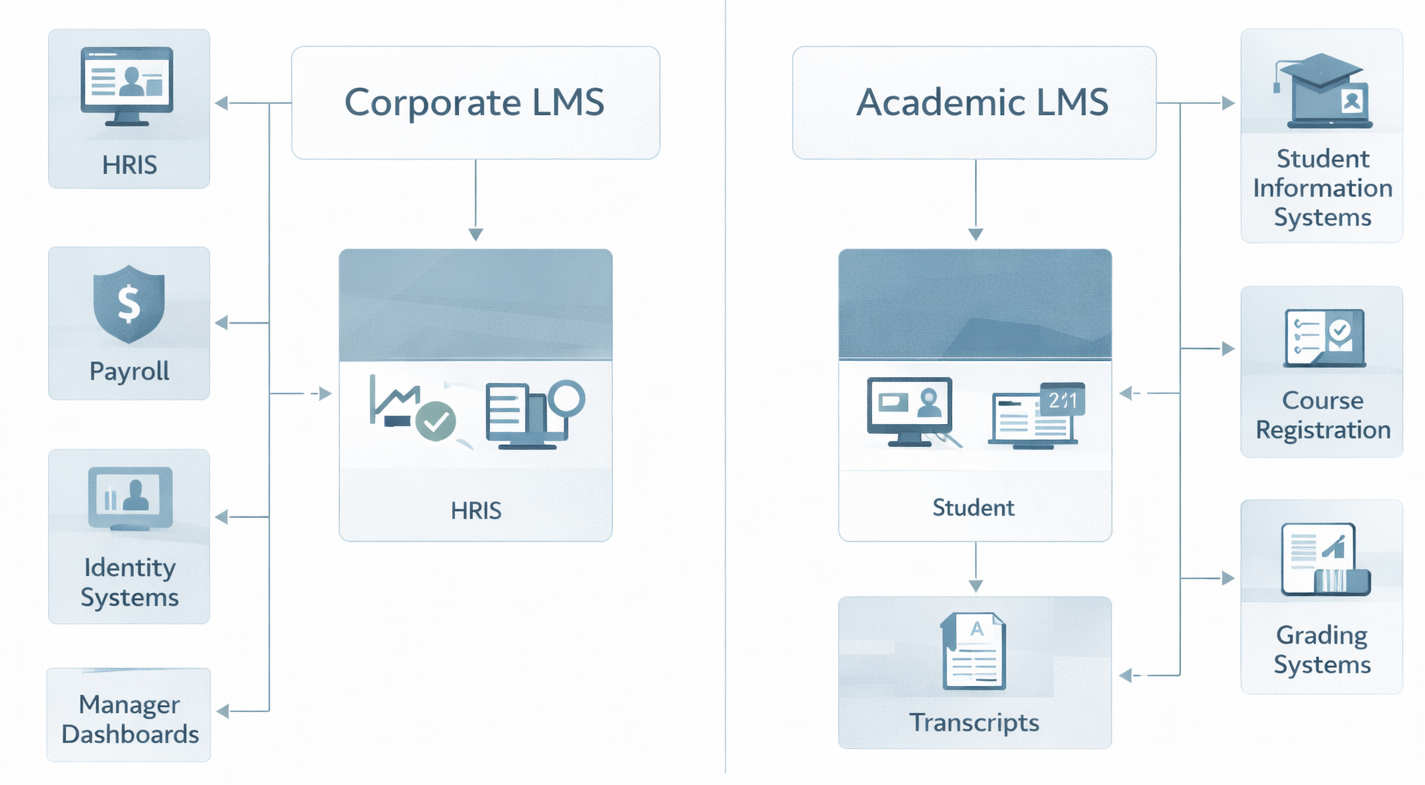
Why Corporate LMS Integrates with HRIS and Academic LMS with SIS
Corporate LMS platforms integrate deeply with HRIS (Human Resource Information Systems) for automated user provisioning, role-based training assignment, manager reporting, and termination-triggered de-provisioning. Employee data, department, location, job title, hire date, drives training logic.
Academic LMS platforms integrate with Student Information System (SIS) for enrollment management, course registration, prerequisite checking, degree audits, and transcript generation. Student data, major, class standing, academic holds, determines course access and academic progression.
These integration ecosystems are incompatible. HRIS doesn’t track academic majors or GPA. SIS doesn’t manage performance reviews or compliance certifications.
Caution - The 6-Month Failure Point
In my experience, organizations that attempt to “force” an Academic LMS into a corporate environment usually fail at the 6-month mark. The lack of automated “Manager Hierarchies” means L&D teams end up manually chasing 500+ employees for compliance, a task that should be automated. What starts as “we’ll save money using free Moodle” becomes “we’re spending 20 hours per week on manual admin tasks that a $15K/year corporate LMS would handle automatically.” The hidden labor cost exceeds the platform licensing cost within the first year.
Standards: SCORM, xAPI, and LTI
Both corporate LMS and academic LMS platforms support SCORM and xAPI for content interoperability, packaging training materials or courses for delivery across platforms.
LTI (Learning Tools Interoperability) is more common in academic contexts, enabling integration of specialized educational tools (plagiarism detection, proctoring, academic apps) into the LMS. Corporate platforms prioritize HRIS and SSO integration over educational tool ecosystems.
Single Sign-On (SSO) Expectations
Both contexts expect SSO but authentication sources differ. Corporate platforms authenticate against corporate identity providers (Active Directory, Okta, Azure AD). Academic platforms authenticate against campus systems (CAS, Shibboleth, federated identity services).
Integration complexity arises when institutions attempt to use one platform type in the other context, corporate LMS in university settings requires SIS integration the platform wasn’t designed to support; academic LMS in workplace settings lacks HRIS connectivity employers expect.
When to Choose Each: Use-Case Decision Framework
Choose a Corporate LMS When Your Primary KPI is “Time to Productivity”
If you measure success by how quickly new hires become productive, certifications remain current, or compliance gaps close, corporate platforms align with these metrics.
Scenarios where Corporate LMS excels:
- New hire onboarding at scale: You hire 50+ people per quarter and need automated training assignment based on job role, location, and department
- Regulatory compliance with audit requirements: You operate in healthcare, finance, or manufacturing where regulators demand proof of employee training with timestamp documentation
- Continuous certification management: You have employees with licenses that expire (CPR, forklift operation, software certifications) and need automated recertification reminders
- Manager-driven accountability: You need managers to receive alerts when their direct reports are non-compliant with mandatory training
- Just-in-time product training: Your product changes frequently and sales teams need access to updated training materials within hours of product launches
For example manufacturing company with 800 employees across 6 facilities needs OSHA compliance training tracked by location, automated reminders 30 days before certification expiry, and monthly compliance reports for safety managers. A Corporate LMS handles this with role-based automation. An Academic LMS would require manual tracking spreadsheets.
Choose an Academic LMS When Your Primary KPI is “Depth of Research and Peer-to-Peer Critique”
If you measure success by learning outcomes, academic rigor, or degree completion rates, academic platforms support these goals.
Scenarios where Academic LMS excels:
- Semester-based course delivery: You operate on academic calendars with registration periods, add/drop deadlines, and final exam schedules
- Complex grading with weighted assignments: You need rubrics, partial credit, grade curves, and the ability for students to dispute grades through formal processes
- Prerequisite enforcement and degree auditing: You need to prevent students from enrolling in advanced courses without completing prerequisites and track progress toward degree requirements
- Faculty autonomy over pedagogy: Your instructors need freedom to design courses, select textbooks, create custom assessments, and experiment with teaching methods
- Accreditation compliance: You need detailed records of learning outcomes, assessment methods, and curriculum design to satisfy accrediting bodies
For Example university offering a 4-year Bachelor’s degree in Computer Science with 120 credit hours, prerequisite course sequences, multiple assessment methods per course, and accreditation requirements for ABET. An Academic LMS supports this complexity. A Corporate LMS would struggle with prerequisite logic and grading nuance.
Decision Checklist: Which System Fits Your Context?
✅ You Need a Corporate LMS If You Check 4+ of These:
[ ] Automated compliance reporting is critical – You need to prove training completion to regulators, auditors, or legal counsel
[ ] HRIS integration is non-negotiable – You use Workday, BambooHR, ADP, or similar HR systems and need automatic user provisioning
[ ] Manager hierarchies drive accountability – Managers must receive reports on their direct reports’ training status
[ ] Certification expiry tracking matters – You have licenses, certifications, or credentials that expire and require recertification
[ ] New hires need immediate training access – You can’t wait for “semester start” or enrollment periods
[ ] Content updates happen frequently – Product launches, policy changes, or regulatory updates require rapid content revision
[ ] Pass/fail competency is sufficient – You don’t need letter grades, GPA calculations, or weighted assignment schemes
[ ] 15-minute microlearning is your norm – Training typically consists of short modules rather than semester-long courses
If you checked 6+: Corporate LMS is your clear fit. Academic platforms will create daily operational friction.
✅ You Need an Academic LMS If You Check 4+ of These:
[ ] SIS integration is required – You use Banner, Ellucian, Workday Student, or similar student information systems
[ ] Semester schedules govern operations – You operate on academic calendars with fixed registration, add/drop, and final exam periods
[ ] Complex grading is necessary – You need weighted assignments, rubrics, partial credit, and grade dispute processes
[ ] Prerequisite enforcement matters – Students cannot enroll in advanced courses without completing required prerequisites
[ ] Faculty governance is non-negotiable – Instructors must have autonomy over course design, content selection, and grading policies
[ ] Accreditation compliance is critical – You must demonstrate learning outcomes, assessment rigor, and curriculum design to accrediting bodies
[ ] Degree auditing is part of operations – You track student progress toward degree requirements measured in credit hours
[ ] Peer review and collaborative learning are core – Pedagogy emphasizes discussion forums, group projects, and student-to-student feedback
If you checked 6+: Academic LMS is your clear fit. Corporate platforms will lack necessary academic features.
Are there any true hybrid LMS platforms that serve both contexts well?
Not really. Platforms claiming to serve both contexts typically excel at one and provide basic functionality for the other. The architectural assumptions (centralized corporate control vs distributed faculty governance, compliance tracking vs academic rigor) are fundamentally incompatible.
What vendors mean by “hybrid”: They’ve added features that superficially address both markets, corporate platforms add “grades” and academic platforms add “certifications”, but the underlying workflow and integration ecosystem remains optimized for one context.
When “hybrid” actually works: Organizations with genuinely distinct systems operating in parallel. A university runs an Academic LMS for degree programs and a Corporate LMS for staff training. A corporation runs a Corporate LMS for compliance and partners with a university’s Academic LMS for tuition reimbursement degree programs. Separation avoids forcing one platform to compromise for both use cases.
Conclusion
Corporate LMS and Academic LMS platforms serve fundamentally different institutional contexts. Corporate systems are risk management and performance optimization tools. Academic systems are knowledge verification and credential management tools. The surface similarities, both deliver content, track progress, generate reports, obscure deep architectural differences shaped by distinct accountability frameworks, governance models, and integration requirements.
Organizations choosing between these platform types should prioritize operational fit over feature counts or initial cost. The right platform aligns with your primary use case, integrates with existing systems, and supports your governance model without requiring extensive workarounds. When platform and context mismatch, hidden costs emerge through manual admin tasks, compliance gaps, or stakeholder frustration. These costs typically exceed the licensing fees saved by choosing the “wrong” platform type. Choose deliberately based on institutional constraints and consequences, not vendor marketing or surface feature comparison.