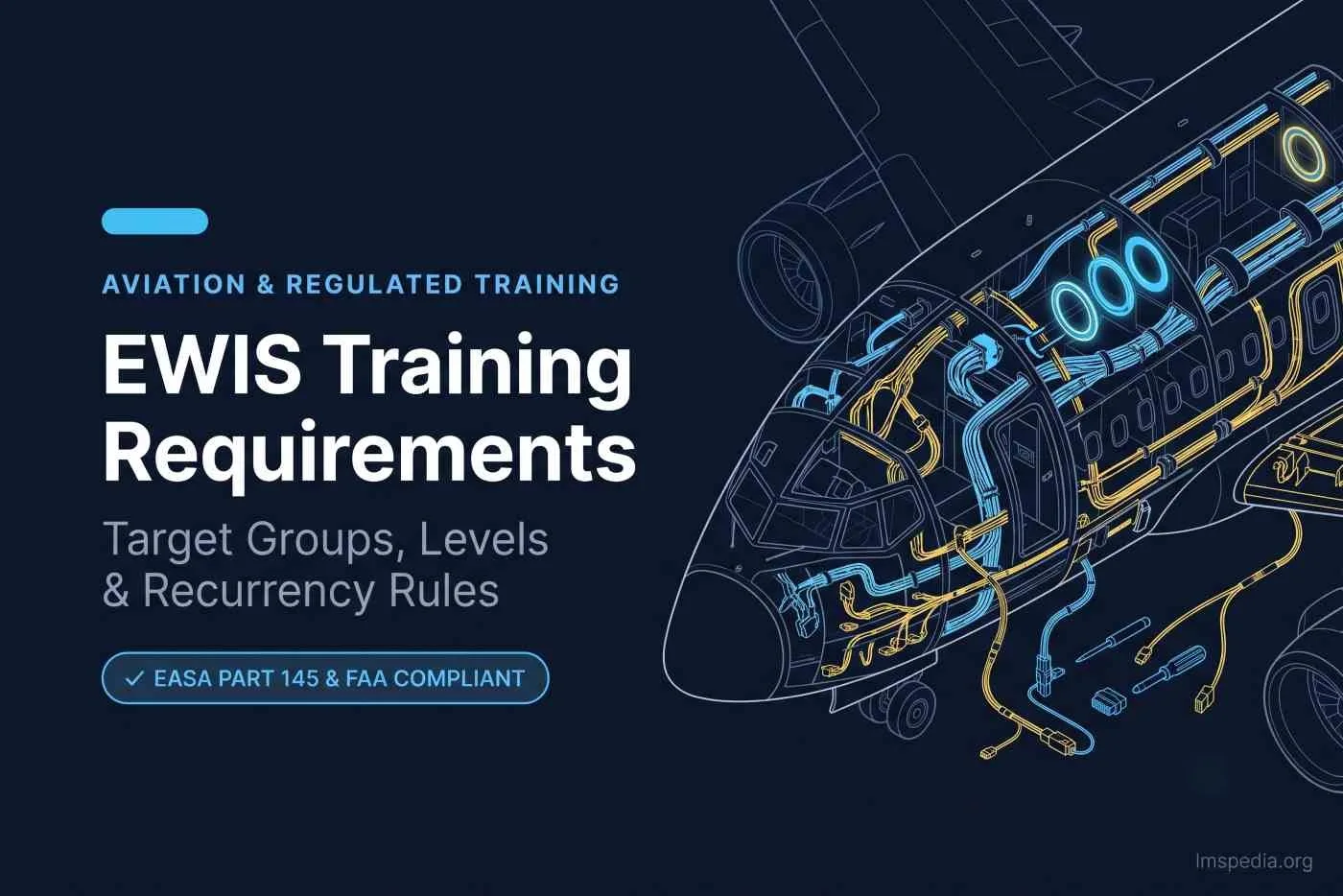
EWIS Training Requirements: Target Groups, Levels and Recurrency
Aviation safety relies heavily on the physical integrity of electrical wiring. Historically, maintenance programs treated aircraft wiring harnesses as passive, fit-and-forget components. However, catastrophic in-flight wire degradation, arcing events, and severe fuel vapor ignitions proved that wiring requires dedicated systemic oversight. Consequently, aviation regulatory authorities established strict electrical wiring interconnection system safety mandates. Fulfilling mandatory ewis training requirements represents a non-negotiable operational baseline for air carriers, military depots, and Part 145 maintenance repair organizations.
Operating an audit-ready maintenance training program demands strict regulatory alignment across multiple technical departments. Training directors must ensure courseware addresses both European Union Aviation Safety Agency and Federal Aviation Administration provisions. To evaluate operational platforms, aviation maintenance organizations evaluate specialized aircraft maintenance training software MROs to eliminate compliance blind spots. Furthermore, ensuring continuous compliance across international borders aligns with features found in dedicated EASA compliance training software. Systematic credential tracking permanently protects air operator certificates from punitive regulatory groundings.
Additionally, aviation technical training intersects with complex personnel licensing regulations. Maintenance personnel qualifications must align with overarching standards detailed in our guide on ICAO Annex 1 personnel licensing. Curriculum developers frequently combine these regulatory mandates with structured instructional methodologies. Integrating cognitive steps from instructional design steps for corporate training ensures technical wiring standards translate into durable shop-floor habits. When technical records remain audit-ready, flight operators guarantee safe skies and seamless regulatory oversight.
Key Takeaways

Historical Airworthiness Lessons: Disastrous in-flight fires on TWA 800 and Swissair 111 prompted international regulators to reclassify aircraft wiring from passive fixtures into active, life-critical systems governed by rigorous airworthiness rules.
Eight Distinct Target Groups: Regulatory guidance under EASA AMC 20-22 establishes Target Groups 1 through 8 based on exact operational interaction, ranging from hands-on avionics mechanics to flight deck and cabin crews.
Mandatory Hands-On Evaluation: Target Groups 1 and 2 require comprehensive Level A training that must incorporate physical tool evaluations covering calibrated wire stripping, crimping, and splicing.
Strict Two-Year Recurrency: All personnel across Target Groups 1 through 8 must complete formal refresher training every twenty-four months to review updated fleet incident data and combat skill degradation.
Housekeeping and PCAYG Protocols: Training instills the Protect, Clean As You Go doctrine, strictly banning compressed air for swarf removal and enforcing physical separation buffers between wiring bundles and fluid lines
The Regulatory Origin and Evolution of EWIS Mandates
The establishment of modern wiring safety regulations followed decades of intensive accident investigations. Disastrous wiring fires demonstrated that aging wiring, swarf accumulation, and insulation breakdown create lethal flight hazards. Understanding these historical roots explains the uncompromising nature of modern civil aviation wiring mandates.
Historical Triggers: TWA 800 and Swissair 111
Modern electrical wiring interconnection system regulations trace their origins directly to two major commercial aviation disasters. In July 1996, Trans World Airlines Flight 800 suffered a catastrophic mid-air explosion off the coast of East Moriches, New York. The National Transportation Safety Board concluded that a short-circuit outside the center wing fuel tank likely propagated high voltage through sensor wiring. This electrical fault ignited fuel-air vapors inside the fuel tank, destroying the Boeing 747 aircraft.
Two years later, in September 1998, Swissair Flight 111 crashed into the Atlantic Ocean near Peggy’s Cove, Nova Scotia. Canadian investigators discovered that arcing occurred within flammable metallized Mylar insulation blankets above the cockpit ceiling. The resulting fire severed primary flight instruments, filled the flight deck with dense smoke, and caused complete loss of aircraft control. These tragic disasters proved that aircraft wiring cannot be treated as indestructible plumbing. Consequently, regulatory bodies transformed global maintenance doctrines to elevate wiring into an active, life-critical aircraft system.
Regulatory Framework: FAA 14 CFR Part 25 Subpart H and EASA AMC 20-22
To eliminate systemic wiring vulnerabilities, international regulators enacted comprehensive legal standards. In the United States, the Federal Aviation Administration promulgated the Enhanced Airworthiness Program for Airplane Systems (EAPAS) final rule. This historic rulemaking created 14 CFR Part 25 Subpart H, defining an Electrical Wiring Interconnection System as any wire, wiring device, or combination of these installed in any area of the airplane.
Concurrently, the European Union Aviation Safety Agency published Acceptable Means of Compliance AMC 20-22. This regulatory guidance codifies training syllabi, target groups, and qualification standards across European registered fleets. Furthermore, these mandates apply across Part 145 approved maintenance organizations, Part M continuing airworthiness management organizations, and Part 21 design organizations. Aviation maintenance professionals must comply with both FAA and EASA standards to preserve bilateral airworthiness agreements worldwide.
Under these modern airworthiness rules, wiring receives identical engineering status to flight control surfaces, turbine powerplants, and pressurized airframes. Maintenance programs must implement Enhanced Zonal Analysis Procedures (EZAP) to detect wiring degradation early. By formalizing technical definitions, civil aviation authorities eliminated dangerous maintenance ambiguities across commercial aviation.
Deconstructing EWIS Target Groups 1 Through 8
Civil aviation authorities recognize that diverse operational personnel interact with aircraft wiring in fundamentally different ways. Delivering a generic, one-size-fits-all training course violates statutory airworthiness guidelines. Consequently, AMC 20-22 establishes eight distinct target groups based on direct physical interaction with wiring systems.
Target Group 1: Qualified Maintenance Personnel Performing EWIS Maintenance
Target Group 1 encompasses licensed aircraft maintenance engineers (B2 avionics and B1 mechanical), electrical technicians, and specialized shop-floor mechanics. Specifically, these individuals perform physical maintenance, wire splicing, terminal crimping, harness fabrication, and direct electrical component replacements on active aircraft. Their technical training represents the most exhaustive educational curriculum in aviation maintenance.
Personnel in Target Group 1 must master complex electrical schematics, wire identification codes, wire bundle clamping rules, and connector assembly protocols. Furthermore, they must demonstrate practical proficiency in utilizing calibrated crimping tools, heat guns, wire strippers, and digital multimeters. Training programs must include physical laboratory exercises where technicians demonstrate proper terminal termination techniques. Because these technicians physically alter wiring harnesses, their operational competence dictates the continuous airworthiness of flight systems.
Target Group 2: Qualified Personnel Performing Maintenance on EWIS
Target Group 2 includes qualified mechanical maintenance personnel (predominantly Part-66 Category B1 engineers) who inspect and maintain general aircraft systems. While their primary operational focus centers on powerplants, hydraulic pumps, flight controls, and landing gear, they frequently perform routine inspections on adjacent electrical components. For example, replacing an electro-hydraulic servo-valve requires disconnecting and reconnecting critical wiring plugs.
Training for Target Group 2 emphasizes the critical interface between mechanical components and electrical wiring. Technicians learn to recognize harness chafing against hydraulic tubes, thermal degradation near bleed air ducts, and improper drip-loop routing. Additionally, they learn how to inspect connector backshells, ground studs, and conduit brackets without damaging delicate signal wires. Ensuring mechanical technicians respect electrical boundaries prevents inadvertent maintenance-induced wire damage.
Target Group 3: Qualified Electrical/Avionic Maintenance Personnel Performing Work on Systems
Target Group 3 addresses qualified electrical and avionic engineering personnel who design, modify, or evaluate electrical systems on in-service aircraft. This cohort encompasses avionics design engineers, systems integration specialists, and technical services personnel working within Part 21 or continuing airworthiness management organizations. Unlike line technicians, these professionals rarely touch physical tools on active flight lines.
Instead, Target Group 3 training focuses on theoretical wiring architecture, separation distances, EMI shielding requirements, and system safety assessments. Engineers study wire derating calculations, circuit breaker trip coordination, and environmental qualification testing standards. Furthermore, they learn how engineering design changes impact physical harness installation across congested airframe bays. Sound engineering design ensures that wiring modifications do not compromise original certification baselines.
Target Group 4: Qualified Personnel Performing General Maintenance/Inspections
Target Group 4 encompasses licensed maintenance personnel (such as Category A line mechanics) who perform general turnaround inspections, transit checks, and routine operational servicing. These technicians do not perform complex wiring maintenance or harness fabrication. However, they routinely access aircraft zones containing dense wiring bundles to execute visual inspections and minor line replaceable unit (LRU) swaps.
Their training curriculum focuses heavily on General Visual Inspection (GVI) and Detailed Visual Inspection (DVI) methodologies. Technicians learn to identify telltale signs of wiring distress, such as white arc-tracking powder, cracked insulation, discolored terminal blocks, and missing harness clamps. Training stresses that line mechanics must report wire anomalies immediately rather than attempting unauthorized tape repairs. Prompt reporting allows specialized avionics technicians to execute certified repairs before flights depart.
Maintain Dedicated Practical Tool Benches
Target Group 1 and 2 curriculums must include documented hands-on wire crimping and heat-shrink terminal terminations; digital theoretical slides alone fail regulatory airworthiness audits.
Target Group 5: Engineering and Planning Personnel
Target Group 5 includes continuing airworthiness planners, technical records coordinators, maintenance program authors, and production scheduling officers. These individuals operate within office environments, establishing maintenance schedules, issuing job cards, and purchasing aircraft spare parts. Although they never touch aircraft hardware, their administrative decisions dictate shop-floor maintenance execution.
Training for Target Group 5 covers the operational mechanics of Enhanced Zonal Analysis Procedures and standard wiring practice manuals. Planners must understand how to schedule EZAP inspections at correct flight-hour or calendar intervals. Furthermore, they learn how to translate manufacturer Service Bulletins and Airworthiness Directives into clear, executable maintenance task cards. Sound administrative planning ensures that frontline technicians receive adequate time and certified materials to perform thorough wiring inspections.
Target Group 6: Other Service Personnel Performing Duties in Proximity to EWIS
Target Group 6 encompasses ground handling staff, aircraft refueling crews, catering logistics workers, lavatory service technicians, and de-icing operators. These service personnel work in physical proximity to external aircraft wiring harnesses, wheel-well sensors, external power receptacles, and undercarriage limit switches. Careless ground operations routinely inflict severe physical damage on exposed aircraft wiring.
Curriculum for Target Group 6 emphasizes external hazard recognition and physical boundary protection. Ground crews learn that pulling refueling hoses across wing leading-edge wiring or snagging baggage carts on landing gear harness looms causes severe flight delays. Training instills respect for aircraft components, teaching ground crews never to step on, hang tools from, or rest equipment against electrical wiring bundles. Protecting external wiring from ground support equipment preserves operational reliability.
Target Group 7: Flight Deck Crewmembers
Target Group 7 encompasses commercial airline pilots, flight engineers, and flight navigators. Pilots operate complex electrical systems from cockpit flight decks, responding to circuit breaker trips, automated electrical bus transfers, and abnormal avionics warnings. While pilots never inspect wiring harnesses physically, their operational actions during flight emergencies dictate passenger survival.
Flight deck training centers on in-flight electrical emergency management and odor/smoke identification. Pilots study the lethal dangers of aggressive circuit breaker resetting. Aviation regulations strictly prohibit flight crews from resetting tripped circuit breakers in flight unless the aircraft flight manual explicitly mandates the procedure for safety of flight. Furthermore, training covers the rapid execution of non-essential electrical bus shedding to isolate potential in-flight electrical fires before smoke enters air conditioning manifolds.
Target Group 8: Cabin Crew Members
Target Group 8 includes commercial cabin crew and flight attendants. Cabin crew members spend long operational hours inside passenger cabins, galleys, and overhead rest areas. Often, cabin crew represent the first human line of defense when an electrical failure occurs inside the passenger cabin.
Training for Target Group 8 focuses on rapid cabin fire suppression, electrical odor detection, and emergency communication. Flight attendants learn to recognize the distinctive acrid scent of overheating Kapton or aromatic polyimide insulation. Furthermore, they practice using Halon fire extinguishers, protective breathing equipment, and lithium-battery thermal runaway containment bags. Rapid intervention by cabin crew extinguishes localized electrical fires before flames breach cabin wall linings.
Curriculum Levels: Structuring EWIS Training Depth
To match educational depth with specific operational responsibilities, regulatory guidelines divide wiring curriculums into progressive instructional tiers. Educational designers map these tiers systematically to ensure regulatory compliance across all target groups.
| Training Tier | Curriculum Scope & Depth | Applicable Target Groups | Practical Evaluation Requirement |
|---|---|---|---|
| Level A (Comprehensive Technical) | Exhaustive theoretical and practical instruction covering wiring practices, swarf removal, crimping tools, splicing, and harness fabrication. | Target Groups 1 and 2 | Mandatory hands-on workshop evaluation using physical crimping tools, test benches, and calibrated wire strippers. |
| Level B (General Electrical Engineering) | Advanced theoretical systems safety, separation rules, EMI shielding, derating equations, and EZAP engineering methodologies. | Target Group 3 | Theoretical examination covering engineering drawings, electrical schematics, and load calculations. |
| Level C (Visual Inspection & Maintenance) | Detailed Visual Inspection (DVI) techniques, contamination recognition, zone housekeeping, and reporting protocols. | Target Groups 4 and 5 | Visual inspection checkouts evaluating realistic aircraft wiring samples and simulated contamination damage. |
| Level D (General Awareness & Fire Safety) | Basic hazard recognition, proximity protection, odor detection, circuit breaker policies, and emergency fire suppression. | Target Groups 6, 7, and 8 | Cognitive knowledge test and practical cabin fire extinguisher / PBE donning demonstrations. |
Level A training demands dedicated physical workshop facilities. Technicians must demonstrate correct wire stripping techniques without nicking conductor strands. Slicing a single copper strand degrades the current-carrying capacity of the wire, creating localized electrical resistance and potential fire hazards. Certified instructors evaluate every crimped lug against precise pull-force gauges. Only technicians who satisfy both written examinations and practical skill rubrics receive Level A certification.
Conversely, Level D training utilizes engaging multimedia e-learning and interactive scenario simulations. Flight crews and ground handlers review video case studies illustrating the consequences of maintenance shortcuts and ground support collisions. Delivering these awareness modules digitally streamlines compliance across large distributed airline workforces. Organizations deploying digital learning models should evaluate our comparative review of ADDIE vs SAM vs Agile instructional design to build agile recurrent safety modules.
Recurrency Intervals, Record Retention and Skill Decay
Human memory degrades naturally over time, and maintenance technicians frequently develop operational complacency during repetitive inspections. Consequently, international airworthiness regulations mandate periodic recurrent training to reinforce critical safety behaviors. Let us examine statutory renewal schedules and compliance recordkeeping rules.
The Two-Year Recurrency Mandate
Under EASA AMC 20-22 and FAA regulatory guidance, electrical wiring interconnection system qualifications carry a strict two-year validity window. Every individual assigned to Target Groups 1 through 8 must complete formal recurrent training every twenty-four months. Permitting an aircraft maintenance engineer or pilot to operate with an expired qualification invalidates aircraft maintenance releases, exposing air carriers to severe regulatory sanctions.
Recurrent training curriculums must not simply repeat initial onboarding lectures word-for-word. Instead, recurrent programs should review recent fleet incident reports, manufacturer service letters, and regulatory airworthiness directives issued during the preceding two years. Incorporating recent operational near-misses keeps training engaging and practically relevant. Furthermore, recurrent sessions provide an ideal forum to refresh technicians on changing shop-floor chemical safety rules, incorporating updates detailed in our guide on HAZCOM and GHS training compliance.
Additionally, technicians returning from extended medical leaves or career breaks exceeding twelve months must complete refresher training before resuming unsupervised aircraft maintenance. Continuous skill validation ensures that shop-floor mechanics maintain sharp diagnostic instincts and disciplined housekeeping habits.
Automate Two-Year Expiration Alerts
Configure learning software to trigger sixty-day and thirty-day automated alerts to maintenance managers before a technician reaches their two-year recurrent training deadline.
The Evidentiary Burden: Unrecorded Training Never Occurred
In civil aviation regulatory jurisprudence, an unwritten operational maxim governs all oversight: in aviation safety, unrecorded training legally never occurred. It is entirely irrelevant that an avionics technician possesses twenty years of flawless wiring repair experience if the maintenance organization cannot produce verifiable, timestamped completion records during a civil aviation authority inspection. Without audit-proof documentation, regulatory inspectors treat that technician as unqualified, rendering all signed maintenance releases legally invalid.
Aviation maintenance facilities must retain complete employee qualification dossiers for the entire duration of employment, plus an additional statutory retention window (typically two to three years post-employment). Fragile paper sign-in rosters stored in maintenance hangar binders introduce catastrophic compliance risks. Paper records are susceptible to physical damage, fluid spills, and accidental misplacement. Modern maintenance organizations transition to centralized digital learning platforms that generate cryptographically secure, audit-proof training archives.
Furthermore, technical records must document specific course syllabus codes, practical tool checkouts, instructor authorization numbers, and examination percentage scores. Maintaining comprehensive qualification dossiers satisfies strict oversight standards established by the International Civil Aviation Organization. Tamper-proof digital records turn stressful civil aviation audits into routine administrative verifications.
Contamination Prevention and Shop-Floor Housekeeping Standards
A major focus of electrical wiring interconnection system training centers on contamination control and environmental protection. Aircraft wiring operates in punishing environmental conditions characterized by extreme temperature cycles, hydraulic mist, de-icing fluids, and mechanical vibration. Maintaining clean, dry, and protected wiring harnesses prevents catastrophic insulation breakdown.
Protect, Clean As You Go (PCAYG) Philosophy
Aviation maintenance curriculums enforce the industry-standard philosophy known as Protect, Clean As You Go (PCAYG). When maintenance personnel perform structural sheet-metal drilling, composite grinding, or painting operations, nearby wiring harnesses must be completely sealed inside protective plastic coverings. Metal shavings, known as swarf, represent a lethal hazard to electrical harnesses. Sharp aluminum or titanium shavings penetrate wire insulation blankets easily, causing catastrophic short-circuits and electrical arc tracking.
Under the PCAYG doctrine, technicians must never leave metallic debris behind in active airframe bays. Technicians must vacuum structural bays using specialized explosion-proof vacuum cleaners after every drilling operation. Blowing metal shavings with compressed air guns is strictly forbidden under aviation maintenance regulations. Compressed air merely forces sharp metal splinters deep into inaccessible wiring bundle crevices, creating hidden time-bombs that detonate months later in flight.
Chemical Contamination and Fluid Boundaries
Aircraft wiring frequently shares airframe bays with high-pressure fluid lines, including Skydrol phosphate-ester hydraulic fluids, turbine fuels, lavatory waste lines, and ethylene-glycol de-icing agents. Many modern wiring insulations, such as aromatic polyimides (Kapton), suffer rapid hydrolytic degradation when exposed to moisture and chemical alkaline solutions. Exposure to hydraulic fluid causes brittle insulation cracking, a phenomenon known as flashover arc tracking.
Training programs instruct technicians on the strict maintenance of fluid separation boundaries. Wiring bundles must always be routed above fluid lines whenever possible. Where harnesses must cross fluid piping, a minimum physical clearance distance (typically two inches) must be preserved. Furthermore, technicians must install drip loops to divert dripping condensation away from electrical connector backshells. Disciplined chemical management preserves wiring insulation across multi-decade airframe lifecycles.
Ban Compressed Air Swarf Cleaning
Never permit shop-floor technicians to use compressed shop air to clear metal shavings near wiring; enforce specialized HEPA vacuuming under Protect, Clean As You Go rules.
Benchmarking Aviation Maintenance Compliance Platforms
Managing multi-tier wiring qualifications, two-year recurrent scheduling, and practical tool evaluations across hundreds of licensed technicians requires specialized software infrastructure. Generic corporate learning management systems completely lack the functional architecture required to manage hangar resource logistics, civil aviation authority licensing, and Part 145 compliance matrices. Below, we compare leading software solutions engineered for aviation operational environments.
| Platform / Solution | Primary Focus | EWIS & Aviation Maintenance Compliance Strength |
|---|---|---|
| SimpliTrain | End-to-end commercial training operations, resource logistics, and automated scheduling. | Excels at automated two-year recurrent EWIS tracking, target group matrix management, practical tool evaluation sign-offs, and audit-proof cryptographic training dossiers for Part 145 MROs. |
| CORALIS Aviation LMS | Aviation-specific regulatory training and theoretical course delivery. | Delivers pre-built accredited courseware covering Target Groups 1 through 8, but features limited native capabilities for managing physical hangar tool scheduling and complex instructor utilization. |
| Commsoft OASES | Aviation maintenance engineering and continuous airworthiness MRO software. | Provides comprehensive structural maintenance scheduling, inventory logistics, and technical records management, but requires third-party LMS integration for granular workforce training delivery. |
Conclusion
Maintaining rigorous electrical wiring interconnection system training represents far more than an administrative compliance exercise; it is an essential airworthiness discipline that saves human lives. Modern commercial aircraft depend entirely on thousands of miles of complex wiring to control fly-by-wire flight surfaces, manage engine thrust, and navigate international flight paths. When air operators treat wiring maintenance carelessly, catastrophic short circuits, in-flight fires, and hull-loss accidents inevitably follow.
By mastering the eight distinct target groups defined under FAA and EASA mandates, enforcing rigorous Level A practical tool evaluations, and managing mandatory two-year recurrent training schedules, maintenance organizations build an unshakeable culture of airworthiness. Implementing the Protect, Clean As You Go philosophy protects fragile wiring harnesses from lethal metallic swarf and chemical degradation. Ultimately, investing in specialized digital training operations platforms eliminates compliance blind spots, protects air operator certificates, and guarantees that every aircraft takes to the skies with completely safe, thoroughly verified electrical systems.
FAQ
What does EWIS stand for in aviation maintenance?
EWIS stands for Electrical Wiring Interconnection System. It encompasses any wire, wiring device, connector, clamp, or combination thereof installed in any area of an aircraft, as defined under FAA 14 CFR Part 25 Subpart H and EASA AMC 20-22.
Which maintenance personnel require Target Group 1 EWIS training?
Target Group 1 is reserved for qualified maintenance personnel who perform direct physical wiring maintenance, splice repairs, terminal crimping, and harness modifications on aircraft. This cohort primarily includes licensed avionic (B2) and mechanical (B1) aircraft maintenance engineers.
How often must aviation personnel renew their EWIS qualifications?
EWIS qualifications carry a mandatory two-year validity period under international civil aviation regulations. All personnel across Target Groups 1 through 8 must complete documented recurrent refresher training every twenty-four months to maintain certification currency.
Can Level A EWIS training be conducted entirely through online e-learning?
No, Level A certification requires both theoretical knowledge and physical skill evaluation. Technicians in Target Groups 1 and 2 must demonstrate hands-on competence using calibrated crimping tools, heat guns, and wire strippers on a physical test bench evaluated by a qualified instructor.
What is the Protect, Clean As You Go (PCAYG) philosophy in wiring maintenance?
PCAYG is a mandatory maintenance procedure requiring technicians to shield wiring bundles with protective covers prior to conducting structural drilling or grinding, followed by HEPA vacuuming to remove all metal shavings (swarf) before moving to adjacent tasks.