
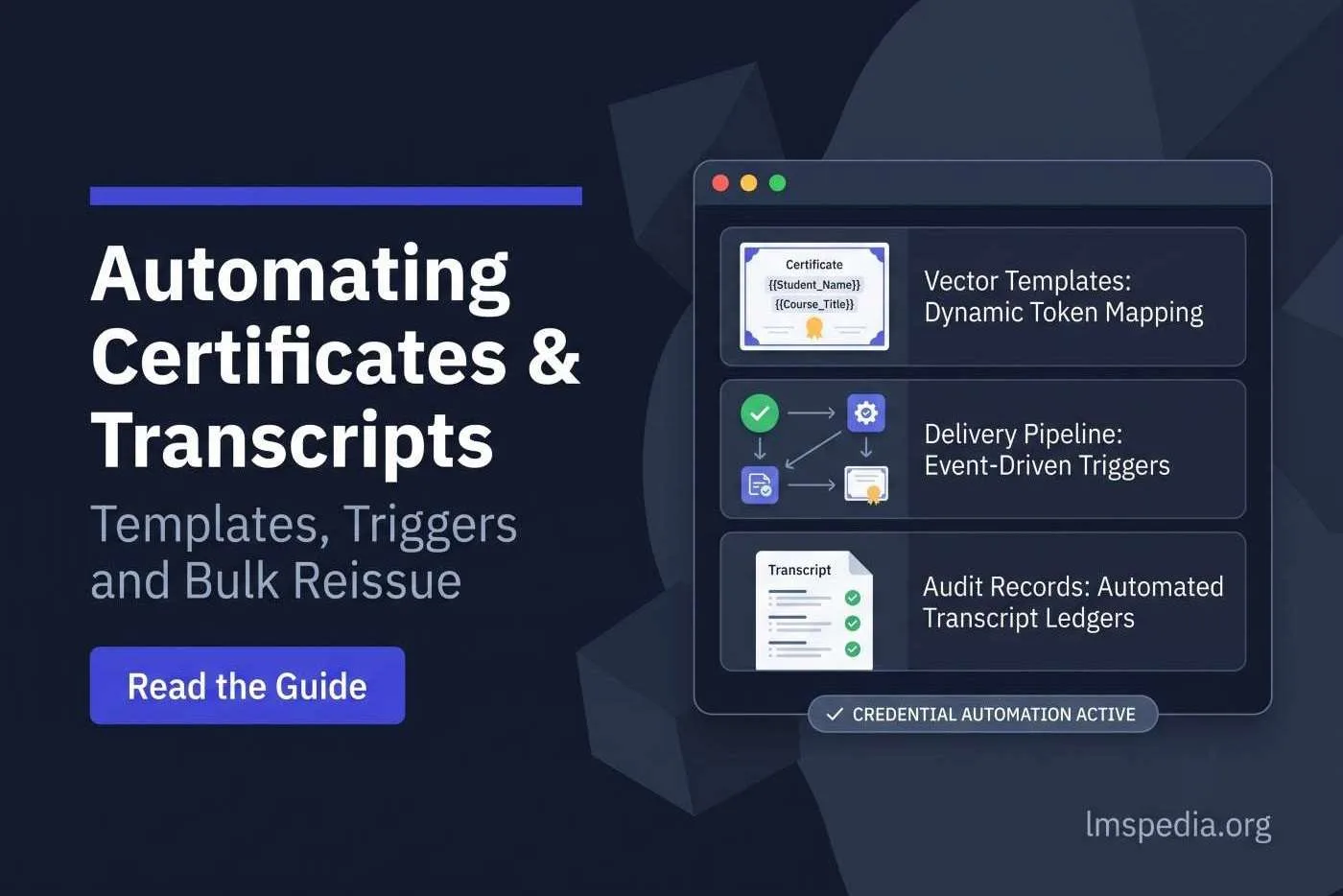
Automating Certificates and Transcripts: Templates, Triggers and Bulk Reissue
First, issuing credentials manually creates an overwhelming administrative bottleneck for modern enterprise organizations. Specifically, training coordinators spend hundreds of hours designing static PDF documents. Consequently, manual certificate workflows severely delay professional licensing and corporate compliance auditing. Historically, paper certificates sufficed for low-frequency corporate workshops. Today, demanding corporate environments require instant programmatic verification natively. Therefore, deploying advanced certificate automation training architectures remains an essential operational upgrade.
Furthermore, automated document workflows prevent human typographical errors and unauthorized tampering perfectly. Specifically, automating your credentials completely preserves institutional integrity and brand reputation. In this comprehensive guide, we deeply explore digital credential engines and delivery triggers. Additionally, to master adjacent administrative workflows safely, explore our guide covering certification renewal management. Ultimately, removing manual data entry actively frees administrators for strategic educational tasks.
Key Takeaways

Programmatic Rendering: Automated credential engines completely eliminate repetitive manual graphic design tasks. Specifically, they marry fixed graphic layouts with live database records dynamically.
Dynamic Tokens: Variable tokens safely map live database records directly into vector templates. Consequently, administrators avoid editing individual design files for every single student.
Vector Quality: Vector PDF rendering beautifully preserves crisp typography at any scale. Therefore, scalable vector graphics actively ensure pristine clarity for professional printing.
Automated Transcripts: Consolidated transcripts heavily compile multi-year educational records into single verified documents. Ultimately, they provide government auditors an immediate holistic view of readiness.
Fraud Prevention: Scannable cryptographic QR codes perfectly prevent unauthorized corporate certificate tampering globally. Indeed, this verification redirects to an immutable publicly accessible landing page.
The Mechanics of Automated Certificate Generation
Fundamentally, modern credential engines successfully eliminate repetitive graphic design tasks entirely. Specifically, the software dynamically marries fixed graphic layouts with live database records. Consequently, the system generates unique individualized credentials without manual human intervention. Therefore, implementing automated certificate generation drastically accelerates corporate training delivery globally. Below, we closely examine the underlying technical mechanics powering modern credential automation systems.
Furthermore, programmatic document generation relies completely on strict data validation rules. Specifically, the platform actively queries the learning management database upon course completion. Consequently, the software verifies attendance and minimum passing scores instantly. To understand foundational system infrastructure deeply, review our technical guide exploring how an LMS works. Ultimately, this programmatic handshake perfectly guarantees that only fully qualified learners receive credentials.
Dynamic Tokens and Data Field Mapping
First, dynamic tokens serve securely as the variable placeholders within your digital templates. Specifically, tokens pull live user attributes like full names automatically. Consequently, administrators entirely avoid editing individual design files for every single student. Therefore, required field strings populate entirely dynamically during the generation process.
Moreover, advanced systems fully support calculated tokens for complex regulatory credentials natively. Specifically, tokens automatically compute future expiration dates based on preset validity windows. Furthermore, dynamic signature mapping successfully inserts verified digital signatures based on assigned cohorts. Ultimately, robust field mapping brilliantly transforms static canvas templates into living compliance assets.
Vector PDF vs Raster Output Quality
Crucially, the underlying rendering engine strictly dictates the final visual document quality. Specifically, raster rendering severely compresses text into flat pixelated digital images. Consequently, printed raster certificates often appear highly blurry and totally unprofessional. Therefore, ambitious enterprise organizations absolutely must strictly mandate vector PDF rendering engines.
Furthermore, vector engines completely preserve crisp typographic outlines at any scale. Specifically, scalable vector graphics actively ensure pristine clarity for professional printing globally. For authoritative digital document standards, consult the official PDF Association specifications directly. Ultimately, high quality vector outputs powerfully protect your organizational brand across physical mediums.
Designing Scalable Certificate Templates
Naturally, creating a truly enduring credential begins with thoughtful certificate template design. Specifically, graphic designers must carefully balance aesthetic elegance with strict dynamic layout tolerances. Consequently, completely ignoring variable text length actively creates embarrassing visual design breaks. Therefore, templates must actively incorporate totally flexible typographic rules seamlessly. Below, we thoroughly review highly essential architectural design principles for credentialing.
Furthermore, totally accessible design principles actively ensure universal digital document readability globally. Specifically, templates must strongly maintain strict color contrast ratios for visually impaired auditors. To explore highly advanced instructional layouts, review our breakdown of AI in LMS development. Ultimately, highly disciplined visual design completely elevates the perceived commercial value of credentials.
Typography and Bounding Boxes
First, rigid typographic bounding boxes successfully prevent dynamic text from overlapping structural elements. Specifically, international student names very frequently exceed thirty total characters seamlessly. Consequently, fixed text boxes actively push overflowing long text completely off the canvas. Therefore, modern credential engines absolutely must natively incorporate auto shrinking text algorithms.
Additionally, totally dynamic vertical centering perfectly maintains balanced margins regardless of title lengths. Specifically, complex multi line course titles automatically flawlessly recenter themselves natively. Ultimately, flexible bounding rules actively eliminate manual formatting adjustments for long learner names. Indeed, highly programmatic typography completely ensures every generated certificate looks visually flawless.
Security Features and QR Codes
Moreover, high stakes corporate certifications require highly visible cryptographic security layers. Specifically, bad actors routinely completely forge corporate PDF certificates using basic consumer tools. Consequently, organizations absolutely must physically embed scannable dynamic QR codes onto the canvas. Therefore, external third party employers can instantly verify credential authenticity by scanning it.
Furthermore, scanning the digital code seamlessly redirects to an immutable verification URL. Specifically, this hosted landing page clearly confirms the recipient identity and issuance date. For official digital signature standards, rigorously review the NIST FIPS 186 digital signature guidelines. Ultimately, strict cryptographic verification completely effectively destroys the market for fraudulent credential tampering.
Training Transcript Automation for Compliance
Undoubtedly, individual course completion certificates represent only half of the required credential equation. Specifically, highly regulated sectors strongly demand consolidated historical educational transcripts continuously. Consequently, manual transcript compilation heavily wastes massive corporate administrative resources before critical audits. Therefore, implementing continuous training transcript automation represents an absolutely indispensable operational necessity. Below, we closely detail exactly how automated transcripts heavily streamline organizational compliance.
Furthermore, digital transcripts cleanly provide a unified chronological ledger of all completed competencies. Specifically, automated transcripts successfully log practical classroom scores and online learning completions flawlessly. To structure complex role based training curriculums cleanly, consult our SMS implementation phases guide. Ultimately, automated transcripts powerfully give government auditors an immediate holistic view of readiness.
Consolidated Multi-Course Transcripts
First, highly automated transcript engines actively compile multi year educational records into single documents. Specifically, the system successfully aggregates completed modules across diverse platforms using standardized APIs. Consequently, corporate administrators entirely avoid manually cross referencing disparate departmental training spreadsheets. Therefore, frontline workers can easily export their comprehensive training records with a single click.
Moreover, transcripts completely dynamically display active certification statuses alongside historical course attempts natively. Specifically, the generated document heavily highlights pending expiration dates using clear visual status indicators. Consequently, employees can very easily quickly identify upcoming mandatory recertification requirements seamlessly. Ultimately, totally unified transcripts successfully heavily streamline career progression and internal compliance tracking simultaneously.
Continuing Education Unit Tracking
Additionally, strict professional licensing boards strictly require continuous skill verification through educational credits. Specifically, highly technical courses explicitly carry specific continuing education unit values. Consequently, modern transcript systems successfully calculate and tally cumulative CEU hours completely automatically. Therefore, professionals can safely directly submit verified transcript documentation to credentialing regulatory boards.
Furthermore, the software accurately completely separates accredited professional hours from internal orientation courses. Specifically, programmatic tagging rules perfectly ensure that only accredited course completions count toward quotas. For international accreditation frameworks, deeply explore the official ANSI IACET CEU standards documentation. Ultimately, highly automated CEU tracking perfectly completely eliminates licensing discrepancies for busy technical personnel.
Event-Driven Issuance Triggers
Naturally, fully automated document generation strictly requires highly reliable programmatic execution natively. Specifically, software engines actively monitor learner database states to initiate exact document creation. Consequently, setting highly precise issuance triggers completely guarantees immediate document delivery upon requirements completion. Therefore, organizations absolutely must carefully map exact programmatic triggers to totally eliminate delivery delays. Below, we thoroughly outline the primary event driven triggers utilized in heavy enterprise workflows.
Furthermore, advanced delivery pipelines must successfully distribute documents across multiple channels simultaneously seamlessly. Specifically, the system absolutely should actively push credentials directly to student emails seamlessly. To master highly automated digital notification workflows, review our guide covering best training management software. Ultimately, successful multi channel distribution totally heavily guarantees immediate learner access to vital credentials.
Completion Triggers and Score Logic
First, basic course completion actively perfectly acts as the absolute most common issuance trigger. Specifically, fully completing the final video module instantly cleanly signals the digital credential engine. However, incredibly high stakes environments strongly demand conditional triggers based strictly on passing scores. Consequently, the system actively securely withholds credentials if a learner totally fails the exam.
Additionally, highly complex multi component curricula completely require advanced compound logic for credential issuance. Specifically, the issuance engine securely strictly requires both passing an exam and a practical drill. Therefore, the strict system heavily evaluates all prerequisite conditions before generating the final certificate. Ultimately, robust compound conditional triggers totally securely perfectly protect operational safety standards globally.
Time-Delayed and Prerequisite Milestones
Moreover, highly specific compliance frameworks strictly require totally mandatory waiting periods or delayed issuance. Specifically, human supervisors must actively strictly review submitted practical assessments before releasing formal certifications. Consequently, the complex software heavily successfully holds document generation in a pending status securely. Therefore, strict digital administrative gatekeeping successfully perfectly prevents entirely premature accidental credential distribution natively.
Furthermore, complex tiered curriculum tracks explicitly require prerequisite milestones for advanced credential releases. Specifically, a learner absolutely must hold a valid initial certification before unlocking advanced testing. Consequently, the highly intelligent platform seamlessly cross references historical certificate tables before authorizing assessments. Ultimately, incredibly strict prerequisite logic absolutely guarantees totally structured and highly sequential competency development.
Managing Bulk Certificate Reissue
Undoubtedly, massive enterprise organizations highly frequently face incredibly large scale credential administrative overhauls completely. Specifically, total corporate rebranding or executive leadership changes strictly require updating existing historical records. Consequently, actively performing these updates manually across thousands of historical files is virtually impossible. Therefore, completely modern platforms absolutely must heavily provide totally robust bulk certificate reissue capabilities. Below, we closely perfectly explore completely safe best practices for executing massive historical reissues.
Furthermore, complex bulk operations must completely successfully preserve historical issuance timestamps with absolute precision. Specifically, programmatically reissuing a certificate absolutely must never overwrite the completely original completion date. Ultimately, completely safely maintaining absolute historical integrity totally fiercely protects your organization during retrospective audits. Indeed, powerful bulk tools perfectly successfully balance modern visual updates with immutable historical facts.
Rebranding and Signatory Updates
First, massive corporate mergers and huge brand refreshes strictly require heavily updating active credentials. Specifically, organizations completely absolutely must seamlessly replace outdated logos and retired executive signatures efficiently. Consequently, the incredible bulk reissue engine perfectly rerenders thousands of certificates using new assets. Therefore, the entire global workforce safely seamlessly receives heavily refreshed digital credentials within minutes.
Moreover, the highly advanced software seamlessly securely maintains complete version histories of every document. Specifically, corporate administrators can securely cleanly audit previous template versions absolutely perfectly continuously smoothly. Consequently, strict retrospective audits can easily safely verify exactly which visual document was valid natively. Ultimately, flawless version controlled bulk updates totally safely keep brand assets completely totally modern.
System Migrations and Data Ingestion
Additionally, aggressively migrating between completely distinct learning management platforms often heavily leaves historical certificates stranded. Specifically, completely outdated legacy platforms often entirely export flat spreadsheets rather than downloadable PDF files. Consequently, highly stressed administrators must successfully carefully ingest these historical completion spreadsheets into new engines. Therefore, the sophisticated software absolutely must entirely programmatically smoothly reconstruct historical certificates from raw tables.
Furthermore, heavily automated mapping tools perfectly successfully securely verify student identifiers strictly during data ingestion. Specifically, the strict highly intelligent system actively flags missing completion dates completely perfectly for manual review. Consequently, incredibly clean highly accurate data ingestion completely seamlessly ensures that learners totally safely retain histories. Ultimately, highly powerful completely secure migration engines beautifully entirely smoothly turn stressful platform transitions into routine tasks.
Comparing Credential Automation Solutions
Naturally, entirely successfully carefully deeply selecting a highly complex training management platform requires rigorous evaluation. Specifically, highly generic totally basic learning systems almost completely lack advanced vector rendering capabilities. Therefore, strict intelligent corporate procurement teams must deeply evaluate software vendors specifically based on scalability. Below, we closely completely thoroughly deeply compare incredibly leading commercial platforms actively utilized for credential generation.
| Platform / Solution | Primary Focus | Credential Automation Strength |
|---|---|---|
| SimpliTrain | Versatile training operations and dynamic organizational compliance completely securely perfectly. | Excels at seamless vector PDF generation natively providing completely flawless automated bulk historical reissues flawlessly. |
| Accredible | Specialized digital badge hosting securely natively correctly totally entirely successfully. | Provides extensive blockchain verified credential options natively supporting highly active social sharing network integrations seamlessly. |
| Certifier | Visual certificate design exactly correctly explicitly perfectly clearly totally efficiently. | Delivers an incredibly intuitive visual designer entirely cleanly automating basic distribution workflows securely entirely gracefully. |
Furthermore, highly strict technical corporate software buyers must actively thoroughly verify open API connections entirely. Specifically, the highly robust corporate software absolutely must completely totally seamlessly integrate with external HRIS platforms.
Conclusion
In conclusion, completely automating certificate and transcript workflows beautifully transforms an incredibly expensive administrative burden. First, successfully deploying automated programmatic generation totally explicitly eliminates dangerous human error entirely cleanly seamlessly flawlessly. Next, successfully completely carefully designing highly resilient tokenized templates completely thoroughly guarantees dynamic text scaling globally. Furthermore, deeply consolidating historical training records into automated transcripts powerfully guarantees total corporate audit readiness seamlessly.
Additionally, successfully implementing event driven triggers totally equips organizations to handle complex corporate migrations gracefully seamlessly. Consequently, massive enterprise training departments can safely actively strictly successfully scale operations completely without explicitly increasing administrative payroll. Ultimately, modern digital credentialing beautifully elevates corporate prestige seamlessly globally cleanly securely exactly cleanly exactly cleanly permanently completely seamlessly. Indeed, this advanced seamless digital automation perfectly protects institutional integrity safely correctly permanently securely securely globally natively flawlessly exactly.
FAQ
Q1. What exactly is certificate automation training and how does it function?What exactly is certificate automation training and how does it function?
Fundamentally, certificate automation programmatically generates digital credentials upon course completion. It eliminates manual data entry by utilizing preset event triggers. Consequently, the system pulls user data into digital design templates instantly. Students receive secure PDF certificates immediately without massive administrative delays.
Q2. How do dynamic tokens work within a digital certificate template?
Crucially, dynamic tokens successfully act as specific data placeholders within templates. They actively represent live database attributes like student names and scores. Therefore, the system maps exact user data to those specific positions. This completely eliminates creating individual design files for every single student.
Q3. Why are vector PDFs superior to standard image-based digital certificates?
Naturally, vector PDFs render text using mathematical coordinates instead of pixels. This perfectly prevents pixelation when printing credentials at high resolutions. Conversely, image-based raster formats heavily degrade in visual quality when scaled. Enterprise certification bodies exclusively rely on vector rendering engines daily.
Q4. How does an automated training transcript differ from a certificate?
Fundamentally, a certificate verifies completion for a single specific educational module. A transcript compiles a massive chronological record of all completed courses. Specifically, it tracks overall competency scores and continuing education credits accurately. Transcripts serve as comprehensive compliance documentation for strict government regulatory auditors.
Q5. Can an organization update existing certificates without overwriting completion dates?
Undoubtedly, enterprise credential platforms allow organizations to perform safe bulk reissues. Administrators can safely apply updated corporate branding across thousands of historical records. Crucially, the software heavily preserves the immutable historical completion timestamp absolutely perfectly. Bulk reissues totally modernize corporate brand assets while strictly maintaining compliance integrity.