CPD Accreditation Management: Verifying Continuing Education and Credits
Professional development requires rigorous structural oversight across all major commercial sectors. Specifically, recognized associations and statutory licensing boards demand strict adherence to continuing education benchmarks. Therefore, effective cpd accreditation management remains absolutely critical for licensed professionals and commercial training providers. Without precise administrative systems, practitioners risk losing their professional licenses and legal practice credentials. Consequently, commercial education organizations must build robust, highly automated tracking architectures to protect learner standing.
Furthermore, the global regulatory landscape grows increasingly complex each year. Historically, simple paper attendance rosters satisfied most regional licensing boards during baseline reviews. Today, regulators demand irrefutable digital proof of actual knowledge retention and verifiable participation. Ultimately, building a resilient administrative infrastructure ensures your training organization easily survives stringent regulatory audits. In this comprehensive guide, we explore the mechanical workflows required to verify continuing education units globally.
Diverse Terminology, Universal Goals: While North America primarily utilizes Continuing Education Units (CEUs) and Europe uses Continuing Professional Development (CPD) points, both frameworks mandate strict tracking of ongoing professional competency.
Approval Requires Intense Scrutiny: Becoming an accredited training provider requires submitting detailed syllabi, proving instructor qualifications, and aligning closely with governing bodies like IACET or ACCME. Attendance Is Not Enough: Modern regulators demand proof of knowledge retention. Providers must implement rigorous assessments and track retake attempts to legally validate earned credits.
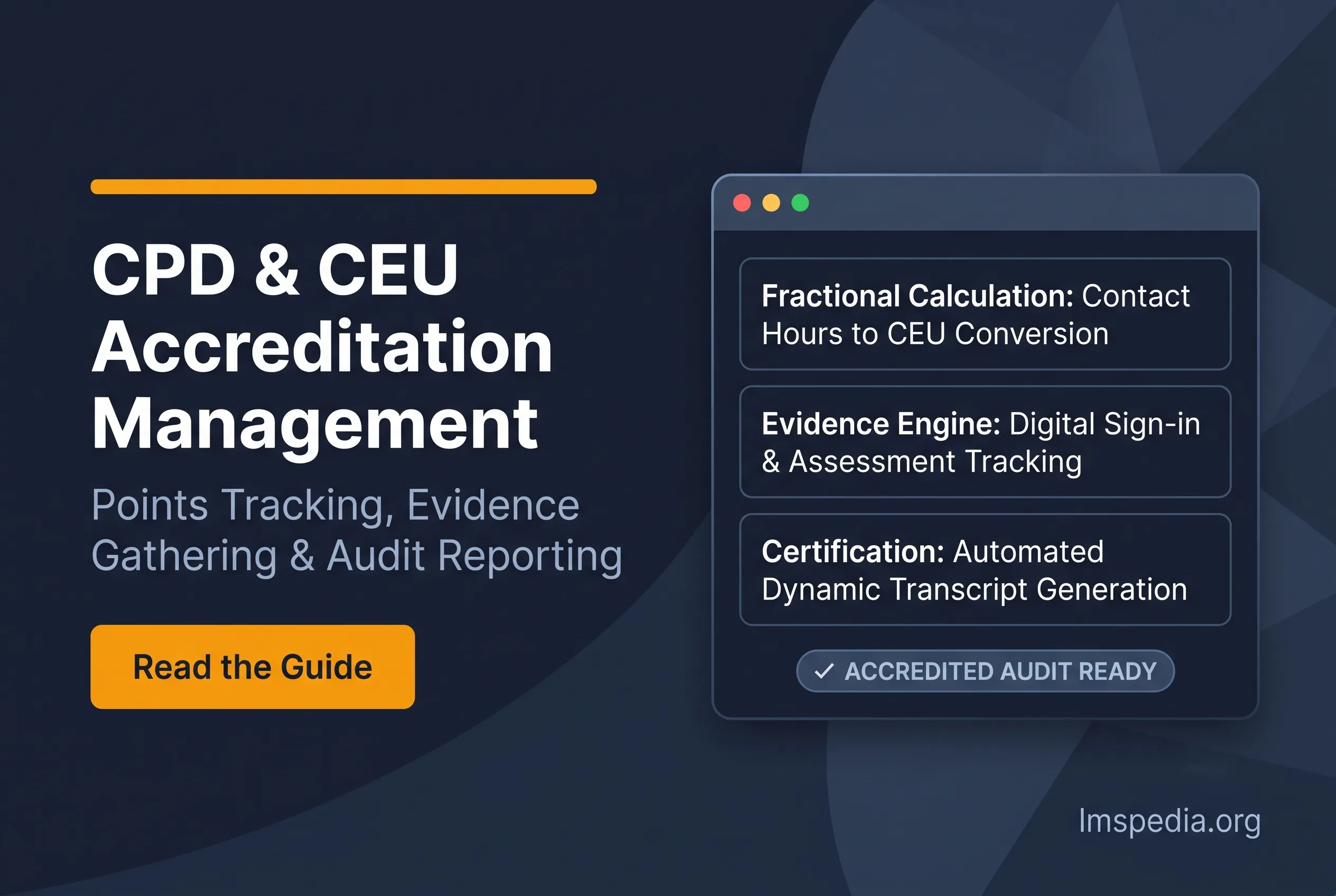
Manual Tracking Invites Audit Failure: Relying on paper sign-in sheets and manual Excel data entry creates formatting errors and delays certificate issuance, severely risking compliance status during formal audits. Software Automates Compliance: Purpose-built Training Management Systems (TMS) calculate fractional credit math, generate automated localized certificates, and preserve the immutable audit trails required by industry regulators.
Key Takeaways

Understanding Continuing Education Units (CEUs) and CPD
Globally, distinct geographic regions utilize entirely different standards to measure ongoing adult professional learning. First, Continuing Professional Development (CPD) dominates European, Asian, and global corporate governance frameworks. Meanwhile, Continuing Education Units (CEUs) serve as the traditional benchmark across North American markets. Ultimately, both distinct credentialing models track the identical educational objective.
Specifically, these frameworks ensure credentialed professionals actively maintain their technical industry competence throughout their careers. Falling behind on required credit totals renders an active practitioner legally unqualified. Therefore, training organizations must understand the mathematical logic governing each distinct regional system. By mastering these regulatory conversion metrics, commercial providers can confidently market their course catalogs internationally. To streamline these operational workflows, exploring specialized training compliance management software helps education businesses automate credential issuance.
Defining CPD Points Tracking
Typically, many European regulatory bodies operate using a very strict points-based system. For instance, one hour of active instructional learning usually equals one specific CPD credit point. Therefore, accurate cpd points tracking requires extreme administrative precision from the hosting training provider. Specifically, training organizations must calculate these points down to the exact contact minute of live instruction.
Furthermore, professional attendees demand instant digital certificates immediately after a seminar concludes. Consequently, administrators cannot spend weeks manually calculating points in messy, detached spreadsheets. Modern professionals expect automated digital wallets that instantly reflect their updated professional credentials. Delivering this seamless digital experience builds substantial brand loyalty for commercial training operations.
Mastering CEU Credit Management
Conversely, North American institutions often issue highly specific fractional academic continuing education credits. For example, ten contact instructional hours usually equal exactly one full CEU credit. Consequently, precise ceu credit management demands highly accurate mathematical conversions within your core administrative software. Crucially, event planners cannot simply distribute generic, unverified attendance certificates.
Instead, commercial academies must issue formal transcripts aligning perfectly with accredited organizational standards. Generating these fractional credits manually introduces severe human mathematical error into learner transcripts. Specialized software platforms handle these complex fractional conversions invisibly in the background. To understand how to properly construct effective corporate learning curriculums, examine our analysis of the best TMS professional development training.
The Legal Stakes of License Renewal
Importantly, training administrators must fully respect the severe legal stakes surrounding professional accreditation. First, licensed medical professionals literally cannot practice medicine without current, verifiable continuing education credits. Similarly, certified public accountants lose their legal signing authority if their state-mandated credits expire. Therefore, your commercial training operation essentially protects the active career livelihood of the learner.
Consequently, if your platform fails to report their earned credits accurately, practitioners face catastrophic professional repercussions. Furthermore, frustrated professionals will instantly damage the public market reputation of an unreliable training provider. Ultimately, investing in flawless data architecture protects your clients and shields your corporate reputation permanently. Clean data pipelines prevent contentious administrative disputes with licensing boards.
Automate Fractional Credit Math
Configure your training administration engine to calculate fractional CEUs down to the exact contact minute to eliminate human calculation errors on issued certificates.
Meeting Accredited Training Provider Requirements
Fundamentally, private educational organizations cannot simply invent their own proprietary professional credits. First, you must earn formal provider approval from a recognized, accredited industry governing body. Consequently, satisfying strict accredited training provider requirements involves intense initial administrative scrutiny. Specifically, regulatory bodies deeply audit your instructional design and ongoing assessment methodologies.
Furthermore, this rigorous approval process prevents fraudulent educational operations from selling unverified certificates. Legitimate commercial providers must welcome this scrutiny as a powerful competitive commercial advantage. Ultimately, securing official accreditation immediately elevates your training catalog above uncertified market competitors. To explore baseline standards across professional sectors, consult the International Accreditors for Continuing Education and Training portal.
Structuring the Application Process
Initially, the formal accreditation journey begins with a massive, highly detailed documentation submission. Specifically, providers must submit comprehensive course syllabi, assessment rubrics, and exact behavioral learning objectives. Furthermore, they must physically prove their hired instructors hold relevant terminal degrees and active licenses. Every instructional asset undergoes thorough evaluation by academic committees.
For example, medical continuing educators must rigorously align with the Accreditation Council for Continuing Medical Education guidelines. Consequently, you must document every single potential conflict of interest regarding pharmaceutical commercial sponsors. Reviewing these strict disclosures requires pristine document version control across administrative teams. Ultimately, this initial regulatory approval phase can take several painstaking months to complete.
Maintaining Rigorous Educational Standards
After earning initial provider approval, the real ongoing administrative challenge truly begins. Specifically, you must continuously prove that your educational delivery remains absolutely consistent with approved standards. Regulators demand highly transparent feedback loops directly from actual paying learners. Therefore, providers must distribute mandatory post-course evaluation surveys to every single attendee.
Additionally, you must actively incorporate this learner feedback into future curriculum revisions. If external auditors discover stagnant or outdated content during periodic reviews, they will instantly revoke your provider status. Furthermore, losing your accreditation immediately destroys your recurring commercial revenue streams. Continuous quality improvement protects your valuable educational brand asset.
Developing Verifiable Learning Objectives
Crucially, regulators require course objectives written in highly specific, measurable behavioral language. Specifically, course descriptions cannot simply state that a learner will understand a complex topic. Instead, you must state that the learner will demonstrate, calculate, or analyze a specific operational outcome. Consequently, this active terminology allows auditors to properly measure instructional success.
Therefore, instructional designers must strictly utilize Bloom’s Taxonomy when drafting official curriculum submissions. Vague learning objectives guarantee immediate rejection during the initial regulatory application process. Instructional rigor ensures that commercial coursework delivers tangible professional value to registered students. Clear objectives streamline both internal assessment design and external regulatory evaluations.
Architecting the Evidence Collection Framework
Historically, regulatory licensing bodies operate on a fundamental principle of extreme academic skepticism. Essentially, auditors legally assume learning never occurred unless you provide irrefutable documentary evidence. Therefore, commercial training organizations must build foolproof digital data collection pipelines. Specifically, you must physically prove that the learner attended the instructional session entirely.
Furthermore, you must definitively prove that the learner actively absorbed and retained the presented material. Consequently, simple honor systems no longer satisfy modern professional licensing boards. Ultimately, robust evidence collection infrastructure completely insulates your organization during unannounced regulatory audits. Sound evidence frameworks transform compliance administration into a repeatable operational process.
Capturing Precise Attendance Data
Clearly, relying on manual paper sign-in sheets invites disastrous human administrative error. First, hurried attendees frequently forget to sign the physical roster at the classroom door. Next, administrators struggle to read messy handwriting during manual database entry. Consequently, modern organizations utilize digital badge scanners or geofenced mobile check-in applications.
Specifically, these digital check-in tools capture exact arrival and departure timestamps automatically. Furthermore, this automated tracking eliminates uncomfortable arguments with attendees regarding their arrival times. Ultimately, accurate digital timestamps ensure you only award valid credits to genuine participants. Verified attendance records establish an unshakeable foundation for certified transcripts.
Verifying Learner Competency
Importantly, basic physical attendance alone rarely satisfies modern professional accreditation standards. Instead, regulatory bodies require providers to explicitly measure individual cognitive knowledge retention. Therefore, instructional designers must build comprehensive, graded assessments into every certified module. Assessments confirm that participants mastered the stated behavioral objectives.
For example, engineering providers closely follow rigorous guidelines established by international continuing education councils. Specifically, you must record exact quiz scores and securely track subsequent retake attempts. Furthermore, learning platforms must enforce rigid passing score thresholds before unlocking credentials. Failing to enforce passing score thresholds completely invalidates your issued certificates during external audits.
Managing Partial Credit Scenarios
Inevitably, busy professionals sometimes leave mandatory training sessions early due to operational emergencies. Consequently, administrators must determine how to handle incomplete attendance legally. Specifically, you cannot legally award a full CEU to someone who missed thirty minutes of instruction. Therefore, your operational software must mathematically calculate and award partial fractional credit.
For instance, if a user attends forty-five minutes of a sixty-minute session, the system calculates a strict pro-rated score. Furthermore, the final printed certificate must clearly display this reduced fractional award. Ultimately, this strict adherence to contact minutes proves your supreme organizational integrity to external auditors. Standardized partial credit rules eliminate subjective administrative decision-making.
Enforce Passing Score Thresholds
Never allow automated certificate issuance without a verified, recorded passing score on the end-of-module assessment to protect your accreditation standing.
Asynchronous E-Learning Verification
Currently, professionals increasingly prefer completing their mandatory credits via asynchronous online modules. However, self-paced learning introduces massive identity verification and engagement challenges. Specifically, learners often click through digital slides rapidly without actually reading the critical text. Therefore, software must track minimum slide viewing durations aggressively.
Furthermore, advanced platforms utilize webcam proctoring or periodic identity verification prompts. Consequently, this technology definitively proves the registered professional actually completed the coursework themselves. Combatting digital credential fraud remains a top priority for all major global accreditation bodies. Modern verification engines guarantee the integrity of remote continuing education.
Overcoming Reporting and Audit Challenges
Eventually, every single accredited provider faces a formal, highly stressful regulatory compliance audit. During this intense review period, auditors demand instant digital access to historical learner transcripts. Consequently, if your data lives scattered across disjointed spreadsheets, you will likely fail the inspection entirely. Disorganized records invite immediate regulatory sanctions and reputational damage.
Furthermore, failing an audit instantly halts your operational ability to sell certified educational content. Therefore, organizations must implement centralized, highly secure digital reporting dashboards immediately. Building these enterprise pipelines requires reviewing our guide on LMS reporting and data exports to optimize information retrieval. Proactive data organization transforms terrifying regulatory audits into simple routine administrative tasks.
Eliminating Manual Spreadsheets
Often, administrative teams waste countless expensive hours manually transferring attendee webinar data. Specifically, moving bulk data from web conferencing platforms into Excel creates massive formatting errors. Consequently, these terrible manual bottlenecks delay critical certificate issuance for several weeks. Frustrated learners cannot afford delays when statutory renewal deadlines approach rapidly.
Naturally, learners become vocal when administrative delays jeopardize their professional practice licenses. Therefore, true operational automation requires connecting your webinar platforms directly to your core operational database. Integrating software layers eliminates manual data entry, saves immense labor costs, and preserves perfect data integrity. Real-time data processing accelerates credential delivery significantly.
Generating Instant Audit Trails
Furthermore, a compliant digital system generates immutable background audit trails automatically. Specifically, the software must seamlessly log every single administrative action permanently. For instance, if an administrator manually adjusts a learner assessment score, the system tracks this modification. Immutable audit logs prevent allegations of record tampering during contentious licensing reviews.
Crucially, the system must record the exact date, timestamp, and specific administrative user identity. Additionally, external auditors respect these standardized, tamper-proof data exports. Demonstrating transparent data custody establishes immediate credibility with visiting inspection committees. Defensible audit trails protect your institution against compliance challenges.
Interoperability with Licensing Boards
Increasingly, state licensing boards refuse to accept manual paper certificate submissions from professionals. Instead, regulators require training providers to push completion data directly to centralized state databases. Consequently, your training management software must feature robust, secure Application Programming Interface capabilities. Direct database synchronization eliminates friction across the entire credentialing chain.
Specifically, the administrative system must automatically transmit completion payloads the moment a learner passes. Furthermore, this instant digital reporting drastically reduces the administrative filing burden on the learner. Providing this automated reporting service creates a massive competitive advantage for your commercial training business. Busy professionals gravitate toward providers who handle regulatory reporting logistics automatically.
Expanding Your Global Accreditation Reach
Many ambitious commercial training providers seek to serve an expansive international professional audience. However, aggressive global expansion introduces severe regulatory and operational complexities. Specifically, you must simultaneously satisfy unique regional certification bodies across multiple distinct continents. Operating across borders demands adaptable administrative technology.
Furthermore, you must navigate entirely different privacy laws regarding learner data retention. Reviewing cross-border compliance baselines on the International Organization for Standardization portal provides essential data protection standards. Therefore, scaling internationally requires incredibly flexible, highly configurable software infrastructure. Conquering these complex logistical barriers unlocks massively lucrative new international revenue streams.
Navigating International Frameworks
Primarily, European commercial markets rely heavily on specialized, centralized certification services. For instance, many global providers seek validation through the CPD Certification Service to ensure broad European acceptance. Consequently, your operational software must handle diverse regional formatting rules concurrently. Automated workflows eliminate the friction of managing disparate international guidelines.
Specifically, the system must seamlessly generate a CEU certificate for a North American user simultaneously. Meanwhile, it must generate a localized CPD certificate for a British user within the exact same course. Dynamic certificate mapping prevents administrators from maintaining duplicate course catalogs for different geographic regions. Centralized catalog management streamlines global educational commerce.
Implementing Multi-Currency Commerce
Furthermore, selling accredited educational courses globally requires highly sophisticated financial infrastructure. Specifically, your platform must process varied international currencies smoothly and securely. Additionally, it must automatically calculate localized consumer taxes based entirely on the buyer location. Automated taxation engines prevent expensive accounting errors across international sales.
Consequently, failing to collect appropriate international value-added taxes triggers massive financial penalties from foreign governments. Combining robust financial payment gateways with automated compliance tracking guarantees a highly profitable commercial training operation. For detailed insights into enterprise systems, explore our breakdown of the best training management software available today.
Localizing Certificate Templates
Importantly, a generic English certificate offends international clients and violates regional regulatory formatting rules. Specifically, Canadian regulatory bodies often demand bilingual certificates printed in both French and English. Therefore, your software must dynamically select the correct language template based on individual user profiles. Template flexibility ensures total compliance with regional language mandates.
Furthermore, the system must automatically adjust date formats from American to European standards seamlessly. Consequently, this precise attention to localization detail prevents irritating administrative rejections from strict foreign licensing boards. Delivering perfectly localized documents proves your organizational commitment to premium global service. Professional presentation elevates your commercial brand internationally.
Financial Implications for Commercial Providers
Critically, managing accreditation is not merely about satisfying regulatory compliance; it drives massive commercial revenue. Specifically, accredited professional content inherently commands a significantly higher market price than unverified training. Therefore, obtaining certified provider status fundamentally transforms your entire corporate financial trajectory. Accreditation positions your catalog as an indispensable career investment.
Furthermore, licensed professionals represent highly captive, recurring annual buyers. Consequently, practitioners must return to your platform every single renewal cycle to maintain their active credentials. Ultimately, this predictable dynamic creates highly profitable recurring revenue streams for your organization. Long-term customer retention maximizes the lifetime value of every registered professional.
Pricing Accredited Content Strategies
Typically, commercial providers utilize tiered pricing models for professional development catalogs. First, they might offer basic informational webinars entirely for free as an audience acquisition strategy. However, they charge a steep premium for the formally accredited, certificate-bearing version of the exact same content. Tiered pricing monetizes both casual learners and credential-seeking professionals.
Specifically, this strategy captures both casual learners and desperate professionals needing immediate credits before statutory deadlines. Furthermore, providers often sell unlimited annual subscription passes to corporate enterprise clients. To understand how to properly price and structure these complex corporate packages, consult our guide on an LMS for corporate compliance training. Strategic pricing unlocks sustainable commercial expansion.
Managing B2B Corporate Accounts
Additionally, large engineering and medical firms prefer buying continuing education in massive bulk packages. Specifically, enterprise clients purchase hundreds of specialized licenses to distribute internally to their active staff. Consequently, your software platform must provide these corporate clients with dedicated administrative dashboards. Centralized portals empower corporate clients to manage workforce credentials efficiently.
Therefore, the corporate manager can instantly view the accreditation progress of their entire departmental team. Ultimately, empowering your B2B clients with self-service reporting portals drastically reduces your internal customer support costs. Seamless B2B portals guarantee massive annual contract renewals from large enterprise organizations. Corporate partnerships establish durable, high-margin commercial revenue pipelines.
Deploy Dedicated B2B Portals
Provide enterprise B2B buyers with self-service administrative dashboards where corporate managers can track team credit progress and download group compliance reports instantly.
Benchmarking Training Management Systems for CPD
Procuring the right operational software completely defines your ultimate organizational success. Specifically, you must select a platform purpose-built specifically for commercial training operations and complex credit tracking. Basic corporate internal learning systems simply cannot handle fractional credit mathematics or automated external reporting securely. Below, we compare leading platforms based on their accreditation management capabilities.
| Platform / Solution | Primary Focus | Accreditation & Certificate Strength |
| SimpliTrain | End-to-end commercial training operations, resource logistics, and automated credential scheduling. | Excels at automated multi-accreditation rules, custom certificate template generation, fractional CEU/CPD point tracking, and self-service B2B corporate client portals. |
| Arlo | Commercial training delivery, e-commerce, and event management. | Provides robust online registration features, payment processing, and automated certificate delivery for instructor-led courses and recurring training events. |
| Administrate | Enterprise training infrastructure and operational logistics. | Delivers complex resource management, scheduling automation, and extensible API integrations for large-scale educational operations. |
Finally, software buyers must rigorously test the certificate generation engine extensively during the initial procurement phase. Specifically, you must ensure the platform allows custom HTML template uploads and dynamic data field mapping. Selecting a restrictive software platform severely cripples your ability to scale across multiple distinct regulatory bodies. Flexible software architecture ensures long-term operational resilience.
Conclusion
Managing professional continuing education requires intense operational discipline, modern technical architecture, and absolute regulatory precision. Ambitious organizations must actively abandon fragile, error-prone manual spreadsheets entirely to protect their operational viability. Next, commercial providers must deploy highly sophisticated digital ecosystems to track precise learner contact minutes and graded assessment scores safely. Precision tracking elevates educational quality across all operational touchpoints.
Furthermore, generating verifiable, tamper-proof certificates physically protects the lucrative professional licenses of your valued corporate clients. By embracing modern, API-driven training management software, administrators easily satisfy the most rigorous external regulatory audits. Consequently, adopting these dynamic platforms drastically reduces costly manual administrative overhead and infuriating data entry errors. Ultimately, automating these complex credit workflows allows your team to focus entirely on delivering exceptional instructional experiences that drive recurring commercial revenue.
FAQ
Q1. What is the functional difference between CEUs and CPD points?
Both metrics measure professional continuing education, but they use different mathematical formulas. Generally, Continuing Professional Development (CPD) awards one point for every active hour of learning. Conversely, Continuing Education Units (CEUs) typically represent ten contact hours of participation in an organized continuing education experience.
Q2. How do training providers earn official accreditation status?
Organizations must apply directly to recognized industry governing bodies. This complex process requires submitting detailed business operational plans, comprehensive course syllabi, verified instructor credentials, and structured assessment methodologies. Regulators must formally approve these elements before a provider can legally issue certified credits.
Q3. Why are manual sign-in sheets dangerous for accredited providers?
Manual paper rosters are highly prone to human error, illegible handwriting, and intentional falsification. During an audit, regulatory bodies require precise arrival and departure timestamps to award partial credit accurately. Consequently, modern providers use digital badge scanners or mobile check-ins to ensure perfect data integrity.
Q4. Do accredited courses require post-training assessments?
Yes, most modern accreditation frameworks require measurable proof of learning. Simply attending a lecture is no longer sufficient. Instructional designers must integrate formal knowledge checks, quizzes, or practical demonstrations to verify that the professional actually retained the required industry information.
Q5. How long should a training provider retain historical learner transcripts?
Record retention requirements vary heavily by specific industry and geographic region. However, a standard best practice requires training organizations to maintain immutable digital transcripts and completion certificates for a minimum of five to seven years. This ensures professionals can retrieve historical data for delayed license renewals or unexpected audits.