Offline Mobile Learning: Sync Architecture, Conflict Resolution and Compliance Risks
First, modern enterprises rely heavily on continuous employee education. Specifically, digital training ensures regulatory compliance and operational safety. However, traditional online platforms assume learners possess constant internet connectivity. Unfortunately, this assumption completely fails for frontline and deskless workers. Consequently, organizations must implement robust offline mobile learning solutions. Ultimately, these systems allow employees to download critical compliance courses securely. Then, workers complete them offline and synchronize their completion data later. Additionally, you can explore foundational mobile strategies by reviewing our guide on mobile learning LMS feature parity.
Furthermore, the technical architecture required to support disconnected environments remains incredibly complex. Specifically, software developers must solve severe data synchronization conflicts automatically. Otherwise, organizations face catastrophic regulatory compliance failures during administrative audits. In this comprehensive guide, we explore the exact mechanics of mobile synchronization. Ultimately, we will outline how to protect your organization from disconnected data loss.
Key Takeaways

Deskless Workers Require Native Offline Access: Relying exclusively on active Wi-Fi connections alienates crucial frontline workers in construction, healthcare, and aviation.
Encrypted Local Caching Secures Data: Modern offline applications download SCORM and video files directly into a secure, encrypted mobile sandbox to protect proprietary corporate property.
xAPI Transcends SCORM Limitations: Traditional SCORM fails in disconnected environments, whereas xAPI successfully caches distinct learning statements locally and batches them upon reconnection.
Conflict Resolution Algorithms Are Mandatory: Systems must employ strict timestamp logic rules (like “latest action wins”) to automatically resolve discrepancies when a user trains across both desktop and offline mobile devices.
Delayed Syncing Causes Compliance Violations: Prolonged offline periods prevent central databases from recording critical safety certifications, exposing organizations to massive regulatory fines and operational disruptions.
The Growing Demand for Deskless Offline Training
Initially, corporate training focused entirely on traditional office-based personnel. Today, industries like mining, maritime shipping, and aviation demand equal educational access. Therefore, delivering effective deskless offline training is absolutely critical for modern global operations. Consequently, ignoring this massive demographic creates severe operational vulnerabilities.
Furthermore, failing to train frontline workers introduces massive legal liabilities. Specifically, regulatory bodies require immediate completion of critical safety briefings. Consequently, if a worker cannot access the digital learning portal, the company risks massive administrative fines. For definitive guidance on federal workplace safety regulations, consult the Occupational Safety and Health Administration (OSHA) training requirements. Ultimately, bridging this connectivity gap protects both employees and corporate profitability.
Aviation and Maritime Environments
First, aviation mechanics frequently work inside massive concrete storage hangars. Consequently, these thick structural walls block cellular signals entirely. Furthermore, commercial Wi-Fi rarely reaches the distant airport tarmac. Therefore, providing digital safety manuals requires highly functional offline applications. Specifically, mechanics must download complex schematic tutorials before their shift actively begins.
Similarly, maritime shipping operations present identical digital connectivity hurdles. For example, commercial cargo ship crews spend weeks crossing deep, isolated oceans. Obviously, satellite internet remains far too expensive for streaming heavy video training. Therefore, offshore operators rely exclusively on robust offline downloading capabilities. Ultimately, this ensures global maritime compliance remains totally uninterrupted.
Healthcare and Emergency Logistics
Next, healthcare professionals face surprisingly frequent network dead zones daily. Specifically, large urban hospitals utilize thick lead-lined walls near radiology departments. Consequently, nurses often lose cellular connections while moving rapidly between specialized wards. However, they still desperately need immediate access to critical medical equipment tutorials.
Therefore, hospital IT departments must deploy offline-capable mobile resource libraries. Furthermore, home healthcare aides travel through extremely rural areas daily. Often, these remote geographic regions lack basic cellular tower infrastructure completely. Ultimately, offline access allows these isolated nurses to complete mandatory certifications securely. Consequently, this technological redundancy prevents dangerous gaps in critical patient care knowledge.
Understanding LMS Offline Sync Architecture
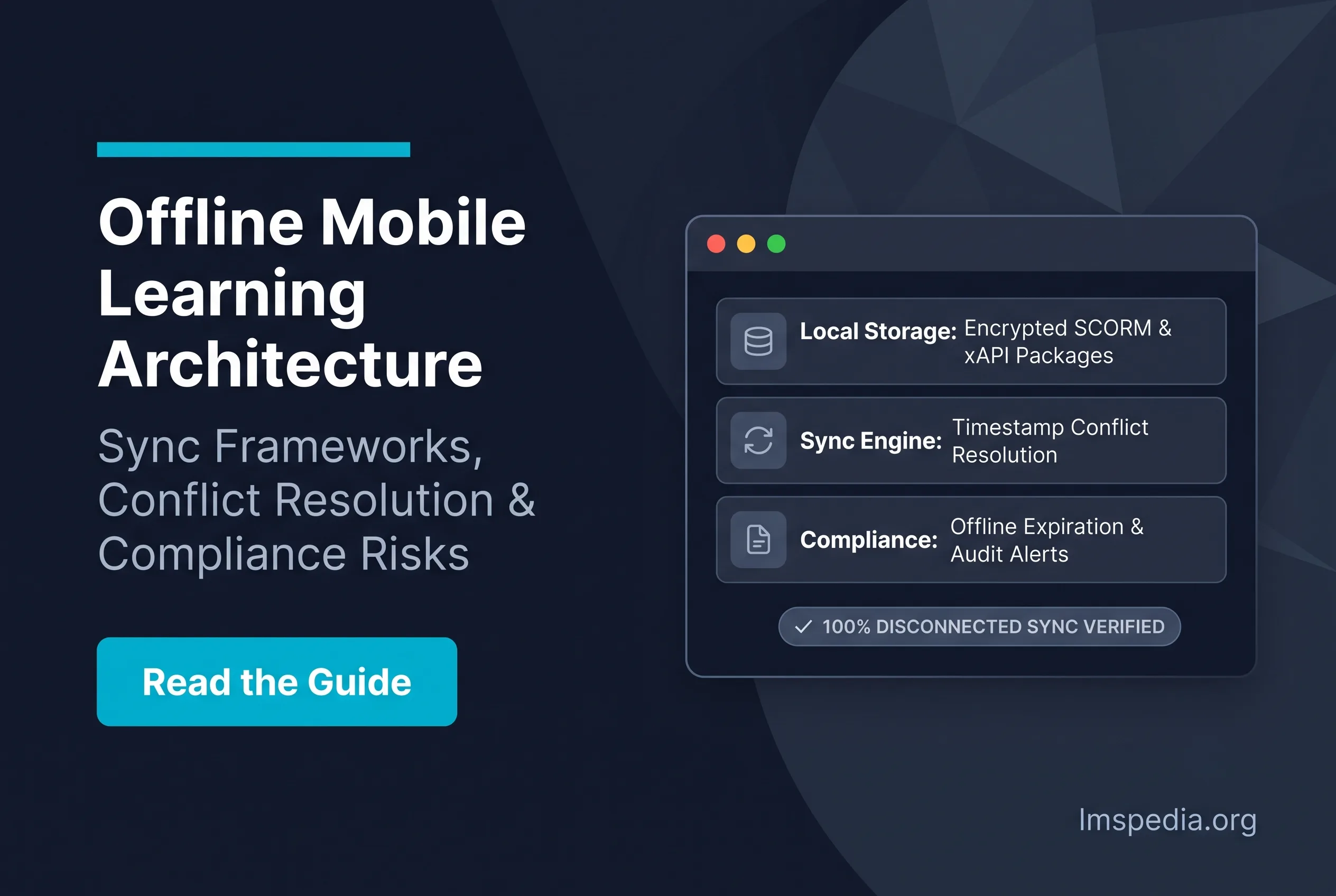
Technically, building a secure offline-capable application is incredibly difficult. First, the overarching system must securely download heavy multimedia files directly to a mobile device. Next, the lms offline sync architecture must track unique user interactions locally. Ultimately, this requires a sophisticated encrypted local database residing directly on the smartphone.
Furthermore, administrators must control exactly which files users can download. Specifically, downloading an entire corporate library would instantly destroy mobile storage limits. Therefore, the architecture must support targeted, modular course assignments. Ultimately, careful curation preserves mobile battery life and crucial storage capacity.
Data Caching and Local Storage
Specifically, when a learner connects to Wi-Fi, the app downloads the assigned educational package. Then, the application stores these sensitive files inside an encrypted sandbox environment. Crucially, this securely prevents unauthorized users from extracting proprietary corporate training videos. Moreover, the application utilizes local browser storage to record quiz scores and page views seamlessly.
Additionally, this local cache must survive unexpected mobile operating system updates. Therefore, developers utilize persistent storage protocols to protect un-synced data. Ultimately, if the app crashes, the cached progress must remain perfectly intact. Finally, to understand broader enterprise architectures, review our breakdown of the best training management software.
Military-Grade Encryption Standards
Undoubtedly, storing corporate data on personal employee devices creates immense security risks. First, malicious actors could steal a lost smartphone and extract confidential training manuals. Therefore, developers must implement advanced AES-256 encryption protocols on the local database. Specifically, the downloaded video files must remain totally unreadable outside the native learning application.
Furthermore, the application must immediately wipe all local data if the user terminates employment. Consequently, human resources platforms trigger automated remote wipe commands directly to the offline app. Ultimately, this strict cryptographic control satisfies rigorous corporate cybersecurity policies. Indeed, neglecting device encryption guarantees a catastrophic enterprise data breach.
Mobile Sync Conflict Resolution Mechanisms
Inevitably, disconnected offline learning creates severe data synchronization challenges globally. For instance, a user might start a compliance course on their office desktop browser. Later, they might complete the exact same course on their disconnected mobile device. Consequently, when the mobile device eventually reconnects, the central server receives conflicting completion records.
Therefore, the entire system requires highly advanced mobile sync conflict resolution algorithms. Without these mathematical rules, database architecture collapses completely. Specifically, administrators would spend countless hours manually deleting duplicate training transcripts. Ultimately, intelligent automation preserves pristine data integrity across the entire enterprise.
Timestamp Tracking and Rule Engines
To solve this, software developers utilize incredibly strict timestamp tracking rules. First, the server analyzes the exact millisecond each offline action occurred historically. Next, the sync engine continuously compares the local mobile data against the central server database. Typically, the system applies a rigid “latest action wins” logic matrix to resolve ties.
Alternatively, compliance courses often utilize a “highest score wins” mathematical rule. Consequently, if the offline test score beats the desktop score, the server accepts the offline data. Ultimately, this automated resolution prevents administrators from manually fixing corrupted learner transcripts daily. Indeed, flawless resolution builds critical trust between learners and the software platform.
Handling Multi-Device Collisions
Furthermore, modern employees frequently juggle multiple mobile devices simultaneously. For example, a manager might use a corporate iPad and a personal Android smartphone. Consequently, they might attempt to sync offline data from both devices simultaneously. Therefore, the server must properly queue incoming data packets sequentially.
Specifically, the API gateway throttles incoming mobile sync requests during peak business hours. Then, it unpacks each payload carefully to prevent database deadlock scenarios. Ultimately, sophisticated load balancers ensure the server never crashes during massive fleet-wide sync events. Consequently, users experience a totally seamless transition between all their personal hardware.
Offline Course Completion Tracking Challenges
Historically, tracking educational progress relied entirely on continuous server pings. Specifically, traditional SCORM courses send vital progress data to the server every few seconds. Obviously, this continuous rapid pinging fails completely in a disconnected environment. Consequently, modern offline course completion tracking requires fundamentally different technological communication standards.
Therefore, legacy corporate learning modules often break when forced into offline modes. Specifically, the legacy course simply freezes when it cannot detect a live internet connection. Ultimately, organizations must modernize their content authoring tools to survive the mobile era. Indeed, clinging to outdated tracking standards guarantees continuous mobile application failures.
The Severe Limitations of SCORM
Initially, the SCORM standard revolutionized early digital learning interoperability. However, developers built SCORM specifically for stable, wired desktop computer networks. Consequently, the standard totally lacks native offline caching capabilities by default. Therefore, forcing SCORM to operate offline requires massive, unstable JavaScript workarounds.
Furthermore, these complex technical workarounds frequently fail on modern smartphone operating systems. Specifically, mobile browsers aggressively kill background JavaScript processes to save device battery life. Ultimately, this aggressive battery management permanently destroys un-synced SCORM progress data. Consequently, frustrated learners must retake entire hour-long compliance modules from scratch.
xAPI and Offline Statements
Fortunately, the modern Experience API (xAPI) standard perfectly solves this disconnected tracking issue. Specifically, xAPI generates discrete, standalone learning statements independently. Instead of requiring a continuous live connection, the mobile app caches these statements locally. Subsequently, when the device detects a stable network, it pushes the batch of statements flawlessly.
Specifically, it transmits this data securely to the central Learning Record Store. For a deeper technical understanding of these statements, review the official xAPI technical overview documentation. Ultimately, adopting xAPI eliminates frustrating mobile progress loss entirely. Indeed, it represents the absolute gold standard for modern disconnected tracking.
Backend Data Optimization
Furthermore, this xAPI batching process must occur flawlessly to ensure legal compliance. Therefore, enterprise IT departments must monitor data payload sizes to prevent mobile network timeouts. Specifically, massive data dumps will instantly crash weak 3G cellular connections. To optimize these complex backend data flows, technical teams should consult our guide on LMS reporting and data exports.
Managing Payload Sizes
First, the mobile application must compress the local database before initiating a server sync. Specifically, compression drastically reduces the total megabytes transmitted over the cellular network. Consequently, this saves valuable mobile data bandwidth for remote frontline workers. Furthermore, the application should prioritize syncing critical assessment scores before syncing basic page views.
Ultimately, intelligent payload prioritization ensures vital compliance data reaches the server immediately. Therefore, even if the connection drops halfway through, the essential quiz grades survive. Indeed, this granular control mechanism proves vital during erratic rural network coverage.
Compliance Risks in Disconnected Environments
Undoubtedly, offline mobile learning introduces highly unique regulatory compliance risks. For example, a rural nurse might complete a mandatory medical certification on their disconnected tablet. However, if they forget to connect to Wi-Fi for three weeks, the central database registers them as non-compliant. Consequently, the hospital might illegally schedule an uncertified professional for a critical surgical shift.
Therefore, offline architectures inherently create dangerous blind spots for safety managers. Specifically, administrators cannot see real-time completion status until the physical device reconnects. Ultimately, this delay severely complicates strict regulatory reporting deadlines. Indeed, organizations must deploy aggressive administrative policies to force timely device synchronization.
Mitigating Audit Failures
To mitigate this, software administrators must absolutely enforce strict mobile sync deadlines. Specifically, the app should display aggressive push notifications demanding an immediate internet connection. Furthermore, regional managers must receive automated email alerts if a user goes offline for too long. Ultimately, this proactive monitoring ensures your organization survives a sudden external regulatory audit.
Additionally, strict international data privacy laws govern how local mobile data must be encrypted globally. Specifically, storing employee data locally triggers massive European regulatory scrutiny. You can read more about global data privacy standards at the International Association of Privacy Professionals (IAPP). Consequently, legal teams must deeply review all offline mobile deployment architectures.
BYOD Security Vulnerabilities
Increasingly, corporations allow employees to utilize personal smartphones for workplace training. However, this Bring Your Own Device (BYOD) strategy severely complicates offline security protocols. First, IT departments cannot fully control the overarching security posture of a personal device. Consequently, a compromised personal phone could expose downloaded corporate compliance materials to dangerous malware.
Therefore, the learning application must operate within a completely isolated digital sandbox. Specifically, it must prevent the user from taking screenshots of proprietary offline training videos. Ultimately, securing personal hardware requires significantly more architectural effort than securing corporate-issued tablets. Indeed, rigorous penetration testing remains mandatory for BYOD offline deployments.
Enterprise IT Integration and MDM
Crucially, deploying an offline learning app to thousands of employees requires intense IT coordination. Specifically, manual app installation becomes mathematically impossible for large global enterprise organizations. Therefore, technology teams utilize Mobile Device Management (MDM) platforms to automate software distribution. Ultimately, this guarantees every remote worker receives the exact same secure application version.
Pushing App Updates
First, maintaining version control across a disconnected fleet presents a massive logistical nightmare. Specifically, an outdated offline app might corrupt data when syncing with an updated central server. Consequently, MDM systems forcefully push critical application updates the moment a device connects to Wi-Fi. Furthermore, the central server actively rejects sync attempts from deprecated application versions.
Ultimately, this strict version enforcement protects the central compliance database from widespread structural corruption. Therefore, IT administrators must carefully schedule these mandatory software updates during off-peak operational hours. Indeed, seamless updates maintain uninterrupted educational access for vital deskless workers.
Comparing Mobile LMS Platforms
Naturally, evaluating enterprise offline capabilities requires incredibly rigorous software testing. Specifically, procurement teams must verify exactly how gracefully the platform handles sudden, violent network drops. Therefore, you must look completely beyond flashy marketing materials and stress-test the actual sync engines natively. For a comprehensive software marketplace overview, review our deep analysis of the best mobile LMS platforms available today.
| Platform Solution | Primary Focus | Offline Sync Architecture |
|---|---|---|
| SimpliTrain | Versatile training operations and compliance tracking. | Features a robust offline mobile app with encrypted local caching and automated conflict resolution. |
| Docebo | Global enterprise learning and AI delivery. | Utilizes the Go.Learn app for seamless SCORM offline playback and secure background syncing. |
| TalentLMS | Accessible, cloud-based corporate training. | Offers a streamlined mobile interface with simple offline course downloading and progress tracking. |
Ultimately, selecting the correct software platform dictates the total success of your deskless training initiative. Furthermore, integrating these modern mobile platforms with your existing HR systems requires strict administrative governance. To properly structure these specific access permissions, consult our technical breakdown on how to architect secure LMS user roles and permissions. Consequently, proper configuration protects your sensitive compliance data permanently.
Conclusion
In conclusion, deploying offline educational infrastructure is simply no longer a luxury for modern enterprise organizations. Instead, it represents an absolute operational necessity for managing highly distributed, remote deskless workforces globally. Specifically, technical organizations must aggressively bridge the connectivity gap to ensure continuous workplace safety and legal compliance. Consequently, ignoring this vital demographic creates severe regulatory vulnerabilities and massive logistical operational inefficiencies.
By proactively implementing advanced synchronization architectures, your technical teams can completely eliminate disastrous progress tracking errors. Furthermore, strictly utilizing xAPI standards and automated conflict resolution rules absolutely guarantees permanent data integrity. Ultimately, investing in a highly capable mobile infrastructure empowers your essential frontline workers to learn securely anywhere, at any precise time. Finally, deploying a resilient offline architecture protects your organization from incredibly costly compliance failures and stressful regulatory audit discrepancies.
FAQ
Q1. Why is offline mobile learning critical for corporate training?
Primarily, millions of global employees operate in environments completely devoid of stable internet connections. For example, maritime workers, underground miners, and remote sales teams cannot stream video content. Therefore, offline learning allows these deskless workers to download necessary compliance materials and complete their mandated training without geographical restrictions.
Q2. How does an LMS track course completion without an internet connection?
Technically, the mobile application caches the user interaction data directly within the local storage of the smartphone. Specifically, modern systems utilize the Experience API (xAPI) to generate localized learning statements during offline play. Subsequently, the moment the device reconnects to a stable network, it pushes this cached data package securely to the central Learning Record Store.
Q3. What happens if a user completes the same course on a desktop and an offline mobile device?
Inevitably, this creates a data collision when the mobile device finally syncs. To resolve this, the LMS relies on mobile sync conflict resolution algorithms. Typically, the system evaluates the timestamp of every action and applies a strict mathematical rule. Consequently, the system automatically accepts the most recent action or the highest assessment score, ensuring accurate transcript consolidation.
Q4. Are there security risks with downloading corporate training to personal mobile devices?
Undoubtedly, allowing employees to download proprietary content introduces data leakage risks. However, enterprise-grade mobile learning applications mitigate this threat by utilizing heavily encrypted sandboxes. Consequently, the downloaded video files and SCORM packages remain completely inaccessible to the native file browser of the phone, preventing unauthorized sharing or extraction.
Q5. How do delayed mobile syncs impact regulatory compliance?
Crucially, an organization cannot legally prove compliance until the training data registers in the central server. Therefore, if an employee finishes a critical OSHA safety module offline but fails to sync their device, the organization remains legally vulnerable. Ultimately, administrators must enforce strict sync deadlines and configure automated managerial alerts to prevent these dangerous data gaps.