First, commercial training providers and enterprise learning departments face unique logistical challenges. Specifically, standard corporate learning platforms cannot resolve these complex issues. While a traditional Learning Management System excels at delivering digital courses and tracking compliance, it fundamentally lacks a robust back-office architecture. Consequently, this administrative architecture is absolutely required to run a profitable, multi-instructor training operation.
For instance, a business model might rely on selling physical classroom seats, managing complex instructor schedules, processing multi-currency transactions, and allocating specialized equipment. In these specific cases, operational software becomes the primary driver of gross margin. Therefore, this technical requirement has driven the rapid adoption of dedicated Training Management Systems (TMS). Ultimately, selecting the correct architectural foundation dictates whether a training business scales efficiently or collapses under the weight of manual spreadsheet administration.
Currently, the global marketplace for training operations software is highly competitive. However, three platforms consistently dominate technical procurement evaluations for commercial training providers. In this article, this comprehensive accessplanit vs arlo vs administrate breakdown dissects the distinct technical philosophies, architectural strengths, and integration capabilities of each platform. By executing a rigorous tms three way comparison, technical buyers can align their organizational workflows with the ideal software engine. Specifically, this engine will be best suited to their operational velocity. Additionally, you can explore foundational procurement frameworks and software evaluation methodologies by reviewing expert LMSPedia resources.
Key Takeaways

Operational Complexity Requires a TMS: Traditional Learning Management Systems cannot handle the logistical complexity of commercial training, such as instructor scheduling, physical classroom allocation, multi-currency invoicing, and complex e-commerce workflows.
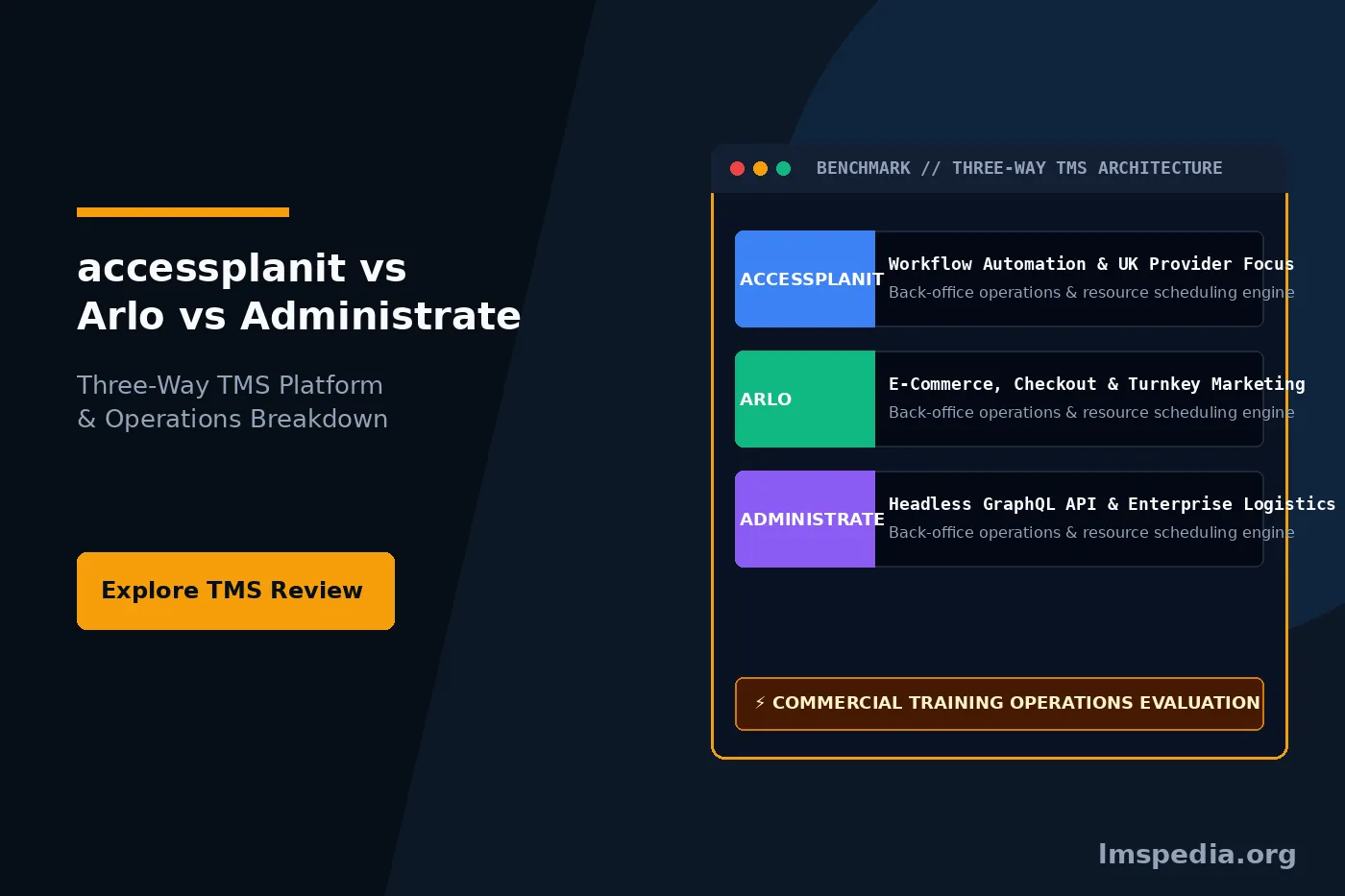
accessplanit for Automation: Based in the UK, accessplanit excels at eliminating manual administrative tasks through a powerful visual workflow engine, making it ideal for managing complex, multi-stage communication rules.
Arlo for E-commerce and Growth: Arlo operates as a marketing-first platform, providing turnkey website integration, robust CRM syncing with Salesforce, and highly refined shopping cart features for short-course providers.
Administrate for API-First Enterprise Scale: Administrate is engineered for massive global operations, offering a headless GraphQL API architecture and an unparalleled resource clash detection engine for complex logistical supply chains.
Total Cost of Ownership Varies Wildly: Arlo offers rapid deployment and predictable costs, accessplanit requires upfront workflow mapping for long-term ROI, and Administrate demands extensive enterprise IT resources for deep architectural integration.
Why Commercial Training Demands Specialized Operations Software
To begin with, procurement teams must map the operational lifecycle of a commercial training provider. Ultimately, this helps them understand the technical divide between these three platforms. Essentially, the lifecycle extends far beyond simple course delivery. First, it begins with digital marketing and lead generation. Next, it transitions into complex customer relationship management. Furthermore, it requires financial reconciliation and invoicing, culminating in resource logistics.
For example, a training company might schedule a five-day heavy machinery certification course. In this scenario, the software must simultaneously verify instructor availability and reserve a physical warehouse space. Additionally, it must allocate the correct machinery, process the client payment, and automatically generate joining instructions. Consequently, if any single variable fails, the training event becomes a logistical disaster.
Therefore, a rigorous training operations software comparison evaluates how seamlessly a platform integrates these disparate back-office functions. Specifically, a mature Training Management System successfully eliminates dangerous data silos. It achieves this by merging e-commerce, CRM, resource scheduling, and automated communications into a unified, secure database. Ultimately, the goal is to maximize instructor utilization rates. Simultaneously, this minimizes the administrative overhead required to manage course logistics.
accessplanit: The Workflow Automation Powerhouse
Initially, based in the United Kingdom, accessplanit has established a formidable reputation. Specifically, it operates as a highly configurable, automation-driven platform. As a leading piece of uk training management software, it caters heavily to commercial training providers. Typically, these specialized providers offer a hybrid mix of public open courses, private in-house corporate training, and digital e-learning. Fundamentally, the architectural philosophy of accessplanit centers on reducing manual administrative touches. It accomplishes this through a powerful, proprietary workflow engine.
Core Technical Strengths of accessplanit
Undoubtedly, the defining feature of accessplanit is its visual workflow automation builder. With this tool, administrators can construct highly complex, multi-stage communication rules based on granular system triggers. For example, a corporate client might book ten seats for a private leadership seminar. Consequently, the workflow engine can automatically generate the financial invoice and email the assigned instructor the course syllabus.
Furthermore, it can text the learners their physical classroom directions three days prior to the event. Finally, it can send a post-course feedback survey precisely two hours after the class concludes. Ultimately, this level of automation drastically reduces the human capital required to manage high-volume training schedules.
Moreover, accessplanit offers robust shopping cart and website integration features. Specifically, their native WordPress plugin and standardized website integration widgets empower training companies. As a result, they can publish their live course schedules directly to their marketing websites. Subsequently, when a user purchases a course online, the transaction flows seamlessly into the accessplanit database. Instantly, this action updates inventory limits and triggers the necessary financial reconciliation workflows.
Potential Architectural Limitations
While the workflow engine is exceptionally powerful, it presents some specific challenges. Particularly, the sheer volume of configuration options can overwhelm organizations lacking dedicated software administrators. Therefore, the platform requires a meticulous implementation phase. This phase heavily maps existing business processes into the automated logic engine.
Additionally, the reporting suite is highly comprehensive. However, organizations requiring highly customized, bespoke data visualization might face restrictions. Often, they find the native dashboarding tools less flexible than dedicated third-party business intelligence integrations.
Arlo: The Marketing and E-commerce Specialist
Next, Arlo takes a distinctively marketing-first approach to training management. Primarily, developers designed it for short-course providers, university continuing education departments, and commercial seminar hosts. Consequently, the platform architecture is heavily optimized for lead conversion, website integration, and customer relationship management. Fundamentally, Arlo operates under a specific philosophy. It believes that a training business is essentially an e-commerce business that happens to sell education.
Core Technical Strengths of Arlo
Importantly, the primary advantage of Arlo lies in its turnkey website integration and native CRM capabilities. For instance, Arlo provides beautiful, conversion-optimized website templates. As a result, these templates allow training providers to launch professional storefronts rapidly. Furthermore, the platform excels at managing promotional discounts, early-bird pricing tiers, and voucher codes. Additionally, it handles complex multi-region tax calculations effortlessly. Ultimately, this makes it an ideal solution for training providers executing aggressive digital marketing campaigns.
Moreover, Arlo features native integration with Salesforce. Crucially, this bi-directional data sync is a major deciding factor for enterprise training providers. Specifically, it appeals to those who rely on Salesforce as their central source of truth for corporate accounts. For example, a sales representative might close a corporate training deal in Salesforce. Consequently, the data populates immediately within Arlo to initiate the scheduling and resource allocation process. Finally, to dive deeper into evaluating modern e-commerce and learning ecosystems, review our guide on the best training management software.
Potential Architectural Limitations
Because Arlo focuses so heavily on short-course delivery and e-commerce, it faces certain technical limitations. For example, it can struggle with highly complex, multi-year certification tracks. Likewise, it may falter with deeply technical resource logistics. Suppose a training provider requires complex algorithmic clash detection for hundreds of physical assets, simulators, and disparate instructor qualification rules. In this case, the Arlo scheduling interface may lack the necessary depth. Ultimately, it falls short when compared to enterprise-grade resource planning tools.
Administrate: The Enterprise API-First Engine
Conversely, if accessplanit focuses on workflow automation and Arlo focuses on e-commerce, Administrate targets a different sector. Specifically, it is built purely for massive enterprise scale. Operating globally, Administrate provides an infrastructure designed for massive corporate training departments. Additionally, it supports complex software companies delivering customer education and global commercial training franchises. Fundamentally, developers engineered the platform with a strict API-first methodology. As a result, it stands out as the most developer-friendly option in this accessplanit comparison.
Core Technical Strengths of Administrate
Interestingly, Administrate approaches training operations as a complex supply chain logistics problem. Therefore, their resource management engine is unparalleled in its ability to detect scheduling clashes across thousands of global events. Specifically, it factors in instructor time zones, specific equipment availability, and regional classroom capacities simultaneously. For instance, an administrator might attempt to book an instructor for a class in London. Instantly, the system verifies if that instructor has the proper active qualifications. Furthermore, it checks if they are double-booked in another region and calculates necessary travel buffer times.
However, the true technical differentiator is the Administrate GraphQL API architecture. By operating as a headless training management engine, Administrate empowers enterprise IT teams. Specifically, it allows them to query the exact data fields they need. Consequently, they can build completely custom learner portals, deeply integrated mobile applications, and bespoke financial dashboards. Ultimately, this headless capability is essential for global organizations that refuse to use standard vendor templates and demand total control over their user interface. Additionally, to properly structure user access across these complex headless deployments, consult our technical breakdown on how to architect secure LMS user roles and permissions.
Potential Architectural Limitations
Naturally, the massive technical scale of Administrate comes with a proportional implementation cost. Furthermore, the platform is highly complex and requires significant technical acumen to configure properly. Clearly, it is not a turnkey solution for a small, five-person training company. Instead, it has a heavy reliance on API integrations. Consequently, organizations will likely require internal development resources or expensive professional services to maximize the return on their software investment.
Comparing Next-Generation Training Management Solutions
Ultimately, evaluating enterprise platforms requires analyzing how effectively they resolve specific operational bottlenecks. Therefore, procurement teams must categorize solutions based on their core architectural focus. By doing so, they align the software with actual organizational workflows. In conclusion, structuring your vendor evaluation around these core differentiators ensures success. Specifically, it guarantees your IT procurement team selects a platform matching your specific operational maturity.
| Platform Solution | Target Market Profile | Core Architectural Differentiator |
|---|---|---|
| SimpliTrain | Versatile training operations and cross-functional resource scheduling. | Streamlines administrative coordination with highly flexible back-office workflows and intuitive enterprise certification tracking. |
| accessplanit | Commercial training providers and UK-based operations. | Powerful visual workflow automation engine designed to eliminate manual administrative communications and tasks. |
| Administrate | Global enterprises and massive customer education departments. | API-first GraphQL headless architecture with unparalleled complex resource and logistics clash detection. |
Evaluating Platform APIs
Crucially, when evaluating an API-first platform for enterprise deployment, always request access to the vendor developer sandbox during the procurement phase. Next, have your engineering team test the GraphQL query response times. Additionally, they should evaluate webhook payload structures. Ultimately, this ensures the system can handle your expected daily transaction volume without rate-limiting.
Head-to-Head: Scheduling and Resource Allocation
Without a doubt, the defining feature of any TMS is its scheduling engine. Particularly in a commercial training environment, human instructors and physical assets represent the highest overhead costs. Therefore, efficient scheduling maximizes resource utilization. Consequently, it directly impacts profitability.
First, Arlo provides a highly intuitive, calendar-based scheduling interface. Specifically, this is perfect for plotting webinars, single-day workshops, and recurring public courses. Furthermore, it allows administrators to quickly clone previous events and push them directly to the marketing website. However, dealing with complex, multi-week programs requires varied instructors for different modules. In these specific situations, the interface can become restrictive.
On the other hand, accessplanit offers deeper resource logistics. For instance, it allows administrators to attach specific physical assets to specific course templates. These assets might include projectors, specialized laptops, or safety harnesses. Subsequently, the system will flag a warning if an administrator attempts to double-book a physical asset. Ultimately, this makes accessplanit highly effective for health and safety training providers managing large inventories of practical training equipment.
Meanwhile, Administrate operates on a completely different logistical tier. Essentially, it treats scheduling as a complex algorithmic matrix. For example, a global software company might organize a multi-week certification bootcamp across three continents. In response, Administrate can effortlessly manage the instructor travel logistics. Additionally, it can verify localized regulatory qualifications and track the shipping of physical training manuals to global satellite offices. Finally, to understand how to test these complex backend engines under stress, review our guide on LMS load testing and performance benchmarking.
Head-to-Head: E-commerce and Financial Reconciliation
Furthermore, a training management system must operate as a secure financial ledger. Specifically, it must process credit card transactions and generate compliant PDF invoices. Additionally, it needs to calculate regional taxes and synchronize data with enterprise accounting software.
Undeniably, Arlo dominates the e-commerce category. Primarily, its checkout process is highly refined. It supports multiple payment gateways including Stripe, PayPal, and Windcave. Moreover, Arlo handles complex pricing rules effortlessly. Consequently, this allows providers to offer corporate group discounts, early-bird specials, and automated refund processing for canceled events. Finally, its native integration with Xero ensures that every web transaction is immediately reconciled in the general accounting ledger.
Similarly, accessplanit also features a robust shopping cart. However, its true financial strength lies in its automated invoicing workflows. For example, the platform can automatically generate custom-branded proforma invoices when a corporate client submits a purchase order. Subsequently, it routes the invoice directly to the client accounts payable department without manual intervention.
Conversely, Administrate handles financial data through a highly customizable reporting engine. While it supports standard payment gateways, its true financial power lies elsewhere. Specifically, it is fully unleashed when integrated via API with enterprise ERP systems like Oracle or SAP. Ultimately, this allows multinational corporations to map training revenue directly into complex global revenue recognition schedules.
Head-to-Head: Reporting and Business Intelligence
Crucially, data visibility is essential for scaling a training business. Specifically, leadership teams must track course profitability, instructor utilization rates, and marketing campaign conversion metrics in real time. Additionally, you might want to discover specialized tools for diagnosing organizational skill gaps before deploying a TMS. If so, consult our comprehensive guide on utilizing training needs assessment tools.
First, Arlo provides excellent out-of-the-box reporting for marketing and sales metrics. Consequently, users can easily track lead conversion rates, campaign ROI, and overall course popularity. Furthermore, the dashboards are highly visual and incredibly accessible to non-technical users.
Next, accessplanit features a proprietary reporting engine called the Data Explorer. Essentially, this tool allows administrators to build highly customized data queries across every single data field in the system. Moreover, users can schedule these reports to automatically email key stakeholders on a weekly or monthly basis. Ultimately, this ensures that executive management maintains visibility over operational health.
Finally, Administrate offers a powerful internal reporting engine. However, it is explicitly designed to push data out to specialized business intelligence tools. Specifically, by utilizing their extensive webhook architecture, enterprise IT teams gain flexibility. As a result, they can stream live training data directly into Tableau, Microsoft Power BI, or Amazon QuickSight. Ultimately, this supports advanced predictive analytics and massive enterprise data warehousing.
Implementation Strategy and Total Cost of Ownership
Undoubtedly, selecting a TMS is a major capital expenditure requiring rigorous financial analysis. Specifically, the software license is only one component of the total cost of ownership. In addition, organizations must account for data migration, staff training, and professional integration services. Therefore, for a complete catalog of strategic vendor inquiries to utilize during procurement, consult our comprehensive list of LMS buyer guide vendor questions.
Typically, Arlo offers the fastest time to value. Because it relies heavily on standardized templates and turnkey integrations, deployment is incredibly swift. In fact, a motivated training provider can launch an Arlo deployment in a matter of weeks. Furthermore, the total cost of ownership is highly predictable. Consequently, this makes it a safe financial choice for mid-sized commercial providers.
Conversely, accessplanit requires a more measured implementation approach. Specifically, mapping complex business processes into their automated workflow engine takes careful planning. While the initial configuration requires significant effort, the long-term total cost of ownership plummets. Primarily, this occurs because the automated engine drastically reduces the need to hire additional administrative staff as the business scales.
Finally, Administrate represents a massive enterprise deployment. Generally, implementation cycles can last several months. These rigorous cycles involve deep architectural planning, API middleware construction, and extensive parallel testing. Admittedly, the total cost of ownership is exceptionally high. However, it is the only viable option for massive global organizations requiring a headless logistical engine capable of supporting unlimited scale.
Conclusion
In conclusion, choosing the correct training operations software requires a brutally honest internal assessment. Specifically, you must evaluate your organizational maturity, technical capabilities, and overall business model. Ultimately, there is no single superior platform in the market. Instead, there is only the platform that best aligns with your specific operational bottlenecks.
For example, your business might rely heavily on digital marketing, website conversions, and rapid e-commerce transactions for short courses. In this particular case, Arlo provides an unparalleled, turnkey growth engine. Alternatively, your operation might be suffocating under the weight of manual emails, spreadsheet tracking, and complex physical resource logistics. Here, accessplanit offers a transformative workflow automation architecture that rapidly restores administrative efficiency. Finally, you might operate a massive global enterprise requiring a headless, API-first logistics engine capable of integrating deeply with custom corporate software. In this scenario, Administrate stands alone as the premier developer-focused solution.
Ultimately, the success of your commercial training operation depends entirely on the strength of your administrative foundation. Therefore, you must execute a rigorous technical evaluation, insist on deep integration testing, and align software architecture with your strategic roadmap. By doing so, you can deploy a Training Management System that protects your profit margins and accelerates your operational scale for years to come.
FAQ
Q1. What is the difference between an LMS and a TMS?
A Learning Management System (LMS) focuses on the digital delivery and tracking of e-learning content for the student. A Training Management System (TMS) focuses on the back-office logistics of the training business, handling instructor scheduling, resource allocation, CRM integration, and financial invoicing.
Q2. Is accessplanit only for UK-based training companies?
While accessplanit is developed in the United Kingdom and maintains a massive market share there, it is a cloud-based SaaS platform utilized by commercial training providers and corporate learning departments globally.
Q3. Can Arlo integrate with my existing corporate website?
Yes. Arlo is specifically designed for rapid website integration. It offers native WordPress plugins, JavaScript web widgets, and full REST APIs that allow you to push your live course catalog and shopping cart directly onto your existing marketing website.
Q4. Why would a company choose a headless TMS like Administrate?
A headless TMS separates the backend database from the frontend user interface. Massive enterprises choose this architecture because it allows their internal developers to use APIs to build completely custom, highly branded learning portals or mobile apps without being restricted by vendor-mandated templates.
Q5. Do these TMS platforms track digital e-learning courses (SCORM)?
Yes. While their primary strength is managing live instructor-led training and physical resources, modern TMS platforms feature integrated e-learning modules or seamless API connectors to dedicated LMS platforms to track SCORM content and blended learning paths.