Headless LMS Architecture: API-First Learning Platforms Explained
First and foremost, corporate learning ecosystems are undergoing a massive structural transformation. Historically, for over two decades, organizations relied on monolithic learning management systems. Specifically, these legacy systems bundled the backend database, the administrative engine, and the learner-facing interface into a single, rigid application. While these legacy systems provided a convenient package for early digital training initiatives, they now present severe technical bottlenecks for modern enterprises.
Consequently, as organizations attempt to deliver training across mobile applications, customer portals, and embedded enterprise software, the limitations become painfully obvious. Therefore, to achieve true omnichannel training delivery, technical architects and Learning and Development leaders are rapidly abandoning monolithic structures. Instead, they favor the headless lms approach. Fundamentally, by completely separating the backend logic from the frontend presentation layer, an API-first framework provides unprecedented flexibility.
As a result, development teams can design customized, high-performance learning experiences without being constrained by vendor-mandated templates. Additionally, you can explore foundational system design principles by reviewing expert LMSPedia resources. Furthermore, the transition toward a composable learning architecture reflects a broader shift in enterprise software engineering. Today, modern technical ecosystems prioritize agility, modularity, and seamless data integration.
Unfortunately, when learning systems remain trapped in siloed, monolithic databases, they cannot communicate efficiently with other enterprise tools. For example, they struggle to integrate with Human Resources Information Systems, Customer Relationship Management platforms, or specialized performance analytics engines. Fortunately, a headless learning platform solves this integration crisis by functioning purely as a backend content and logic repository. Specifically, it relies entirely on Application Programming Interfaces (APIs) to push and pull data to any digital endpoint. In this article, this technical guide deconstructs the mechanics of headless architecture, explores the operational advantages of a decoupled lms frontend, and provides a strategic framework for evaluating an api first lms for enterprise deployment.
Key Takeaways

The Fall of the Monolith: Traditional learning systems bind the backend database and the user interface together, severely restricting design flexibility, integration capabilities, and system performance during traffic spikes.
True Architectural Decoupling: A headless LMS acts entirely as a backend engine for data processing and content storage, allowing developers to build completely custom, independent frontend interfaces on any device or screen.
API-First vs API-Enabled: Modern composable ecosystems demand true API-first architectures built on OpenAPI or GraphQL standards, rather than legacy monolithic platforms that simply bolted on a limited REST API as an afterthought.
Omnichannel Embedded Learning: By leveraging a decoupled frontend, enterprises can seamlessly deliver corporate training directly into the daily workflow of employees, embedding courses natively inside CRM, ERP, or custom mobile applications.
The MACH Philosophy: Transitioning to a headless LMS represents the first step toward a fully composable enterprise architecture characterized by interchangeable microservices, API-first communication, and superior digital agility.
The Technical Constraints of Monolithic Learning Systems
For over twenty years, corporate e-learning was dominated by monolithic software architectures. In a monolithic system, the database, the server-side business logic, and the user-facing presentation layer are tightly coupled. Essentially, they form a single, indivisible application. Consequently, when an organization licenses a traditional platform, they are forced to accept the specific user interface mandated by the vendor.
For instance, if the internal corporate marketing department wants to overhaul the visual branding of the employee training portal, they face roadblocks. Specifically, they cannot simply rewrite the structural HTML and CSS. Instead, they are heavily restricted to uploading basic logo files or changing primary hex colors within a rigid administrative configuration menu. Furthermore, any structural changes require the organization to wait for the vendor to release a comprehensive core system update. Ultimately, this tight coupling creates massive operational friction for enterprise IT departments looking to innovate.
Additionally, rendering logic in a monolith is processed entirely on the server side. For example, thousands of employees might log in simultaneously to complete a mandatory annual compliance module. When this occurs, the centralized server must process the heavy database queries and dynamically generate the frontend web code for every single active user. Consequently, this heavy computational burden severely limits performance and frequently causes system latency during peak traffic periods. Therefore, technical buyers and enterprise architects must recognize that traditional monoliths were designed for an era of desktop computing, making them fundamentally unsuited for modern, high-velocity digital ecosystems.
Deconstructing Headless LMS Architecture
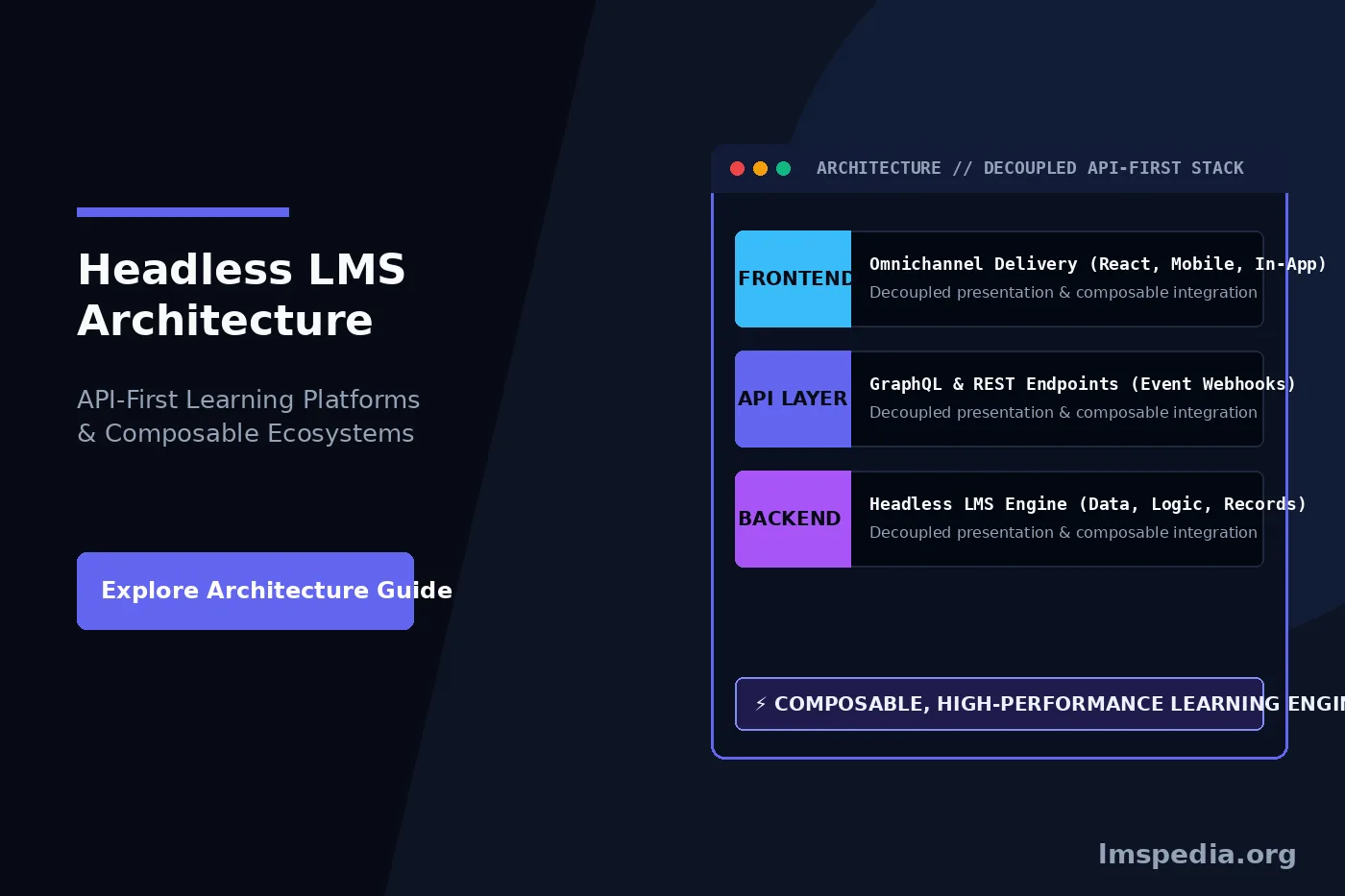
Primarily, the term headless refers to the complete architectural separation of the backend functionality from the frontend presentation layer. In a headless lms environment, the backend learning engine is solely responsible for core administrative operations. Specifically, it manages user authentication, stores digital course files, tracks enrollment logic, records assessment scores, and maintains immutable compliance data.
Crucially, the backend does not dictate how this information looks on a physical screen. Instead, the frontend interface is built completely independently by the purchasing organization. Typically, development teams achieve this using modern web frameworks like React, Vue, Angular, or Swift for native mobile applications. Meanwhile, the technical bridge connecting these two isolated environments is the API layer.
Because the decoupled lms frontend operates entirely independently, internal developers can deploy agile updates to the user interface on a daily basis. Importantly, they can do this without risking the stability of the underlying database. For example, if a rogue code error occurs on the frontend web application, the backend learning records remain perfectly secure and unaffected. Ultimately, this architectural separation empowers technical teams to build highly customized, pixel-perfect learner portals that match exact corporate branding standards while relying on a stable engine for heavy data processing.
API-Enabled vs API-First LMS Platforms
First, a critical distinction must be made between legacy platforms that simply offer a supplementary API and true API-first architectures. Historically, many legacy software vendors recognized the market shift toward enterprise integration. Consequently, they hastily bolted a REST API onto their existing monolithic codebase. However, these systems are merely API-enabled.
Because the integration layer was built as an afterthought, it often lacks comprehensive endpoint coverage. Furthermore, it suffers from poor documentation and experiences severe rate-limiting under high transaction loads. Conversely, an api first lms is engineered from inception around its application programming interfaces.
In an API-first framework, the vendor builds the robust API infrastructure before designing any graphical interface. Moreover, if the vendor provides an optional out-of-the-box frontend, that interface actually consumes the exact same public APIs available to their enterprise clients. Ultimately, this methodology guarantees that every single feature, administrative setting, and data point within the platform is fully accessible via programmatic requests. Additionally, engineering teams rely heavily on the OpenAPI Specification to standardize these RESTful interface contracts, ensuring that endpoints for user synchronization and grade submissions are highly predictable and perfectly documented.
GraphQL and Event-Driven Webhooks
While REST APIs remain the established industry standard, modern headless deployments increasingly leverage advanced data querying technologies. For instance, many forward-thinking platforms utilize query languages standardized by the GraphQL Foundation. Unlike traditional REST endpoints that return fixed data payloads regardless of the context, GraphQL offers superior flexibility.
Specifically, it allows frontend developers to request the exact specific data fields they need in a single network call. For example, a developer can request a learner name, their current course progress percentage, and their next required module without downloading unnecessary metadata. Consequently, this query precision drastically reduces payload sizes and improves interface rendering speeds, especially on low-bandwidth mobile networks.
Additionally, headless architectures rely heavily on event-driven webhooks. Instead of forcing the frontend application or external HR systems to continuously poll the API for status updates, the backend engine acts instantly. Specifically, it automatically fires a webhook payload the exact millisecond a learner completes a critical certification. Ultimately, this asynchronous, event-driven communication reduces server strain and enables real-time data synchronization across the entire enterprise.
Core Advantages of a Decoupled LMS Frontend
Undoubtedly, transitioning to a headless architecture unlocks several strategic advantages that are mathematically impossible to achieve within a traditional monolithic framework. First, the primary business benefit is the realization of true omnichannel learning delivery. Consequently, organizations are no longer restricted to forcing employees to log into a standalone, isolated destination portal.
Instead, internal developers can embed training modules directly into the daily workflow of the end user. For example, a global sales representative can access micro-learning videos natively within their CRM dashboard. Similarly, a factory floor technician can pull up diagnostic training manuals on a ruggedized IoT tablet. Ultimately, the headless backend securely serves the exact same content to all these diverse endpoints simultaneously.
Furthermore, a decoupled frontend vastly improves system performance and dynamic scalability. Because the custom frontend relies entirely on lightweight API calls, engineering teams can utilize modern edge caching networks and static site generation techniques. Consequently, interface content can be pre-rendered and distributed across global Content Delivery Networks. As a result, this generates near-instantaneous page load speeds for learners regardless of their geographic location.
To thoroughly validate how decoupled architectures handle sudden traffic spikes and API payload stress, technical teams should carefully review our deep dive on LMS load testing and performance benchmarking. Moreover, security and digital governance also see dramatic improvements under a decoupled structural model. Specifically, by strictly separating the public-facing application from the backend database, organizations significantly shrink their external attack surface.
Therefore, malicious actors attempting to exploit frontend application vulnerabilities cannot directly access the core administrative database, as it sits safely isolated behind an encrypted API gateway. Finally, to ensure your API access tokens and user permissions are properly configured across these distinct environments, refer to our comprehensive guide on how to architect secure LMS user roles and permissions.
Frontend Framework Selection
Crucially, when building a custom decoupled interface for your headless learning backend, prioritize modern JavaScript frameworks like Next.js or Nuxt. Specifically, these frameworks support Server-Side Rendering (SSR). Ultimately, this optimizes your custom learning portal for search engine visibility and drastically accelerates initial load times on enterprise networks.
Embracing Composable Learning Architecture
Often, the initial implementation of a headless learning platform is merely the first step toward building a fully composable learning architecture. Fundamentally, composable architecture represents the pinnacle of modern enterprise software design. In this model, massive digital ecosystems are constructed from highly specialized, interchangeable microservices rather than bloated, bundled software suites.
Furthermore, many global enterprise architects strategically align their technology roadmaps with the principles established by the MACH Alliance. Notably, this is a prominent industry body that advocates for Microservices, API-first, Cloud-native SaaS, and Headless technologies. Under a composable learning framework, an enterprise refuses to rely on a single vendor for every technical feature. Instead, they select the absolute best-in-class specialized tool for each specific function.
For instance, the organization might utilize a headless LMS engine strictly for complex enrollment logic and compliance tracking. Simultaneously, they might connect a specialized headless Content Management System to stream high-definition localized video assets. Meanwhile, they can route all behavioral data into a dedicated centralized analytics data lake. Because these distinct microservices communicate seamlessly via open APIs, IT teams can rapidly unplug and replace an underperforming video streaming module without disrupting the broader learning ecosystem. However, before migrating an enterprise to such a complex, multi-vendor framework, it is vital to assess organizational readiness and technical maturity by utilizing modern training needs assessment tools.
Comparing API-First LMS and Composable Solutions
Ultimately, selecting the correct platform for a headless deployment requires evaluating the depth, speed, and documentation of the vendor APIs rather than evaluating graphic design aesthetics. Therefore, technical buyers must examine how different software solutions support modular enterprise integration.
| Platform / Architecture Solution | Primary Focus | Headless & API Capabilities |
|---|---|---|
| SimpliTrain | Versatile training operations and resource scheduling. | Powerful headless API integration for back-office scheduling and hybrid resource coordination. |
| Contentful | API-first composable content platform. | Serves raw learning content, rich text, and multimedia to any frontend device via strict GraphQL and REST endpoints. |
| Docebo | Enterprise learning management and AI delivery. | Offers robust API coverage and webhooks allowing enterprises to embed training catalogs directly into proprietary software. |
Finally, when evaluating these powerful platforms, enterprise IT procurement teams must demand sandbox access specifically to test API response times and explore webhook payload structures before signing extensive software agreements.
Middleware Necessity
Importantly, do not attempt to connect your frontend application directly to your headless LMS backend without a middleware layer. Instead, implementing a secure middleware proxy allows your engineering team to cache heavy API responses and format complex data payloads. Ultimately, it securely stores private API authentication keys away from the client-side browser.
Strategic Implementation and Migration
Indeed, deploying a headless ecosystem requires a fundamentally different implementation strategy than launching a traditional monolithic software package. Specifically, it requires exceptionally close collaboration between the corporate Learning and Development department and the core IT engineering team. First, the critical phase of implementation involves comprehensive API auditing.
During this phase, engineering teams must rigorously evaluate the API documentation of the prospective vendor. Specifically, they must test payload rate limits, pagination rules, and authentication protocols. Ultimately, this ensures the platform can safely handle the anticipated daily transaction volume of the enterprise. Following the rigorous API audit, internal development teams must build the middleware integration layer.
Essentially, this middleware acts as a centralized digital traffic controller. Specifically, it securely routes data between the headless LMS backend, the custom frontend application, and existing enterprise software like Workday or Microsoft Active Directory. Once the middleware routing is securely established, frontend developers can begin constructing the user interfaces utilizing atomic design principles.
Finally, organizations should execute a meticulous parallel run phase. During this period, the legacy monolithic platform and the new headless architecture operate simultaneously. Consequently, data is synchronized continuously between both systems. Ultimately, this allows quality assurance teams to verify that API payloads are processing correctly before officially sunsetting the legacy platform.
Conclusion
In conclusion, as digital transformation accelerates across the global corporate landscape, the technical limitations of rigid, all-in-one software suites become increasingly unsustainable. Consequently, organizations require supreme agility, rapid deployment capabilities, and the ultimate freedom to deliver essential training across a multitude of diverse digital touchpoints. Therefore, by actively abandoning monolithic constraints and adopting a headless architecture, enterprise IT and corporate learning departments can finally align their educational infrastructure with modern software engineering standards.
Furthermore, the calculated transition to an API-first framework is not merely a technical software upgrade; it is a strategic repositioning of how corporate knowledge is securely distributed. Specifically, it heavily empowers developers to build seamless, highly performant user interfaces while relying on a stable, unshakeable backend engine to manage complex regulatory data sets. Ultimately, for organizations ready to build a truly composable, future-proof ecosystem, the time to decouple the presentation layer is right now. Finally, to explore how leading platforms support these advanced backend integrations and manage robust data pipelines, review our extensive guide on the best training management software available in the enterprise market.
FAQ
What exactly is a headless LMS? A headless LMS is a learning management system that completely separates its backend functionality from the frontend user interface. It stores data and manages business logic on the backend while using APIs to deliver that data to any custom website, application, or digital portal the organization chooses to build.
What is the difference between an API-first LMS and a traditional LMS with an API? An API-first LMS is designed from the ground up prioritizing programmatic access, ensuring every single feature and data point is available via the API. A traditional LMS with an API is typically a monolithic system that added integration points as an afterthought, often resulting in limited endpoint coverage and poor scalability.
How does a headless learning platform improve user experience? Because the presentation layer is decoupled from the backend database, organizations are not forced to use clunky vendor templates. User experience (UX) designers gain total freedom to build accessible, lightning-fast, highly branded interfaces optimized for their specific employee demographics.
What is composable learning architecture? Composable architecture is a software design philosophy where a digital ecosystem is built by combining various specialized, best-in-class microservices rather than using one bundled software suite. In learning, this might mean using a headless LMS for enrollment, a specialized headless CMS for content, and a distinct data lake for analytics.
Does a headless LMS require more technical resources to implement? Yes. Implementing a headless LMS requires a dedicated engineering or development team capable of building the custom frontend application, configuring secure API middleware, and managing ongoing UI maintenance, whereas traditional systems offer pre-built, ready-to-launch templates.