Initially, traditional corporate training certificates rapidly face obsolescence. For decades, organizations have relied on static PDF certificates or paper badges to document employee learning accomplishments. Consequently, these legacy formats prove easy to falsify, difficult to verify, and remain fundamentally trapped inside proprietary enterprise learning management systems. When an employee leaves a company, their training history often stays behind. Therefore, this forces them to restart or re-verify their credentials with every new employer. Ultimately, this friction wastes valuable time, slows down skills-based hiring, and strips workers of ownership over their own professional achievements.
To establish true workforce agility, Learning and Development teams must embrace cryptographic trust models. Specifically, implementing verifiable credentials learning frameworks transforms static certificates into portable, tamper-proof digital assets. Additionally, you can explore foundational digital passport architectures by reviewing expert LMSPedia resources.
Furthermore, the modern global economy demands transparent, verifiable proof of competency. Employers can no longer rely on unverified resume claims or unstandardized course completion records. At the same time, educational institutions and corporate training departments face intense pressure to prove the tangible value of their curricula. Consequently, this dual demand has accelerated the adoption of learning and employment records, commonly known as LERs. In practice, these digital portfolios aggregate formal degrees, corporate micro-credentials, and practical on-the-job certifications into a single, comprehensive record that the learner controls entirely. Ultimately, this technical buyer and strategist guide explores the mechanics of w3c verifiable credentials education standards, evaluates enterprise issuance platforms, and outlines how organizations can implement portable credentials training models.
Key Takeaways

Enhanced Privacy Controls: Modern cryptographic standards support selective disclosure, allowing workers to prove specific competencies without exposing unnecessary personal information.
Strategic Workforce Agility: Adopting portable credentials enables skills-based hiring, reduces onboarding friction, and empowers organizations to map internal talent capabilities accurately.
The Evolution of Certification: From Paper to Portable Trust
First, the history of credentialing mirrors the evolution of digital data storage. In the early days of corporate e-learning, training records lived inside isolated server databases. If an employee changed jobs, their training records vanished or required manual transcript requests. Later, digital badges emerged as a popular alternative. While badges added visual appeal and basic hyperlink verification, they still suffered from centralization vulnerabilities. For instance, if a badge-issuing platform went out of business or altered its API, the underlying verification links broke instantly.
Eventually, enterprises and educational standard bodies recognized that true credentialing requires decentralization and cryptographic permanence. The World Wide Web Consortium addressed this by establishing open standards for secure data exchange. By utilizing w3c verifiable credentials education frameworks, organizations can issue digital certificates that operate much like a digital passport. First, the issuer signs the credential cryptographically. Next, the holder stores it in a secure digital wallet. Finally, any third-party employer can verify its authenticity instantly without contacting the original issuer. For deeper insights into managing decentralized learner data, review our guide on leveraging Open Badges 3.0 standards.
Decentralized Trust Architecture
Crucially, when evaluating credentialing infrastructure, ensure your chosen platform supports decentralized identifiers and cryptographic signing rather than relying solely on proprietary URL validation. True verifiable credentials must remain verifiable even if the original training vendor ceases operations.
What Are Learner Employment Records (LER)?
Fundamentally, while a verifiable credential represents a single isolated achievement, a Learner Employment Record functions as a comprehensive, multi-source career passport. The ler standard initiative unites government agencies, workforce development boards, and enterprise L&D leaders to create a unified ecosystem for career data. Specifically, an LER combines formal academic degrees, state-issued professional licenses, corporate compliance certifications, and verified practical work history into a cohesive timeline.
Driving the Shift to Skills-Based Hiring
Notably, the primary advantage of an LER lies in its focus on skills-based hiring. Traditional resumes often obscure actual competencies behind job titles and company names. In contrast, an LER provides hiring managers with granular, verified evidence of what a candidate actually knows and can do. For example, if an aircraft mechanic completes specialized avionics training at one MRO facility, that verified competency record flows seamlessly into their portable LER profile. Consequently, this enables immediate deployment at a new employer without redundant testing. To understand how secure data portability impacts technical validation, review our analysis on building digital training passports for employee credentials.
The Mechanics of W3C Verifiable Credentials
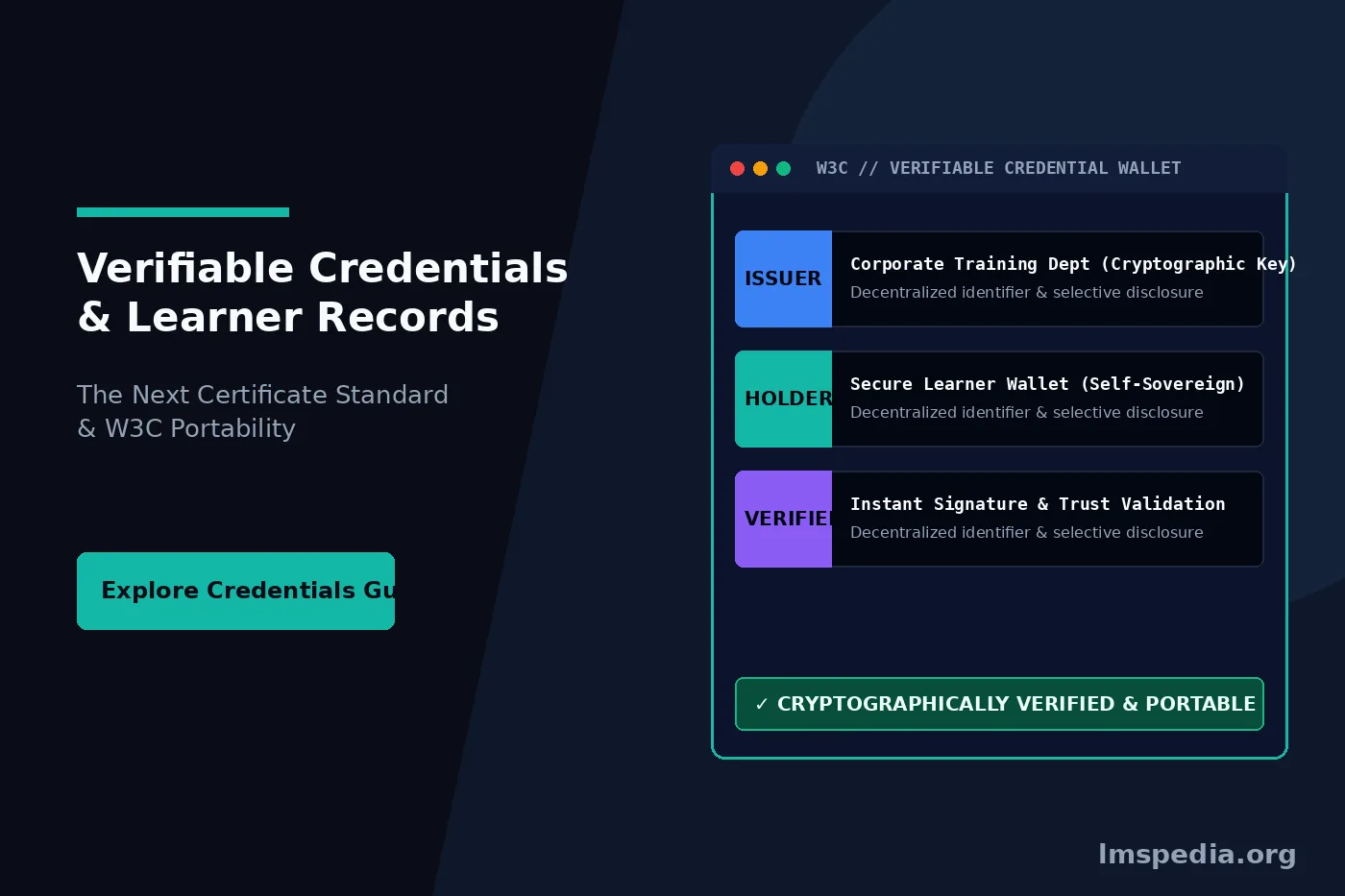
To begin with, understanding how verifiable credentials function requires examining the trust triangle: the issuer, the holder, and the verifier. Importantly, each entity plays a distinct cryptographic role in ensuring data integrity and user privacy.
1. The Issuer
Initially, the issuer acts as an authorized organization, such as a corporate training department, an accredited university, or a trade association. This entity evaluates the learner against specific competency criteria and generates a digital document containing claims about the learner. Subsequently, they sign this document using their private cryptographic key, effectively binding their organizational reputation to the credential.
2. The Holder
Next, the holder represents the individual learner. Unlike legacy systems where corporate servers host certificates, verifiable credentials belong entirely to the holder. Consequently, the learner stores their credentials in a secure digital wallet application on their mobile device or desktop. Furthermore, they maintain absolute control over when, with whom, and under what conditions they share their credentials.
3. The Verifier
Finally, the verifier acts as a third party, such as a prospective employer, a regulatory auditor, or a client organization. When the learner applies for a role, they present their verifiable credential to the verifier. Instantly, this verifying party uses the issuer’s public key to validate the cryptographic signature. Ultimately, this confirms that the credential is authentic, unaltered, and issued to the exact individual presenting it, all without needing to query a central database.
Comparing Credential Issuance and Management Platforms
Moreover, to implement a robust credentialing program, enterprise L&D teams must evaluate specialized issuance platforms that support modern cryptographic and badge standards.
| Platform Solution | Primary Focus | Key Credentialing Strength |
|---|---|---|
| Credly | Enterprise digital badge management and talent marketing. | Mass issuance workflows, rich labor market insights, and wide network integration. |
| Accredible | Scalable certificate and badge generation for training providers. | Automated credentialing templates, robust API integrations, and verification directories. |
| SimpliTrain | Versatile training management and operational scheduling. | Streamlined back-office resource coordination and flexible administration. |
Ultimately, selecting the right administrative platform ensures your training workflows integrate smoothly with your issuance pipelines. Additionally, for structural best practices on platform governance, consult our breakdown on how to architect secure LMS user roles and permissions.
Interoperability Warning
Importantly, avoid vendor lock-in by ensuring your training management and content authoring tools can export credential metadata in open JSON-LD formats compliant with W3C specifications. This precaution allows seamless migration to future wallet ecosystems.
Implementing Portable Credentials in Enterprise Training
Transitioning an enterprise training department toward portable credentials training models requires a phased implementation strategy. Realistically, organizations cannot simply discard legacy learning management systems overnight. Instead, L&D leaders must build a bridge between internal course completion tracking and external credential issuance.
Auditing and Automating the Credential Pipeline
First, the initial step involves auditing your existing course catalog to identify high-value certifications that carry external market value. Specifically, general safety compliance certificates, specialized software proficiencies, and technical trade licenses serve as prime candidates for verifiable credential issuance. Once identified, configure your learning management system or learning record store to trigger automated credential generation the exact moment a learner completes all practical and theoretical requirements.
Next, educate your workforce on digital wallet adoption. Typically, many employees lack familiarity with decentralized identity concepts. Therefore, providing clear internal documentation on how to claim, store, and share their verifiable credentials ensures high adoption rates. Moreover, it demonstrates that your organization genuinely invests in their long-term career mobility. To evaluate how modern diagnostic platforms measure mastery before issuance, check out our insights on evaluating effective training assessment tools.
Overcoming Privacy and Security Challenges
While transparency stands as a primary benefit of verifiable credentials, enterprise organizations must also strictly protect sensitive employee data. Historically, traditional credentials often expose excessive personal information, such as full home addresses, birth dates, or employee identification numbers, during routine verification checks.
Fortunately, W3C verifiable credentials solve this through advanced privacy features such as selective disclosure and zero-knowledge proofs. Specifically, selective disclosure allows a learner to share only the specific claims required for a job verification without exposing their entire training transcript. For example, a security guard can prove they hold an active first-aid certification without revealing their personal contact details or employment start date. Ultimately, this cryptographic privacy model aligns enterprise training with strict regulatory frameworks like GDPR and modern corporate data governance standards.
The Future of Workforce Mobility and Skills Passports
As labor markets become increasingly specialized and remote, the demand for instant, frictionless credential verification will only accelerate. Consequently, organizations that adopt verifiable credentials and learner employment records early will clearly position themselves as employers of choice. In turn, they will attract top-tier talent who heavily value career transparency and verifiable skill recognition.
Furthermore, integrating LER ecosystems with internal human resources systems allows enterprises to map existing workforce capabilities in real time. Instead of relying on static job descriptions, talent managers can query internal skill graphs built from verified credentials to assemble cross-functional project teams instantly. This operational agility transforms L&D from a cost center into a strategic driver of enterprise adaptability. Finally, to discover how modern systems manage these comprehensive workflows, review our guide on best training management software options.
Conclusion
In conclusion, as corporate learning departments evolve beyond static paper certificates and proprietary digital badges, adopting W3C verifiable credentials and Learner Employment Records represents the pinnacle of modern educational technology. By prioritizing cryptographic permanence, learner-owned data wallets, and seamless interoperability, enterprises can effectively eliminate verification friction and empower workforce mobility. Embracing these advanced credential standards ensures that employers universally recognize, securely validate, and thoroughly future-proof employee achievements across every career milestone.