Scenario-Based Assessment Design: Writing Items That Predict Job Performance
Traditional multiple-choice testing falls dangerously short in complex, high-stakes corporate environments. Employees often memorize isolated facts, regulatory definitions, and procedural steps just long enough to pass a compliance exam, only to falter completely when faced with ambiguous, high-pressure real-world decisions on the job floor. Organizations waste substantial budgets on training programs that measure short-term memory retention rather than actual behavioral change. To truly predict workplace success and drive measurable business impact, Learning and Development teams must pivot away from passive knowledge checks and toward authentic evaluation frameworks. Designing high-fidelity scenarios bridges the gap between passive knowledge absorption and active professional execution. You can explore foundational measurement principles through expert LMSPedia resources.
The core objective of any corporate assessment should not be grading compliance, but forecasting on-the-job competency. When an assessment fails to reflect the complexity of daily operations, the resulting performance data is effectively useless. Instructional designers and enterprise executives must understand that modern professional competency is multi-dimensional. It requires weighing competing priorities, interpreting incomplete data sets, managing interpersonal friction, and balancing immediate operational demands against long-term strategic risks. This comprehensive guide explores the principles, architectures, and step-by-step methodologies required to build scenario-based assessments that accurately predict job performance.
Key Takeaways

Scenario-Based Design Measures Application:
Traditional recall testing evaluates passive memory, whereas scenario-based assessments measure critical thinking, decision-making, and behavioral application under realistic workplace constraints.
Three Structural Components Are Essential:
High-fidelity scenario items require a realistic context narrative derived from top performers, plausible distractors based on actual historical errors, and nuanced weighted response options.
Avoid Binary Right-and-Wrong Scoring:
Real-world professional decisions rarely feature a simple binary outcome, meaning graded scoring models that yield partial credit provide far more accurate insights into employee readiness.
Pilot Testing Prevents Ambiguity:
Deploying new assessment items with subject matter experts before enterprise rollout ensures the narrative scenarios are clear, objective, and accurately aligned with actual field operations.
Advanced Authoring Tools Are Required:
Deploying dynamic, branching scenario items successfully requires dedicated learning technology that supports conditional logic, multimedia integration, and granular performance tracking.
The Psychological and Operational Flaws of Traditional Testing
Standard corporate assessments rely heavily on recall-based questions and surface-level knowledge checks. These traditional tests ask learners to define terms, list sequential steps, or identify correct policies from a curated list of options. While such tests are exceptionally efficient to grade and administer, they fail entirely to evaluate cognitive application. An employee might pass a safety policy test with a flawless score, yet violate core safety protocols on the shop floor because they cannot translate abstract text into concrete situational action.
This disconnect stems from the illusion of competence. Rote memorization activates transient memory pathways rather than deep structural understanding. In modern enterprises, professionals operate in fluid, fast-paced environments where problems rarely present a single, textbook answer. Professionals must navigate organizational politics, resource constraints, and conflicting stakeholder demands. When training assessments ignore these workplace realities, the data provides a false sense of security to executive leadership. L&D leaders must replace recall testing with evaluation items that mirror daily challenges. For deeper strategic alignment, review our guide on maximizing the transfer of training.
Behavioral Alignment
Never write an assessment item that tests purely for trivia unless the job strictly requires rote memorization of regulatory codes or part numbers. Always anchor your scenario choices in real friction points observed during performance audits and critical incident debriefs.
Anatomy of a High-Fidelity Scenario Assessment
Writing effective, predictive scenario questions requires a systematic architectural blueprint. A high-fidelity assessment item consists of three distinct structural components: the context narrative, the decision point, and the weighted response options. Each component must be engineered with psychological fidelity in mind.
1. Establishing Realistic Context and Psychological Fidelity
The scenario must immerse the learner in a believable, high-stakes workplace dilemma. Avoid generic placeholder names or overly dramatic corporate fiction. Instead, pull specific operational details directly from interviews with top-performing staff and frontline supervisors. Describe the exact environmental constraints, the software tools available, the time pressures, and the human stakeholders involved. The learner should immediately recognize the scenario as an authentic situation they face in their daily routine.
2. Crafting Plausible Distractors from Field Errors
In a poorly designed multiple-choice question, wrong answers are obviously incorrect to anyone with a passing familiarity with the topic. In a well-crafted situational judgment test, distractors must represent common traps, cognitive biases, or suboptimal habits practiced regularly by average performers. Every incorrect option should stem from actual historical errors documented in the field. If a distractor is too easily dismissed, the assessment loses its diagnostic power.
3. Implementing Weighted Scoring Matrices
Real-world professional decisions rarely feature a simple binary outcome of right versus wrong. Most complex workplace decisions involve trade-offs where one choice is optimal, another is marginally acceptable, and others are counterproductive or disastrous. Implementing graded, multi-tier scoring allows instructional designers to award full points for the best decision, partial credit for safe but inefficient actions, and zero points for hazardous choices. This nuanced scoring model provides accurate insights into employee readiness.
Comparing Assessment Delivery and Authoring Platforms
Deploying advanced scenario items requires software infrastructure that supports branching logic, multimedia integration, and granular scoring matrices. Technical buyers must evaluate how different tools handle complex assessment logic.
| Platform / Tool | Primary Focus | Scenario & Assessment Strength |
|---|---|---|
| SimpliTrain | Versatile training management and scheduling. | Streamlines administrative workflows and coordinates multi-step training evaluations. |
| Articulate Storyline | Interactive e-learning authoring. | Advanced branching logic and custom variable tracking for immersive simulations. |
| Adobe Captivate | Simulation and responsive course creation. | Robust software demonstrations and scenario-based quiz generation. |
Selecting the right authoring and delivery tool ensures your scenario logic functions smoothly across mobile and desktop devices without breaking data reporting pipelines. For additional structural best practices on platform governance and user administration, consult our breakdown on how to architect secure LMS user roles and permissions.
Pilot Testing Scenarios
Always pilot new scenario items with a small group of subject matter experts before enterprise rollout. If top performers consistently disagree with your designated correct answer, your narrative is ambiguous and requires immediate revision.
A Step-by-Step Methodology for Writing Scenario Items
Building predictive assessment items is an iterative engineering process that requires close collaboration between instructional designers, operational supervisors, and data analysts. Follow this structured methodology to write high-impact questions.
Step 1: Mine Critical Incidents
Partner with operational supervisors to identify recent project failures, safety near-misses, or customer service bottlenecks. Convert these authentic workplace friction points into the narrative seed for your scenario question. Real data ensures your scenarios reflect actual operational risk.
Step 2: Define the Core Competency
Identify the exact skill, judgment call, or ethical boundary being tested. Ensure the scenario isolates this single variable rather than overwhelming the learner with unrelated administrative clutter or confounding variables that obscure the evaluation.
Step 3: Draft Graded Outcomes and Feedback Loops
Write the optimal response first, followed by two plausible mistakes and one catastrophic error. Review these options with veteran staff to ensure the psychological fidelity matches reality. Furthermore, write immediate, formative feedback for every chosen option explaining why the decision succeeds or fails. To learn more about modern diagnostic tools, check out our insights on evaluating effective training assessment tools.
Evaluating Interpersonal and Complex Judgment Skills
While technical competencies are straightforward to test, evaluating soft skills, leadership acumen, and ethical decision-making requires sophisticated branching logic. In a branching scenario, the learner makes an initial decision, and the narrative shifts based on that choice, presenting subsequent challenges that compound their earlier actions. This simulates the cascading consequences of workplace behavior.
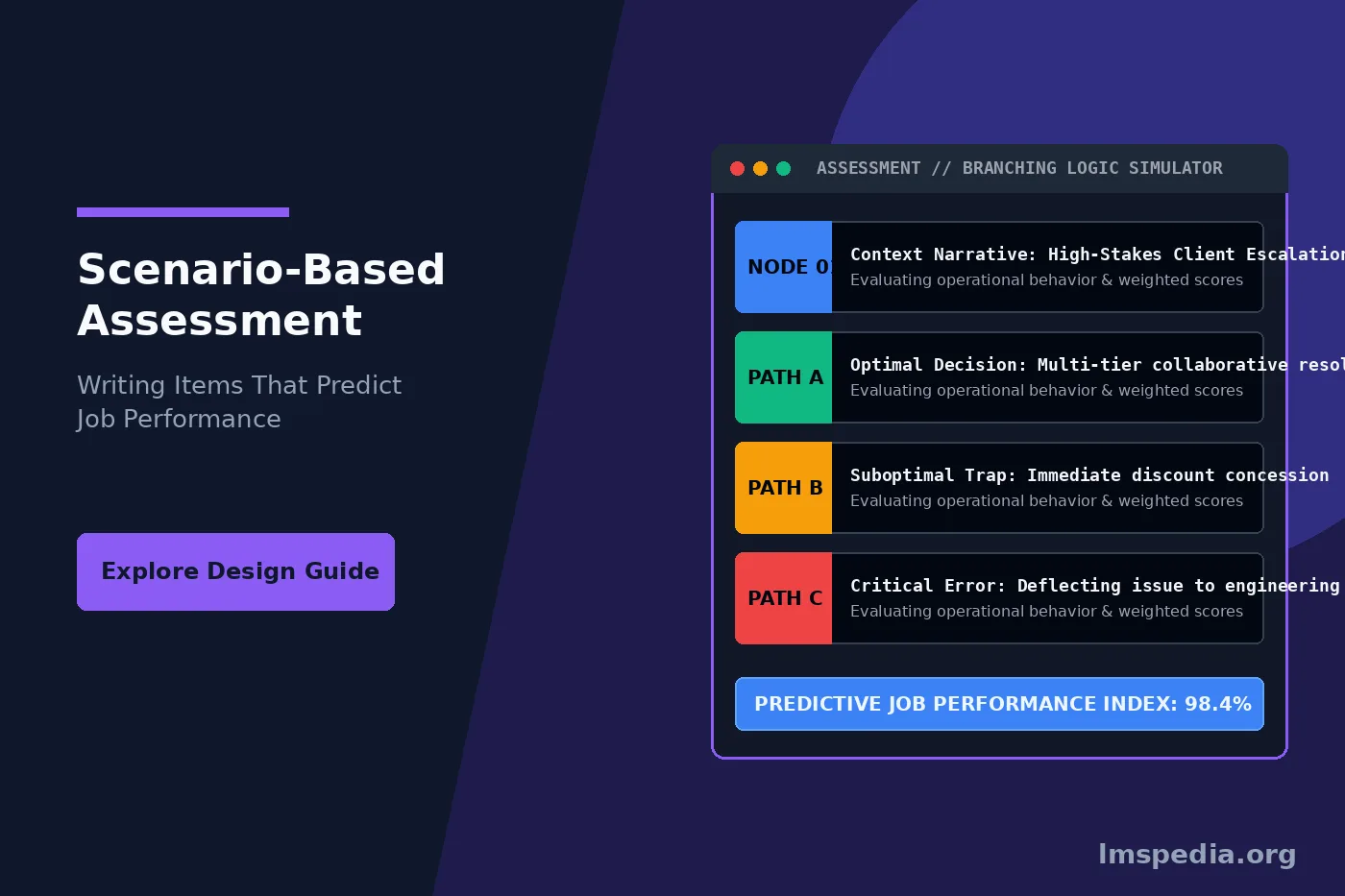
For example, a customer service manager handling an irate client must choose whether to offer an immediate financial concession, escalate the issue to engineering, or investigate the underlying product defect. Each path introduces new complications, such as budget restrictions or technician shortages. By tracking the learner path through these branching decisions, L&D professionals can identify systemic coaching needs across entire departments.
Avoiding Common Pitfalls in Scenario Design
Even experienced instructional designers occasionally fall into traps that undermine the validity of their assessments. Recognizing these pitfalls ensures higher design quality.
Pitfall 1: The Transparent Right Answer
When the correct option is significantly longer, more detailed, or morally virtuous compared to the distractors, learners will select it simply through test-taking strategy rather than genuine comprehension. Ensure all options share similar length, tone, and plausibility.
Pitfall 2: Overcomplicating Narratives
While psychological fidelity is vital, cluttering the scenario with excessive background noise, irrelevant character names, and unnecessary data tables creates a reading comprehension test rather than a judgment test. Keep the narrative laser-focused on the core decision.
Pitfall 3: Ignoring Organizational KPIs
Every scenario assessment should tie directly back to operational key performance indicators, such as reduced error rates, shorter resolution times, or higher compliance adherence. If an assessment cannot be linked to business outcomes, its value to executive leadership remains unproven.
Conclusion
Beyond narrative realism and plausible distractors, psychometric validity remains the ultimate litmus test for effective scenario-based items. Instructional designers should periodically perform item analysis on their assessment banks to evaluate difficulty indices and point-biserial discrimination coefficients. A properly calibrated scenario question should successfully differentiate between novice practitioners and elite veteran performers. If top-performing employees routinely fail a specific decision node, it rarely indicates a widespread skills gap; instead, it signals a flaw in the scenario’s narrative logic or an ambiguous distinction between the optimal choice and the plausible distractors. Establishing a regular data review cycle ensures your evaluation items maintain high predictive accuracy over time.
Incorporating multimedia elements into scenario items further elevates cognitive engagement and immersion. Traditional text-based scenarios, while useful, often fail to capture the sensory pressure and emotional volatility of real-world professional crises. Integrating short video clips of an upset customer, simulated audio recordings of a stressful radio transmission, or interactive replicas of complex enterprise software dashboards transforms a flat multiple-choice test into an engaging diagnostic simulation. When learners must evaluate facial expressions, tone of voice, or chaotic interface data streams before making a critical decision, the assessment measures true situational awareness and emotional regulation, offering a profound indicator of how they will perform when real stakes are on the line.
Designing scenario-based assessments is an essential discipline for modern organizations committed to moving beyond compliance checkboxes and toward true operational excellence. By replacing passive recall testing with high-fidelity simulations, weighted scoring matrices, and authentic workplace dilemmas, Learning and Development teams can accurately forecast job performance and mitigate risk. Investing time in rigorous scenario engineering transforms training from a passive administrative burden into a powerful strategic driver of enterprise success. To discover how modern platforms manage these comprehensive workflows, review our guide on best training management software options.
FAQ
Q1. What is the primary benefit of scenario-based assessment over traditional testing?
Scenario-based assessments measure critical thinking, decision-making, and behavioral application under realistic constraints, providing a far more accurate prediction of on-the-job performance than rote memorization tests.
Q2. How do you handle subjective decision-making in situational judgment tests?
Subjectivity is minimized by collaborating with subject matter experts to establish standardized scoring rubrics, weighted choices, and multi-tier credit models based on actual historical outcomes.
Q3. Can scenario assessments be automated within a standard learning management system?
Yes, modern authoring tools and platforms allow instructional designers to build branching scenarios and conditional logic that automatically grade complex responses and report performance data back to administrators.
Q4. How many response options should a scenario question include?
A standard scenario item typically includes four distinct choices, consisting of one optimal response, two suboptimal or partial-credit actions, and one clearly counterproductive choice.
Q5. What is the best way to pilot test a new set of assessment items?
Deploy the questions to a small, representative sample of learners and subject matter experts, analyze response distribution patterns, and interview participants to ensure the scenario narratives are clear and unambiguous.
Q6. Can scenario assessments be automated within a standard learning management system?
Yes, modern authoring tools and platforms allow instructional designers to build branching scenarios and conditional logic that automatically grade complex responses and report performance data back to administrators.
Q7. How many response options should a scenario question include?
A standard scenario item typically includes four distinct choices, consisting of one optimal response, two suboptimal or partial-credit actions, and one clearly counterproductive choice.
Q8. What is the best way to pilot test a new set of assessment items?
Deploy the questions to a small, representative sample of learners and subject matter experts, analyze response distribution patterns, and interview participants to ensure the scenario narratives are clear and unambiguous.