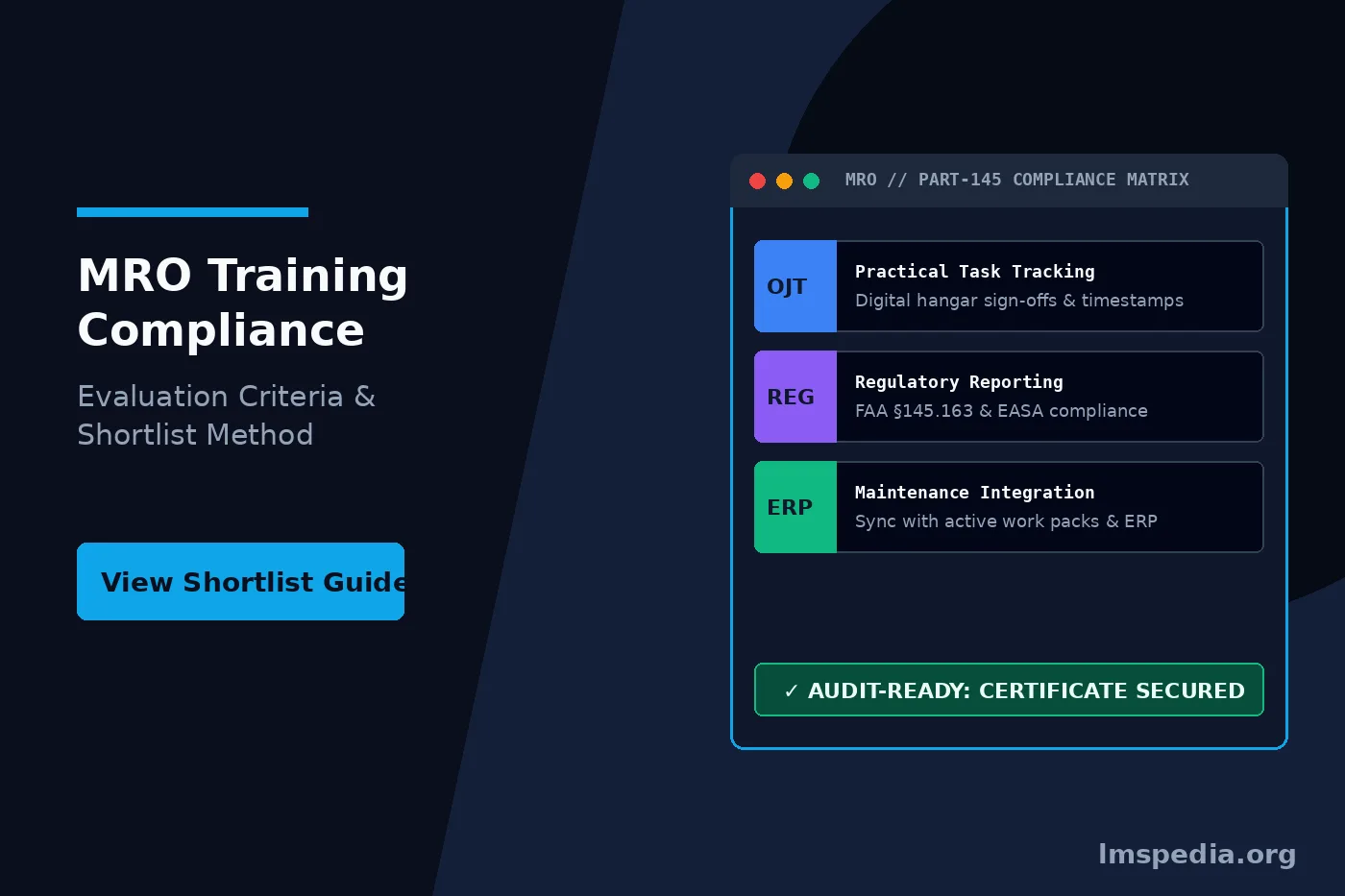
MRO Training Compliance Software: Evaluation Criteria and Shortlist Method
Maintaining absolute airworthiness within an aviation Maintenance, Repair, and Overhaul (MRO) environment requires extraordinary precision, rigorous documentation, and unwavering adherence to safety mandates. Regulatory authorities such as the Federal Aviation Administration under 14 CFR Part 145 and the European Union Aviation Safety Agency under Part-145 demand comprehensive, immutable evidence of technician qualifications, specialized aircraft type-ratings, and ongoing competency evaluations. Despite the high stakes of heavy maintenance operations, a surprising number of repair stations still rely on fragmented spreadsheets, disconnected legacy tools, and paper binders to manage training records. This administrative negligence introduces severe audit liabilities, catastrophic grounding risks, and operational inefficiencies that can cost millions of dollars in unexpected downtime.
Implementing a dedicated software solution is no longer optional for modern repair stations striving to maintain competitive advantage. It functions as a critical operational safeguard. However, standard corporate learning management systems fail miserably in heavy maintenance environments because they cannot track On-the-Job Training, practical task authorizations, or specialized tool certifications. Selecting the right platform requires a rigorous, multi-faceted evaluation framework tailored specifically to aviation workflows. In this technical buyer’s guide, we explore the essential evaluation criteria and shortlist methods for choosing an advanced platform. You can explore broader industry standards by reviewing expert LMSPedia resources and specialized tools to shape your initial requirements.
Key Takeaways

Beyond Passive Learning:
Standard corporate learning management systems fail MROs because they cannot track practical tasks, aircraft type-ratings, or supervisor sign-offs.
Audit Readiness:
Evaluated systems must allow quality teams to compile complete mechanic qualification histories within a few clicks during unexpected regulatory audits.
Real-Time Integration:
Training software must synchronize directly with maintenance planning systems to automatically block expired technicians from being assigned work packs.
Hangar Usability:
Solutions must feature mobile-friendly interfaces designed for technicians working directly on active hangar floors under demanding physical conditions.
Structured Shortlist Filtering:
Procurement teams should apply strict regulatory knockout filters and hands-on sandbox proof-of-concept testing before finalizing any vendor contract.
The Regulatory Landscape and Why Standard LMS Platforms Fail MROs
Commercial learning software is typically engineered for passive course completion tracking within corporate or academic settings. These standard platforms record whether an employee watched a video module or answered a series of multiple-choice questions. In stark contrast, aviation maintenance compliance operates on an entirely different plane of operational and legal complexity. Technicians must demonstrate physical proficiency, complete verified practical tasks, and maintain strict recurrency schedules linked directly to specific airframes, engine variants, and component systems.
When a regulatory inspector walks onto an active hangar floor, they do not want to see a generic completion certificate stored in a filing cabinet. They demand to trace the exact lineage of a mechanic authorization from initial qualification through every recurrent cycle. This includes initial training logs, certified supervisor sign-offs, specialized human factors courses, and recurrent qualification windows. Standard enterprise learning tools lack the relational data structures required to map these complex interactions. MRO operations require specialized software that treats compliance as a continuous, verifiable audit trail rather than a static human resources checklist. For deeper insights into managing technical education pathways, review our comprehensive guide on aircraft maintenance training software for MROs.
Furthermore, maintenance environments involve dynamic shift rotations, contractor management, and multi-facility networks. A standard human resources portal cannot handle the fluidity of hangar assignments or automatically cross-reference training status with active work orders. When evaluating platforms, engineering leaders must understand that best aviation training management systems are designed specifically to eliminate these administrative blind spots and protect the station certificate.
Audit Readiness Strategy
Always test a prospective MRO training system by running a simulated regulatory audit report for a high-turnover mechanic during your vendor demonstration. If compiling their practical logs, type ratings, and recurrent sign-offs takes more than three clicks, the platform will create severe bottlenecks during real FAA or EASA inspections.
Core Evaluation Criteria for MRO Training Software
When building your technical evaluation matrix, your engineering, quality assurance, and training teams must assess software candidates against specific pillars tailored to heavy maintenance workflows. Relying on generic software feature lists will lead to expensive implementation failures.
1. Practical Task-Level Tracking and Competency Management
The core of maintenance compliance lies in practical execution on the hangar floor. The software must support digital logs where a certified inspector can sign off on specific maintenance tasks directly from a mobile device or tablet. Every single entry must capture the task code, aircraft tail number, supervisor signature, and a tamper-proof timestamp. Effective architect secure LMS user roles and permissions ensures that only authorized quality personnel can grant these critical task sign-offs, preventing unauthorized entries.
2. Multi-Standard Regulatory Reporting and Automated Alerts
Whether your repair station operates under strict FAA Part 145 or EASA Part-145 rules, the system must generate compliance reports aligned directly with statutory requirements, such as federal code section 145.163. It should automatically flag expiring authorizations, medical certificates, and required human factors refreshers well before a technician is legally permitted to sign off on a return-to-service document. Automated notification workflows ensure that supervisors can reassign training before a compliance gap grounds a project.
3. Real-Time Integration with Maintenance Enterprise Planning
Training data can never exist in an isolated silo. The training software must communicate seamlessly with your broader maintenance planning and enterprise resource planning systems. If a technician training currency expires, the scheduling module should automatically block them from being assigned to critical maintenance work packs. To understand how operational data flows across technical frameworks under heavy loads, review our guide on LMS load testing and performance benchmarking.
Deep Dive into Digital OJT and Electronic Signatures
Managing On-the-Job Training manually is one of the greatest administrative burdens faced by director-level maintenance personnel. Technicians complete practical tasks across irregular shifts, and paper sign-off sheets are frequently lost, damaged by fluid spills, or filled out incorrectly. A robust platform digitizes this entire workflow. Instructors and supervisors can review a mechanic progress matrix on a shop floor terminal, input evaluations instantly, and apply secure electronic signatures that satisfy strict legal non-repudiation standards.
Moreover, modern LMS buyer guide vendor questions emphasize the need for offline functionality. Hangars often feature poor cellular connectivity or shielded metallic structures. Technicians need mobile applications that allow data entry while offline, automatically syncing securely back to the central server the moment the device reconnects to the local network. This technical capability ensures zero data loss during remote line-maintenance operations or heavy hangar overhauls.
Comparing Leading MRO Compliance Platforms
To navigate the market effectively, technical buyers must evaluate how different software vendors approach aviation maintenance and compliance tracking. The market features solutions ranging from massive enterprise ERP modules to specialized training management tools.
| Platform Solution | Primary Focus | Key MRO Compliance Strength |
|---|---|---|
| SimpliTrain | Versatile training management and scheduling. | Streamlined back-office resource coordination and flexible administration. |
| Comply365 | Integrated content, training, and safety ecosystems. | Unified operational visibility across maintenance publications and compliance. |
| Ramco Aviation Suite | Enterprise-grade MRO suites and global airlines. | Built-in training modules managing thousands of aircraft worldwide. |
Each of these options serves a distinct operational scale within the aviation sector. Evaluating them requires looking past glossy marketing brochures to examine how they handle daily hangar disruptions, emergency shift changes, and sudden regulatory amendments. Selecting the wrong architecture will force your quality assurance team into endless manual workarounds.
Integration Warning
Never purchase an MRO training tool that relies solely on manual batch data imports from your human resources information system. Mechanics move quickly across stations and shifts, meaning your training software requires real-time synchronization with active maintenance work orders to prevent compliance drift.
Managing Human Factors and Recurrency Matrices
Aviation maintenance training is not a one-time event completed during initial onboarding. It is a continuous, highly regulated lifecycle. Personnel must complete recurrent training in human factors, fuel tank safety, electrical wiring interconnection systems, and specific airframe updates at mandated intervals. A reliable platform maintains a dynamic matrix that recalculates windows automatically based on calendar rules or operational hours.
Furthermore, maintenance training platforms must accommodate specialized tool qualifications. If a facility introduces a new composite repair kit or advanced nondestructive testing equipment, the system must allow safety managers to instantly deploy targeted micro-learning modules and restrict tool crib access until technicians verify completion. This proactive control mechanism shields the organization from liability and ensures that every task is executed by certified professionals.
The Shortlist Method: A Step-by-Step Selection Process
Narrowing down dozens of software vendors to a viable shortlist requires a disciplined, multi-stage filtration methodology. Skipping steps during procurement often results in costly software implementations that suffer from poor user adoption on the hangar floor.
Step 1: The Regulatory Knockout Filter
Immediately eliminate any vendor that cannot provide verifiable proof of out-of-the-box compliance for your specific jurisdictional framework. If a platform requires extensive custom coding or expensive third-party plugins to track basic mechanic type-ratings and practical sign-offs, reject it from consideration entirely.
Step 2: Hangar Floor Usability Testing
Involve lead inspectors, quality managers, and floor supervisors directly in the vendor demonstration process. Software that looks brilliant to a corporate executive in a quiet office will fail immediately if it requires a mechanic to navigate confusing navigation menus while wearing heavy work gloves in a loud, active hangar environment. Prioritize clean touch-screen workflows and intuitive mobile designs.
Step 3: Sandbox Proof of Concept
Request a dedicated sandbox environment populated with a representative sample of your actual technician data, shift schedules, and historical training records. Test the system by executing a complete audit scenario: onboard a new mechanic, assign an airframe type-rating course, log a practical task via mobile sign-off, and generate a full regulatory compliance report. If the software stumbles or requires manual intervention during this controlled test, remove it from your shortlist.
Conclusion
Another critical architectural consideration for heavy maintenance facilities is offline data resilience and edge synchronization. Hangar environments frequently feature massive steel structures, thick concrete bulkheads, and remote apron locations where Wi-Fi or cellular connectivity is severely degraded or entirely blocked. If a maintenance training application requires an active internet connection to log a supervisor sign-off or verify a mechanic certification, operations will grind to a halt. Leading MRO compliance platforms utilize progressive web applications or native mobile architectures with robust local caching. This allows certified inspectors to record practical task completions offline on a tablet, safely storing the tamper-proof timestamps locally until the device re-establishes a secure connection to the central database, thereby preventing administrative bottlenecks during active shift changes.
Furthermore, maintenance training oversight must extend beyond permanent full-time staff to encompass contract mechanics, temporary specialists, and third-party vendor personnel who rotate through your repair station on short-term project contracts. Managing transient labor pools introduces unique compliance vulnerabilities, as temporary technicians often arrive with disparate training histories, unverified certifications, and unfamiliarity with station-specific Standard Operating Procedures. A sophisticated MRO training ecosystem should feature automated onboarding portals and credential verification workflows that allow external contractors to upload validated proof of prior training before they ever step foot on the hangar floor. This dynamic contractor management layer protects your facility from unauthorized sign-offs and ensures uniform safety adherence across your entire blended workforce.
Achieving and sustaining compliance in an aviation repair station demands robust digital infrastructure designed specifically for technical environments. By prioritizing practical task tracking, seamless maintenance scheduling integrations, and rigorous audit trails, engineering leaders can eliminate administrative risk. Building a disciplined evaluation shortlist ensures your facility invests in a platform that truly supports safe, airworthy operations for years to come.
FAQ
Q1. What are the primary regulatory requirements for MRO training software?
MRO training software must maintain complete, immutable audit trails, secure electronic signatures, role-based user permissions, and precise tracking of initial qualifications, recurrent deadlines, and practical tasks mandated by regulations like FAA Part 145 and EASA Part-145.
Q2. Why can't standard corporate LMS platforms be used in aviation maintenance?
Standard corporate LMS platforms are designed for passive desk-based learning and generic tracking. They generally lack the technical architecture required to manage complex aircraft type-ratings, supervisor task sign-offs, and real-time integration with heavy maintenance work orders.
Q3. How does practical task tracking work within a compliant MRO system?
Digital task tracking allows certified inspectors to validate a mechanic practical task execution directly on the hangar floor using a mobile device or tablet. The system records the task code, supervisor credentials, date stamps, and final sign-offs into a secure compliance profile.
Q4. What is the benefit of integrating training software with a maintenance enterprise system?
Integrating training data with your broader maintenance planning system ensures that mechanic currency is verified automatically before work packs are assigned. If a technician certification lapses, the system prevents scheduling errors and blocks unauthorized sign-offs.
Q5. How long does it typically take to implement an MRO training compliance platform?
Implementation timelines vary based on organizational size and existing data cleanliness. A targeted proof of concept and initial rollout for a single repair station typically takes between four to eight weeks, while global network deployments can span several months.