Despite massive investments in next-generation firewalls, endpoint detection, and automated threat hunting, the human element remains the most vulnerable attack surface in any organization. Phishing, social engineering, and accidental data exposure account for the vast majority of enterprise data breaches. Recognizing this critical vulnerability, the International Organization for Standardization (ISO) places immense emphasis on human behavior within its flagship information security standard. Achieving and maintaining certification requires deploying rigorous, continuous iso 27001 security awareness training across your entire workforce.
However, treating security awareness as an annual, “check-the-box” PowerPoint presentation will guarantee non-conformities during an external audit. Modern auditors from accredited certification bodies do not just look for attendance sheets; they actively hunt for proof of comprehension, cultural integration, and continuous improvement. Organizations must seamlessly weave the core principles of their Information Security Management System (ISMS) into the daily operational habits of every employee, contractor, and third-party vendor.
Successfully navigating an ISO 27001 Stage 2 certification audit requires a deep understanding of the standard’s structural requirements. To see how these training frameworks overlap with broader corporate quality initiatives, you can review our guide on ISO 9001 Clause 7.2 Competence. In this comprehensive reference guide, we will decode the explicit iso 27001 training requirements, dissect the modern annex a 6.3 awareness training controls, and detail exactly how to generate unshakeable isms training evidence that satisfies even the most rigorous auditor.
Key Takeaways

Understand the Dual Requirements:
ISO 27001 separates human knowledge into two distinct clauses: Clause 7.2 (Competence for ISMS operators) and Clause 7.3 (Security Awareness for all employees). You must satisfy both independently.
Annex A 6.3 Demands Continuous Education:
The 2022 revision of ISO 27001 updated the awareness control to mandate “regular updates.” Annual, one-time PowerPoint presentations are no longer sufficient; training must be an ongoing, continuous process.
Customize by Job Role:
Generic training fails audits. Annex A explicitly requires training to be relevant to a user’s specific job function. Developers need secure coding training, while HR needs advanced data privacy instruction.
Evidence Must Prove Comprehension:
Attendance logs are not enough. Audit-ready ISMS training evidence must include passing assessment scorecards and digital signatures acknowledging the latest version of the Information Security Policy.
Automate Your Recordkeeping:
Manage your information security training records via an LMS synced with your Active Directory. This automates onboarding assignments, tracks compliance expirations, and eliminates the human error inherent in spreadsheet tracking.
Decoding the Core ISO 27001 Training Requirements
To build a compliant training program, you must first understand how the ISO 27001 standard structures its educational mandates. The requirements are divided between the mandatory management system clauses (the main body of the standard) and the specific security controls (Annex A).
Within the main body of the standard, two distinct clauses dictate how your organization must manage human knowledge and behavior: Clause 7.2 (Competence) and Clause 7.3 (Awareness). Confusing these two distinct iso 27001 training requirements is a frequent source of audit failure.
Clause 7.2: Competence
Competence applies specifically to the personnel who are directly responsible for designing, operating, or monitoring the ISMS. This includes your Chief Information Security Officer (CISO), IT administrators, network engineers, and internal auditors. The standard requires that you:
- Determine the necessary competence of persons doing work that affects your information security performance.
- Ensure these persons are competent on the basis of appropriate education, training, or experience.
- Take actions to acquire necessary competence (e.g., sending an IT admin to a specialized firewall configuration bootcamp).
- Retain appropriate documented information as evidence of competence (e.g., professional certifications like CISSP or CISM).
Clause 7.3: Awareness
While Clause 7.2 applies to your security experts, Clause 7.3 applies to everyone—from the CEO to the newest frontline intern. Clause 7.3 explicitly mandates that all persons doing work under the organization’s control shall be aware of:
- The organization’s overarching information security policy.
- Their specific contribution to the effectiveness of the ISMS, including the benefits of improved security performance.
- The implications of not conforming with ISMS requirements (including disciplinary actions for security violations).
Deep Dive: Annex A 6.3 Awareness Training (2022 Revision)
In 2022, ISO released a major update to the ISO 27001 standard, completely restructuring the Annex A controls. What was formerly known as Control A.7.2.2 (Information security awareness, education, and training) was modernized, expanded, and relocated to annex a 6.3 awareness training under the “People Controls” category.
Annex A 6.3 explicitly dictates that: “Personnel of the organization and relevant interested parties shall receive appropriate information security awareness, education and training and regular updates of the organization’s information security policy, topic-specific policies and procedures, as relevant for their job function.”
The Shift from Annual to Continuous Training
The addition of the phrase “regular updates” is critical. It signifies the death of the annual, one-hour compliance marathon. Cyber threats evolve daily. A training video produced two years ago regarding email phishing will not prepare your finance team for a modern, AI-generated deepfake voice-cloning attack. Your annex a 6.3 awareness training program must be continuous, delivering micro-learning modules, threat briefings, and simulated phishing campaigns throughout the calendar year.
| Training Component | Traditional Approach (Non-Compliant) | Modern Annex A 6.3 Approach (Audit-Ready) |
|---|---|---|
| Frequency | Once a year during onboarding or annual review. | Monthly micro-learning, quarterly deep-dives, and continuous phishing simulations. |
| Content Delivery | Generic, off-the-shelf slide decks. | Role-based, tailored content focusing on specific internal policies and emerging threats. |
| Assessment | No testing, or a simple “click-to-acknowledge” button. | Scenario-based quizzes with defined passing thresholds (e.g., 80% or higher). |
| Scope | Only internal W-2 employees. | All relevant interested parties, including contractors, freelancers, and vendor partners. |
Designing a Compliant Security Curriculum
To satisfy an auditor, your iso 27001 security awareness training curriculum must directly map to the specific risks identified in your organization’s Risk Assessment (Clause 6.1.2) and the corresponding Annex A controls you selected in your Statement of Applicability (SoA).
A robust, audit-ready curriculum typically includes mandatory modules covering the following core domains:
- Social Engineering & Phishing: Recognizing malicious links, Business Email Compromise (BEC), spear-phishing, tailgating, and baiting.
- Clean Desk and Clear Screen Policy (Annex A 7.7): Ensuring sensitive physical documents are locked away and computer screens are locked when stepping away from the workstation.
- Information Security Incident Reporting (Annex A 6.8): Exactly who to contact, what to say, and how quickly to report suspicious activity or confirmed breaches.
- Remote Working and Bring Your Own Device (BYOD) (Annex A 6.7): Securing home Wi-Fi networks, avoiding public charging stations, and using Virtual Private Networks (VPNs).
- Data Handling and Classification (Annex A 5.12 & 5.13): Understanding the difference between Public, Internal, Confidential, and Restricted data, and how each must be encrypted and transmitted.
Customize Training by Role
Do not give your software developers the exact same training as your HR department. Annex A 6.3 requires training “as relevant for their job function.” Developers must receive targeted training on secure coding practices (OWASP Top 10) and secure development lifecycles (Annex A 8.25), while HR should focus heavily on PII handling and social engineering.
Generating Defensible ISMS Training Evidence
During a certification audit, the auditor will pull a random sample of employees from your organizational chart and ask you to prove they were trained. If you cannot produce immediate, verifiable isms training evidence, you will receive a non-conformity. To understand how automated systems prevent these gaps, you can explore our guide on utilizing an LMS for compliance training audit evidence.
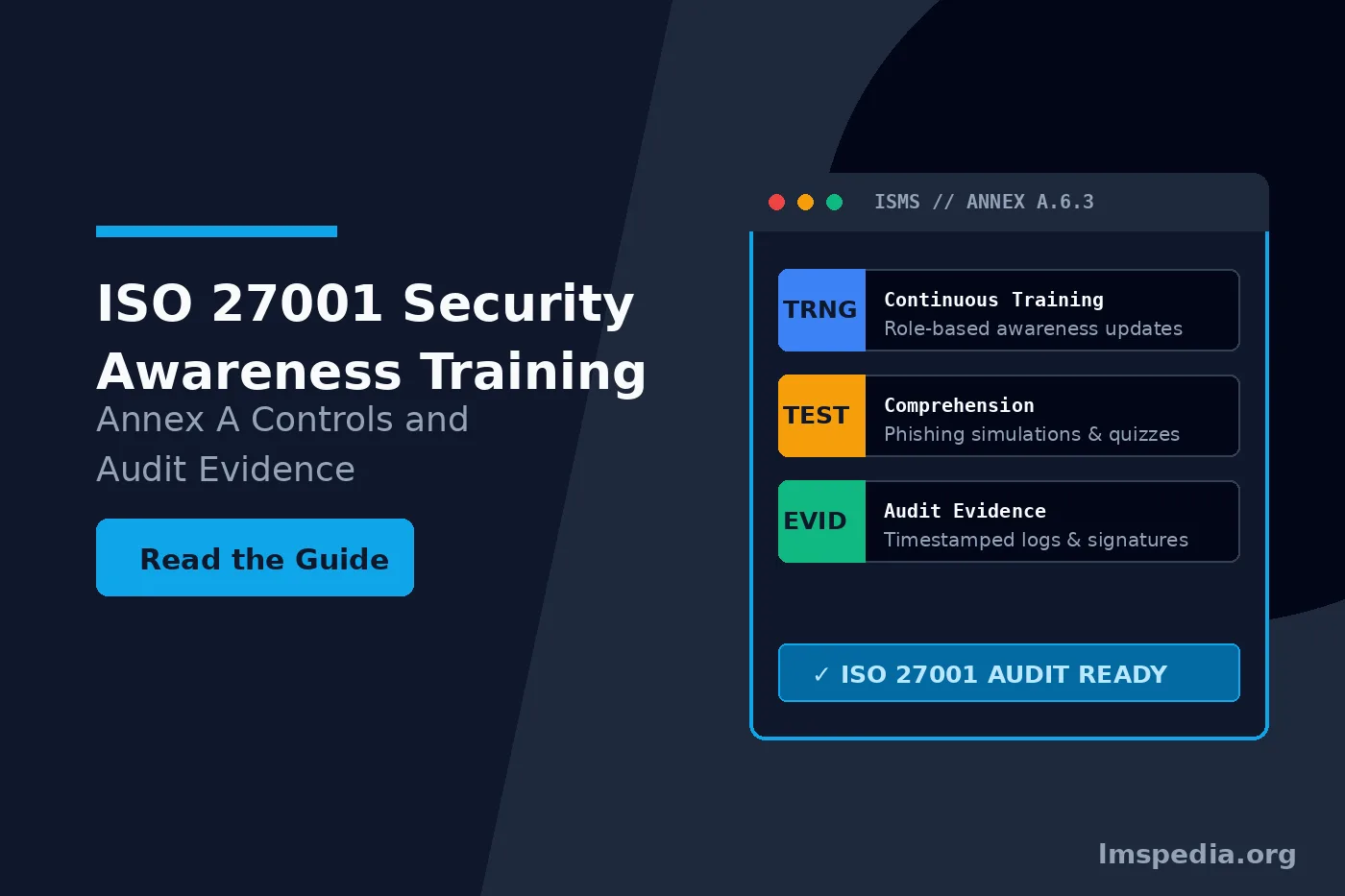
Audit evidence must prove three things: Delivery, Comprehension, and Traceability.
1. Proving Delivery (Attendance)
You must prove that the training was actually delivered to the specific user. Simple calendar invites are insufficient. You need timestamped system logs showing exactly when the user logged in, launched the SCORM module, and completed the course. For live virtual training, utilize digital sign-in sheets backed by Zoom/Teams attendance export logs.
2. Proving Comprehension (Assessments)
To prove comprehension, every awareness module must conclude with an assessment. You must retain the digital exam scorecards proving the employee surpassed the minimum passing score. If an employee fails, your isms training evidence must show the remediation loop: that they were forced to retake the module and successfully passed on a subsequent attempt.
3. Proving Traceability (Policy Acknowledgments)
Because Clause 7.3 requires employees to be aware of the information security policy, your training records must link directly to the policy document. The best practice is to embed a digital signature or attestation checkbox at the end of the training, stating: “I have read, understood, and agree to abide by the Information Security Policy V2.4.” Linking the training directly to a specific document version number proves tight document control.
Maintaining Information Security Training Records
Organizing and preserving information security training records requires an enterprise-grade Learning Management System (LMS) or a dedicated security awareness platform. Attempting to manage these records across hundreds of employees using Excel spreadsheets is a guaranteed path to audit failure.
Because your LMS will house sensitive compliance data and act as the core repository for these records, you must also verify the platform’s own security posture. When selecting a vendor, ensure they maintain rigorous operational security by reviewing the importance of SOC 2 Type II compliance for LMS vendors. Additionally, for a comprehensive look at how modern learning platforms must protect employee privacy against evolving cyber threats, consult our complete LMS security and data privacy 2026 guide.
Integration and Automated Provisioning
Your LMS must integrate seamlessly with your HR Information System (HRIS) or Active Directory (e.g., Azure AD, Okta). When a new employee is hired, the system must automatically provision their account and immediately assign the mandatory ISO 27001 onboarding curriculum. If you rely on manual HR emails to trigger training assignments, users will inevitably fall through the cracks. To ensure these critical data pipelines remain intact and your automated enrollments never fail, review our technical breakdown on HRIS data syncs issues.
Record Retention and Expiration Tracking
ISO 27001 requires that records be protected from loss and unauthorized alteration. Your information security training records must be stored in a centralized, backed-up database with role-based access control. Furthermore, the system must automatically track expiration dates. If your policy requires annual refresher training, the LMS should automatically alert the employee and their manager 30 days before their compliance status expires.
Track Phishing Simulation Metrics
Modern auditors expect to see practical training metrics alongside formal course completions. Run simulated phishing campaigns monthly. Your training records should include your organization’s “Click Rate” and “Report Rate.” Demonstrating a downward trend in click rates over time acts as powerful, empirical evidence that your awareness program is continuously improving the effectiveness of your ISMS.
Measuring Training Effectiveness
Clause 9.1 (Monitoring, measurement, analysis, and evaluation) applies directly to your training program. You cannot simply deliver training; you must measure if it is actually working to reduce organizational risk.
To demonstrate continuous improvement to an auditor, track and present the following KPIs during your annual Management Review meetings:
- Compliance Completion Rate: The percentage of staff who completed mandatory training within the required SLA (Target: 100%).
- Phishing Simulation Report Rate: The percentage of users who actively use the “Report Phish” button when encountering a suspicious email, rather than just deleting it (Target: >70%).
- Incident Response Time: Does security training lead to faster internal reporting of lost devices, suspicious network activity, or potential data breaches?
- Audit Findings: A reduction in minor non-conformities related to clear-desk violations or unauthorized access during internal audits.
Conclusion
Achieving and maintaining ISO 27001 certification requires far more than drafting a dense security manual. It requires cultivating a deeply ingrained culture of vigilance across your entire workforce. By designing a dynamic iso 27001 security awareness training program, organizations can transform their employees from their greatest vulnerability into their strongest line of defense.
To satisfy external auditors, security and HR leaders must meticulously align their curricula with the iso 27001 training requirements outlined in Clause 7.3 and the explicit controls of annex a 6.3 awareness training. Furthermore, by abandoning manual spreadsheets and leveraging automated learning platforms, organizations can effortlessly generate verifiable isms training evidence. Maintaining pristine, centralized information security training records not only guarantees a smooth certification audit but proves that your organization is fully committed to protecting its most critical data assets against an ever-evolving threat landscape.
FAQ
Q1. What are the primary ISO 27001 training requirements?
ISO 27001 requires organizations to ensure competence for individuals managing the ISMS (Clause 7.2) and mandates comprehensive information security awareness training for all employees and relevant contractors (Clause 7.3), ensuring everyone understands the security policy and the consequences of non-compliance.
Q2. What is Annex A 6.3 awareness training?
Annex A 6.3 (formerly A.7.2.2 in the 2013 standard) is a specific control in the ISO 27001:2022 revision. It dictates that all personnel and relevant interested parties must receive appropriate security awareness training and regular updates on organizational policies relevant to their job functions.
Q3. What qualifies as valid ISMS training evidence for an auditor?
Valid ISMS training evidence includes timestamped completion logs from a Learning Management System (LMS), passing exam scorecards to prove comprehension, and digitally tracked acknowledgments proving the employee has read and understood the current version of the Information Security Policy.
Q4. How often does ISO 27001 require security awareness training?
While the standard does not explicitly prescribe a rigid timeframe (like “every 365 days”), it mandates “regular updates.” Best practices and modern auditor expectations dictate that core awareness training occurs upon onboarding, annually for deep-dives, and monthly or quarterly for continuous micro-learning and phishing simulations.
Q5. Do contractors need to take ISO 27001 security awareness training?
Yes. ISO 27001 Annex A 6.3 explicitly includes “relevant interested parties.” If a contractor, freelancer, or vendor has access to your corporate network, physical office space, or confidential data, they must complete relevant security awareness training and have their records retained for audit.