Modern commercial aviation relies entirely on the technical proficiency of certified maintenance personnel. Specifically, without highly trained mechanics, the entire global aerospace network would collapse instantly. Therefore, the European Union Aviation Safety Agency explicitly regulates how aviation technicians receive their education. To deliver this critical instruction legally, educational facilities must secure a highly coveted easa part 147 approval certificate. This specific regulation dictates exactly how a facility must structure its instructional environment, manage its instructors, and conduct its final examinations.
Navigating this massive regulatory framework requires absolute precision and flawless administrative oversight natively. Consequently, to manage these complex student pathways efficiently, forward-thinking academies utilize specialized aircraft maintenance training software mros daily. As a result, these digital platforms automate massive compliance burdens, allowing instructional staff to focus entirely on transferring vital technical knowledge to the next generation of mechanics.
Transitioning to an Approved Training Center
Transitioning from a standard technical school into an approved aviation training center requires a profound operational shift. Initially, the regulatory authorities will audit every single aspect of your organization meticulously before granting a certificate. Furthermore, they will conduct continuous surveillance audits to ensure your operational standards never degrade over time.
By implementing highly robust digital systems, you can digitize your audit trails effortlessly. Additionally, you can streamline your manual revisions and prove your continuous adherence to strict aviation compliance training standards instantly. Let us break down the exact steps required to transform your facility into a fully certified easa part 147 training engine completely.
Key Takeaways

Secure Facility Compliance:
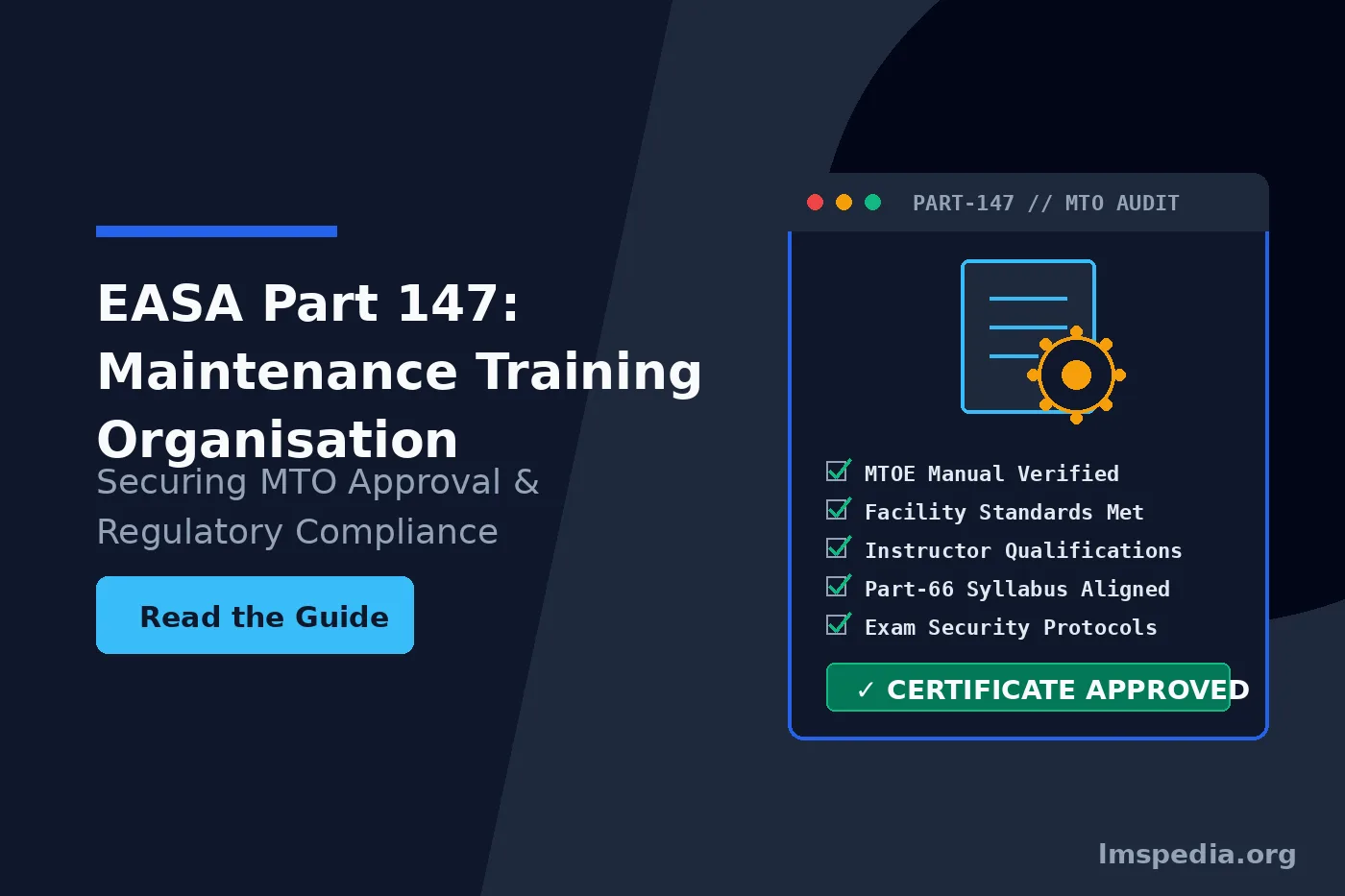
Ensure your classrooms, hangars, and practical workshops meet strict environmental and equipment standards before applying.
Appoint Qualified Personnel:
Select an Accountable Manager who possesses the financial authority to guarantee total regulatory compliance permanently.
Draft a Robust Manual:
Construct a comprehensive Maintenance Training Organisation Exposition that details every single instructional procedure perfectly.
Maintain Examination Security:
Implement rigorous security protocols to protect all final assessments and prevent academic fraud completely.
Adopt Digital Tracking:
Utilize specialized aviation compliance software to track instructor qualifications, student progress, and certification renewals automatically.

Understanding EASA Part 147: The Foundation of Aviation Safety
To operate a legal aviation academy in Europe, you must understand the underlying philosophy of the regulatory framework natively. The easa part 147 regulation exists to standardize maintenance training across all member states completely. Historically, different countries utilized wildly different educational standards. Consequently, this fragmentation created massive safety risks when mechanics crossed borders to work on foreign registered aircraft. The European Union Aviation Safety Agency solved this problem definitively by creating a unified, highly strict organizational standard.
This specific regulation applies exclusively to the organizations delivering the training. It does not apply directly to the individual mechanic. However, if an organization lacks this formal easa part 147 approval, any certificate they issue becomes completely worthless to the student. Therefore, achieving this certification serves as the absolute baseline for your commercial viability. For official regulatory text regarding these mandates, you can review the current legislation directly on the official EASA website.
Defining Core Part 147 Approval Requirements
Securing an approval certificate requires massive financial and infrastructural investments natively. Indeed, the regulatory authority will not grant a certificate to an organization operating out of a poorly lit garage. You must explicitly meet all part 147 approval requirements before submitting your initial application.
Facility and Equipment Standards
The regulation strictly defines the physical environment required for learning. Classrooms must be fully enclosed to prevent distractions. Furthermore, the lighting, temperature, and acoustic environment must actively support student concentration perfectly. For instance, if an inspector deems a classroom too noisy due to adjacent hangar operations, they will fail your facility immediately. Additionally, practical workshops must contain the exact tools, calibration equipment, and aircraft components necessary to teach the specific syllabus effectively.
You must maintain these physical environments securely at all times. To ensure external contractors and students do not compromise your facility safety, review our comprehensive guide on implementing safety LMS training in construction and heavy industry today. Moreover, discovering your exact safety gaps remains critical for global compliance. Check our detailed training needs assessment checklist carefully to avoid costly citations.
Qualified Instructors, Assessors, and Examiners
Having a beautiful facility means nothing without exceptional personnel. The easa part 147 regulations require you to nominate specific individuals to key roles. Specifically, you must employ qualified instructors to teach the theoretical knowledge, practical assessors to evaluate physical skills, and knowledge examiners to grade the final written tests. Ultimately, these individuals must possess deep aviation experience and formal instructional training natively.
Separate the Roles for Integrity
To maintain absolute examination integrity, you must separate your instructional staff from your examination staff. The instructor who teaches a specific module should never be the exact same person who writes or grades the final examination for that specific class. This strict separation prevents academic bias entirely.
Creating the Maintenance Training Organisation Exposition
Every certified organization must document its exact procedures thoroughly. The Maintenance Training Organisation Exposition serves as the legal blueprint for your entire operation. A part-147 mto simply cannot function without an approved exposition manual natively.
The Role of the Accountable Manager
The manual must begin with a formal corporate commitment. First, the organization must nominate an Accountable Manager. This individual must possess the absolute corporate authority to finance all required training operations perfectly. Consequently, the Accountable Manager must sign a formal statement in the manual confirming that the organization will comply with all regulatory obligations at all times. If the organization fails an audit, the regulator holds the Accountable Manager personally responsible for the systemic failures.
Structuring the Part-147 MTOE Effectively
The manual must contain highly specific chapters. You must document your exact organizational chart, detailing the chain of command perfectly. Furthermore, you must list all approved instructors and examiners by name. The manual must also explicitly describe how you develop course material, how you control examination papers securely, and how you audit your own internal processes continuously. To design highly effective instructional modules for this manual, review our reference guide on utilizing cognitive learning principles and measurable objectives thoroughly.
Bridging the Gap: Part 66 Licence Training
The primary purpose of securing an organizational easa part 147 approval is to deliver highly regulated instruction to future mechanics. Specifically, organizations seek this approval to provide official part 66 licence training natively. Part-66 defines the exact knowledge requirements an individual technician must possess to become a licensed certifying staff member in Europe.
Basic Training vs Type Training
Organizations can apply to deliver two distinct categories of instruction. First, basic training covers the fundamental science, mathematics, and aerodynamics required to understand aircraft generally. Conversely, type training covers the highly specific systems of a single aircraft model, such as the Airbus A320 or the Boeing 737.
You must state exactly which categories you intend to teach in your initial application. Subsequently, the regulator will audit your facilities to ensure you actually possess the specific Airbus or Boeing manuals required to teach those type courses perfectly. To fully grasp how modern aviation organizations measure student capability during these intense technical courses, explore our methodology breakdown covering competency based assessment training strategies natively.
Managing Examination Integrity and Security
The regulatory authority views examination security as the absolute most critical component of your entire operation. A maintenance training organisation easa must prove that its final examinations are completely secure from internal and external tampering.
Secure Question Banks and Grading
You must maintain a massive, highly secure question bank. The software housing these questions must utilize strict cryptographic access controls natively. Furthermore, you cannot use the exact same test for every single class. Instead, the system must generate randomized examinations from the question bank to prevent students from memorizing the specific answers in advance. If an inspector discovers that a test paper leaked to students prior to the examination date, they will suspend your organizational certificate immediately.
| Operational Component | Standard Educational Facility | Approved Part-147 Training Organisation |
|---|---|---|
| Facility Standards | General classrooms with basic standard lighting. | Strictly regulated acoustic, lighting, and workspace dimensions. |
| Curriculum Design | Flexible syllabuses modified easily by local teachers. | Rigid syllabuses strictly mapped to Part-66 regulatory requirements. |
| Examination Security | Standard filing cabinets managed by the primary teacher. | Cryptographically secure digital banks managed by independent examiners. |
| Quality Assurance | Periodic informal reviews by the academic principal. | Continuous independent audits mandated directly by the MTOE manual. |
| Record Retention | Records often discarded after graduation ceremonies. | Records maintained securely for an unlimited legal duration natively. |
Digital Tracking for a Maintenance Training Organisation EASA
Managing student enrollments, examination scores, and instructor qualifications manually using paper spreadsheets will destroy your administrative efficiency completely. Therefore, modern approved organizations utilize highly specialized learning management systems to track everything perfectly.
Automating the Audit Trail
When an auditor walks into your facility, they will demand to see the exact training records for a specific instructor. If you utilize a digital system, you can generate a timestamped compliance report in three seconds natively. Furthermore, a digital system will automatically block an instructor from teaching a class if their own internal recurrent training qualifications expire. Consequently, this automated safeguard prevents massive regulatory violations entirely.
Resolving Digital Completion Errors
Deploying digital e-learning modules to supplement your classroom theory represents a massive operational advantage. However, digital courseware occasionally suffers from technical tracking failures. For example, if a student completes a mandatory theoretical module but the system fails to record the score, the student cannot sit for the final examination.
E-Learning and Diagnostics
You must diagnose these technical failures rapidly to prevent student delays. To resolve stubborn software errors, you must understand exactly how your authoring tools transmit grading data to the server. Master the specific reporting parameters by reviewing our SCORM vs xAPI tracking guide thoroughly. Accurate tracking guarantees that you never issue a certificate to a student who actually failed the theoretical component.
Conclusion
Achieving and maintaining an easa part 147 organizational approval represents a monumental administrative and operational achievement natively. By strictly adhering to the rigorous part 147 approval requirements, you guarantee that your facility produces the safest, most competent aviation mechanics in the global industry. You must construct a flawless Maintenance Training Organisation Exposition to serve as your guiding legal document. Furthermore, by separating your instructional staff from your examiners, you protect the absolute integrity of your part 66 licence training programs completely. Ultimately, operating a highly successful maintenance training organisation easa requires abandoning outdated paper processes entirely. Embrace modern digital tracking systems, secure your examination banks cryptographically, and elevate your aviation academy to the absolute highest tier of global regulatory compliance.
FAQ
Q1. What is EASA Part-147?
It is the specific European aviation regulation that establishes the strict organizational requirements for facilities seeking approval to conduct maintenance training and examinations. It applies to the training organizations, not the individual mechanics.
Q2. What is the difference between Part-147 and Part-66?
Part-66 defines the specific technical knowledge and experience requirements an individual mechanic needs to obtain an aircraft maintenance licence. Part-147 defines the strict facility, personnel, and quality standards an organization must meet to legally teach that Part-66 syllabus.
Q3. What is an MTOE?
The Maintenance Training Organisation Exposition (MTOE) is the official manual that an approved training organization must produce. It explicitly details the organization’s corporate structure, instructional procedures, facility layouts, and strict quality assurance policies natively.
Q4. Can an instructor grade their own final exams?
No. To maintain strict examination integrity and prevent academic bias, EASA regulations require organizations to separate the instructional roles from the examination roles. An independent knowledge examiner must oversee and grade the final assessments.
Q5. Who is the Accountable Manager?
The Accountable Manager is a senior executive nominated within the MTOE who possesses the absolute corporate and financial authority to ensure that all training operations continuously meet EASA regulatory standards. They are personally responsible for the organization’s overall compliance.