Saba LMS was once a genuine pioneer in enterprise learning management. At its peak, Saba Software served over 31 million users at 2,200 organizations globally, with a reputation for robust compliance management, blended learning delivery, and deep talent integration, but now people are looking for Saba LMS Alternatives for Corporate Training and enterprise learning management system alternatives that provide better UX and AI capabilities. For many L&D teams, Saba was the system of record for a decade or more of employee development data.
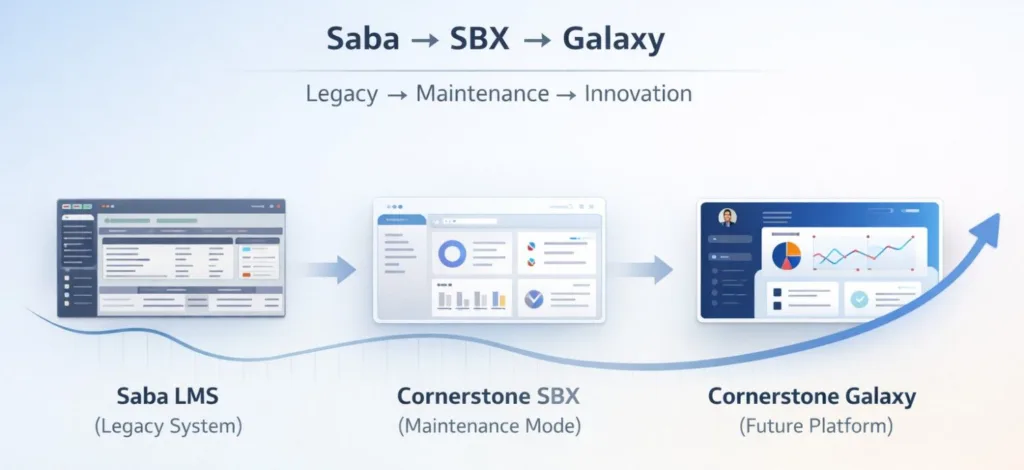
That era is ending. Cornerstone OnDemand’s acquisition of Saba in 2020, followed by Clearlake Capital taking Cornerstone private in 2021, set in motion a product consolidation that has fundamentally changed what Saba customers can expect. Today, Saba operates under the Cornerstone SBX label, with strategic investment in AI features and new functionality directed toward the Cornerstone Galaxy platform rather than the legacy Saba environment. For organizations still on Saba, the message is clear: migration is a matter of when, not if.
Over 30% of legacy LMS migrations occur primarily because of outdated user experience, and Saba’s administration interface, described by one Gartner reviewer as resembling a platform “from the 90s,” is a textbook example. When the UX challenges combine with reduced innovation velocity, rigid LMS reporting tools, and an uncertain product roadmap, the business case for switching becomes compelling.
This guide covers the 10 best Saba LMS alternatives for corporate training in 2026, including platform profiles, a comparison table, and a practical migration framework to help L&D managers plan their next move.
What Happened to Saba LMS After the Cornerstone Acquisition
Understanding the post-acquisition trajectory is essential context for any Saba LMS migration strategy. This is what led organizations looking for Saba LMS Alternatives for Corporate Training. The story unfolds in three distinct phases.
Phase 1 – The Acquisition (2020)
Cornerstone OnDemand acquired Saba Software in April 2020 for approximately $1.4 billion. At the time, Cornerstone’s leadership publicly committed to supporting both platforms indefinitely. Heidi Spirgi, then Chief Marketing and Strategy Officer, told industry analysts there was no plan to push Saba customers toward Cornerstone Learning, describing the products as “so similar” that migration was unnecessary. For Saba users, this created a period of cautious stability.
Phase 2 – Going Private and Strategic Reorientation (2021)
Everything changed in August 2021 when Clearlake Capital and Vector Capital took Cornerstone private. As industry analyst Josh Bersin noted, going private shifted the company’s priorities from public-market revenue growth toward operational consolidation and margin improvement. With multiple legacy platforms to maintain, the original Cornerstone CSX, Saba Cloud (now SBX), EdCast, and others, investment resources became finite. New AI features, product innovation, and the Cornerstone Galaxy roadmap were directed at the core Cornerstone platform, not legacy Saba.
Phase 3 – Cornerstone Galaxy and the SBX Status (2023–Present)
Cornerstone’s unified platform strategy, branded as Cornerstone Galaxy, consolidates learning, skills, and talent capabilities into a single environment. Saba Cloud has been relabelled Cornerstone Learning SBX (SBX) and continues to operate as a contained, supported system. However, as one implementation partner noted in mid-2025, new functionality and cutting-edge AI capabilities are concentrated on the Cornerstone product line, not SBX. Migration from SBX to Galaxy is part of what Cornerstone calls its Evolve strategy, making migrating from Saba to Cornerstone Galaxy or exploring SBX alternatives a strategic decision, a structured, client-managed transition that does not happen automatically.
SBX remains supported but is no longer the platform receiving meaningful product investment. Organisations waiting for native AI-powered personalisation, modern LMS reporting tools, or mobile learning platform improvements within SBX will be waiting indefinitely.
For Saba customers, the practical implication is straightforward:
Saba LMS Limitations: Why Are People Looking for Alternatives to Saba for Corporate Training
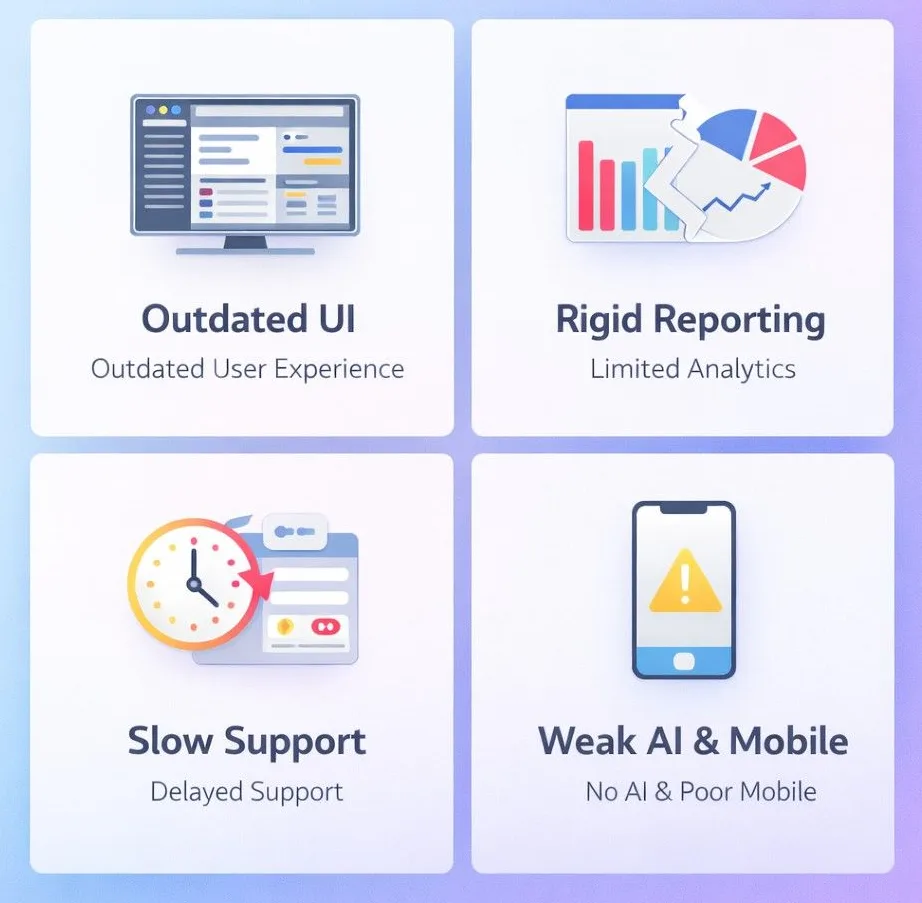
Reviewing verified user feedback across G2, Gartner Peer Insights, and Capterra reveals consistent patterns of dissatisfaction that apply equally to the legacy Saba environment and the current SBX platform. These are not edge-case complaints; they are structural limitations of a traditional LMS platform built before AI-driven personalization, modern mobile UX standards, and API-first integrations became table stakes.
Outdated User Interface
Multiple Gartner Peer Insights reviewers describe Saba’s interface as unintuitive and administratively complex, one reviewer noting it resembles a platform designed in the 1990s and an outdated LMS interface. The admin backend requires significant time investment to configure, and the learner-facing experience lacks the clean, consumer-app-quality UX that modern employees expect from an enterprise learning software platform. This directly contributes to lower learner engagement and higher abandonment rates in self-directed learning scenarios owing to the LMSuser experience issues.
Rigid Reporting and Analytics
Reporting functionality is among the most commonly cited limitations. Gartner reviewers flag that the platform’s LMS reporting tools feel rigid, do not offer enough flexibility to tailor outputs to specific business needs, and require multiple steps to extract actionable data. For L&D managers who need to demonstrate training ROI to leadership, poor LMS reporting tools lead to time-consuming manual exports and workarounds.
Slow and Inconsistent Support
Support quality issues are well-documented in legacy LMS challenges. Reviewers on FinancesOnline and G2 report that ticket-based support without direct phone access results in resolution timelines of several days for non-critical issues. The reliance on a legacy LMS replacement path, migrating to a newer platform within the Cornerstone ecosystem, means support teams are managing transitions rather than investing in improving SBX itself.
Limited AI and Mobile Learning Capabilities
As an outdated LMS platform, Saba SBX lacks the AI-powered learning platform features that competitors now offer as standard: adaptive learning paths, AI-generated assessments, skills gap analysis, and intelligent content recommendations. Its mobile learning platform experience also trails competitors significantly, with some users reporting system instability and unclear error states on mobile devices.
Integration Complexity
LMS integrations and APIs are a friction point for organisations running modern HR tech stacks. While Saba supports standard SSO and SCORM-compliant LMS content delivery, deeper integrations with contemporary HRIS platforms (Workday, BambooHR, Rippling) and productivity tools (Teams, Slack) require custom development work that adds to the total cost of maintenance.
Top 10 Saba LMS Alternatives For Corporate Training (2026)
The comparison below evaluates the best LMS corporate training along with enterprise LMS pricing comparison across deployment model, G2 rating, and primary capability strength. Full platform profiles follow in subsequent sections.
| Platform | Best For | Deployment | Rating | Key Strength |
|---|---|---|---|---|
| SimpliTrain | Training businesses & academies | Cloud SaaS | 4.2 / 5 | Unified LMS + TMS + LXP; white-label; multi-location management; flat-rate pricing |
| Docebo | Enterprise organisations | Cloud SaaS | 4.4 / 5 | Harmony AI engine; 400+ integrations; multi-audience extended enterprise |
| TalentLMS | SMBs & mid-market | Cloud SaaS | 4.6 / 5 | Rapid deployment; intuitive UI; SCORM compliant; free tier available |
| Absorb LMS | Corporate compliance training | Cloud SaaS | 4.6 / 5 | Clean UX; AI-powered Absorb Amplify; strong certification tracking |
| SAP Litmos | Global compliance & SAP customers | Cloud SaaS | 4.2 / 5 | 2,000+ pre-built compliance courses; SAP SuccessFactors native integration |
| LearnUpon | Multi-audience enterprise | Cloud SaaS | 4.7 / 5 | Employee + customer + partner training; highest-rated support in segment |
| iSpring Learn | Content-authoring-led teams | Cloud SaaS | 4.4 / 5 | PowerPoint-native authoring; SCORM/xAPI; rapid deployment; per-user pricing |
| 360Learning | Collaborative learning cultures | Cloud SaaS | 4.6 / 5 | Peer-led course creation; AI-powered learning paths; transparent per-user pricing |
| Kallidus | Employee learning & compliance | Cloud SaaS | 4.4 / 5 | Learning + compliance + ready-made content + reporting |
| Moodle | Education & budget orgs | Open source / self-hosted | 4.1 / 5 | Zero licensing cost; full customisation; large global community |
Best Saba Alternatives for Corporate Learning
Enterprise organizations migrating from Saba typically need a SCORM-compliant LMS, certification tracking system functionality, deep HRIS integrations, and analytics that go beyond basic completion reporting. The following platforms are the strongest enterprise LMS platforms similar to Saba for organizations with 500+ learners and established compliance requirements.
1. Docebo – Best AI-Powered Enterprise Replacement
Docebo is the most direct like-for-like replacement for Saba as an enterprise LMS solution. Its Harmony AI engine handles content tagging, personalized learning path recommendations, skills gap analysis, and a Learner Coach feature that delivers contextual nudges based on individual progress capabilities that Saba SBX cannot match natively.
- Best for: Mid-to-large enterprises running multi-audience training (employees, customers, partners)
- Deployment: Cloud SaaS; reported implementation time of 6-10 weeks for standard enterprise deployments
- Docebo Pricing: Two tiers – Elevate (reported ~$40,000/year) and Enterprise (custom quote); no public pricing
- Rating: 4.4 / 5
- Standout capability: Harmony AI Deep Search; Learner Coach personalisation; e-commerce for training monetisation; 400+ pre-built integrations including Workday, Salesforce, and SAP SuccessFactors
For L&D managers switching from Saba specifically because of poor analytics and limited AI features Docebo delivers the most complete upgrade across both dimensions. Its multi-audience extended enterprise capability also addresses the customer and partner training use cases that legacy LMS replacement often overlooks.
Where Docebo can improve: Premium pricing makes it less accessible for organisations below 500 learners. Advanced configuration has a learning curve for lean L&D teams without dedicated admin resource.
2. Absorb LMS – Best Compliance Training Software
Absorb LMS is consistently rated among the highest-scoring corporate LMS platforms for ease of use, a direct response to the UX complexity that drives most legacy LMS migration decisions. Its AI-powered Absorb Amplify engine automates content tagging, surfaces learning recommendations, and generates intelligent reporting summaries.
- Best for: Corporate training teams managing compliance certification, onboarding, and skills development
- Deployment: Cloud SaaS; typically 4–8 weeks for standard implementations
- Pricing: Custom quote; structured by organisation size and feature tier
- Rating: 4.6 / 5
- Standout capability: Intuitive admin UX; built-in AI reporting summaries; certification tracking system with automated renewal notifications; 40+ HRIS connectors
Absorb LMS is the strongest choice for organisations migrating from Saba primarily because of admin complexity and rigid reporting. Its certification tracking and compliance management functionality directly replaces Saba’s most-used enterprise capabilities with materially better usability.
Where Absorb can improve: Advanced course layout customisation is more limited than some competitors. Data-heavy reporting dashboards can experience occasional load time delays.
3. SAP Litmos – Best for SAP-Integrated Global Compliance Programs
For organisations already running SAP infrastructure, Litmos is the most natural Saba replacement. Its native integration with SAP SuccessFactors eliminates the HRIS connector work that consumes significant migration budget in standalone LMS deployments. The platform’s 2,000+ pre-built compliance courses also reduce time-to-training-value considerably for regulated industries.
- Best for: Large enterprises in healthcare, financial services, and manufacturing running global compliance programs
- Deployment: Cloud SaaS; tiered implementation model (Foundation, Premier, Platinum)
- Pricing: Subscription-based; reported from ~$18,000/year for Foundation tier
- Rating: 4.2 / 5
- Standout capability: Pre-built compliance content library; SAP SuccessFactors native integration; mobile-first design; 35+ language packs for global deployment
SAP Litmos is a logical migration path for Saba customers who also run SAP HCM or SuccessFactors, as it eliminates one of the most complex integration challenges in any enterprise LMS migration strategy. Its compliance content library provides immediate training value without additional content investment.
Where Litmos can improve: Users note that reporting still requires multiple steps to surface specific data. Organisations not in the SAP ecosystem may find better value elsewhere.
4. LearnUpon – Best for Extended Enterprise Training
LearnUpon holds the highest rating of any platform on this list (4.7/5) and is particularly strong for organisations that need to train employees, customers, and partners from a single unified platform — a use case that Saba SBX handles poorly, as noted by industry analysts even at the time of the Cornerstone acquisition.
- Best for: Organisations running extended enterprise training across multiple audiences
- Deployment: Cloud SaaS; rapid guided onboarding model
- Pricing: Custom quote; structured by active user count and feature requirements
- Rating: 4.7 / 5
- Standout capability: Multi-portal architecture for audience segmentation; customer success-led implementation; Salesforce integration for customer training use cases; consistently top-rated support
For organisations that identified Saba’s limited extended enterprise support as a migration trigger, LearnUpon is the standout alternative. Its portal architecture allows employee, customer, and partner learning environments to run independently with shared administration – something traditional LMS platforms rarely achieve cleanly.
Best Saba Alternatives for Corporate Training Providers
Training providers, academies, franchise networks, and L&D teams that monetise training content have distinct needs that differ from internal corporate training programs. The best Saba LMS alternatives for training providers combine LMS functionality with course marketplace capabilities, white-labelling, certification management, and increasingly training operations management that integrates scheduling, instructor management, and enrolment workflows.
5. Kallidus – Best for Employee Learning and Compliance
Kallidus is a corporate learning platform designed to simplify employee training, compliance, and development. It combines learning management, ready-made content, reporting, and skills development in a user-friendly platform, making it a strong alternative for organisations moving away from complex legacy systems like Saba.
- Best for: Organisations focused on employee training, compliance, and development
- Deployment: Cloud SaaS
- Pricing: Custom quote
- Standout capability: Employee-focused LMS combining learning delivery, compliance management, content, reporting, and skills development
For Saba users looking for a more modern learning experience without sacrificing core corporate training and compliance capabilities, Kallidus provides a streamlined approach to managing learning across the employee lifecycle.
Where Kallidus can improve: It is primarily focused on employee learning, so organisations with complex external customer or partner training requirements may prefer a platform built specifically for extended enterprise use cases.
6. SimpliTrain – Best Unified Platform for Training Businesses
SimpliTrain is purpose-built for the use case that most corporate LMS platforms handle as an afterthought: running training as a core business function rather than an HR overhead. Founded in 2022 and already deployed across 450+ organisations in 15 countries, it has earned recognition in the Talented Learning 2025 LMS Awards for its innovative approach to training operations management and being the best LMS for training providers.
- Best for: Training businesses, academies, franchise networks, and multi-location L&D teams
- Deployment: Cloud SaaS; flat-rate model with guided onboarding
- Pricing: Custom / flat-rate; contact vendor for quote
- Rating: 4.2 / 5
- Standout capabilities: Unified LMS + TMS + LXP + LRS + Knowledge Portals in one environment; white-label platform; AI-driven assessments; multi-location management; course monetisation features; no per-user pricing surprises
SimpliTrain directly addresses the tool fragmentation problem that plagues training providers who have historically stitched together a separate LMS, TMS, and LXP. Its flat-rate pricing also makes it one of the most budget-predictable, affordable alternatives to Saba LMS for organisations with variable learner counts across cohorts and programmes.
For L&D managers evaluating how to migrate from Saba LMS, SimpliTrain’s combined platform approach means fewer integration points, lower total cost, and a single vendor relationship to manage. See our LMS vs TMS Platforms guide for more details on how training management system functionality fits alongside LMS capability.
7. TalentLMS – Best Affordable SMB Alternative
TalentLMS is among the most widely adopted affordable alternatives to Saba LMS in the 50–500 learner range. Its reputation for fast deployment, clean learner UI, and strong course management makes it a common landing point for organisations switching from legacy LMS platforms that have outgrown their practical utility. It has come up as an affordable alternative to Saba LMS.
- Best for: SMBs, training providers, and mid-market teams seeking a fast-deployment SCORM-compliant LMS
- Deployment: Cloud SaaS; free tier available; paid plans from $89/month (annual billing)
- Pricing: Per-user model; transparent published pricing
- Rating: 4.6 / 5
- Standout capability: Recognised best-in-class for course creation and content management; gamification engine; branch portals for multi-audience delivery; Shopify and Stripe integrations for training monetisation
For training providers migrating from Saba who need an immediate operational LMS at low cost, TalentLMS delivers roughly 78% of core enterprise LMS functionality in a package that most teams can deploy within days. Its free tier allows proof-of-concept before any budget commitment.
Where TalentLMS can improve: Multi-year training history tracking has known limitations that create compliance record-keeping issues. Reporting tools are described as basic by users coming from deeper analytics platforms.
8. iSpring Learn – Best for PowerPoint-Based Content Teams
iSpring Learn occupies a distinct niche among Cornerstone LMS alternatives, Corporate Training for training providers: it combines a full cloud LMS with PowerPoint-native content authoring, making it ideal for L&D teams whose instructional designers build course content in Microsoft Office environments.
- Best for: Training teams with high course creation volume and Microsoft Office-centric workflows
- Deployment: Cloud SaaS; per-user pricing from ~$3.70/user/month for the Suite bundle
- Rating: 4.4 / 5
- Standout capability: Native PowerPoint-to-eLearning conversion; SCORM/xAPI/cmi5 export; video assessments and role-play simulations; white-labelling; MS Teams integration
iSpring Learn is the lowest-friction upgrade path for Saba users whose primary frustration is the content creation process. Where Saba’s authoring workflow requires third-party tools, iSpring’s PowerPoint-native approach allows existing slide decks to become structured, trackable courses within minutes
9–11. Additional Notable Alternatives
The following platforms round out the top 10 and merit evaluation for specific use cases:
- 360Learning (Rating: 4.6/5): Best choice for organisations prioritising collaborative and peer-led learning. AI-powered learning path creation and transparent per-user pricing from ~$8/user/month suit fast-growing teams.
- Cornerstone LMS (Rating: 3.9/5): The supported migration path for Saba SBX users. Moving to Cornerstone Galaxy provides access to the latest AI features within the Cornerstone ecosystem, though users should expect a structured migration project and comparable UX challenges to legacy Saba.
- Moodle (Rating: 4.1/5): The open-source option for organisations with in-house technical capacity and zero appetite for licensing cost. Unlimited customisation but requires developer resources for deployment and ongoing maintenance.
How to Migrate from Saba LMS for Employee Training
Enterprise LMS migration is one of the most disruptive technology transitions an L&D function can undertake. A failed or poorly planned migration can result in lost training records, compliance gaps, and learner disengagement. The following framework reflects LMS migration best practices and addresses the specific data and workflow complexities of migrating from Saba Cloud or SBX environments.
Step 1 – Audit Your Current Saba Environment
Before evaluating any new platform, conduct a full data and process audit of your Saba environment. This includes:
- Active user count and organisational hierarchy mapping
- Course and content catalogue inventory (SCORM files, xAPI packages, video assets)
- Completion and certification records, particularly multi-year compliance histories
- Custom reports and dashboards that will need to be recreated
- Current integrations: HRIS, SSO, content providers, and API connections
This audit typically takes two to four weeks and will surface the data migration complexity that most vendor RFP processes underestimate.
Step 2 – Define Your Non-Negotiable Requirements
Translate your audit findings into a clear requirements document. Non-negotiables for most Saba migrations include SCORM-compliant LMS content ingestion, certification tracking system parity, and HRIS integration continuity. Distinguish between requirements (must-have on day one) and priorities (important but configurable over time). This separation prevents scope creep from extending implementation timelines.
Step 3 – Evaluate and Shortlist Platforms
Use your requirements document to run a structured LMS vendors comparison. Request sandbox access from your shortlisted platforms and test specifically against your audit findings, not vendor demo scenarios. Pay particular attention to data import capabilities: can the platform ingest historical completion records from Saba’s export format? Can it recreate your organisational hierarchy? How does it handle certification records with associated compliance evidence? See our Best Corporate LMS guide and LMS Implementation Checklist for evaluation frameworks.
Step 4 – Plan the Data Migration
Data migration is the highest-risk component of any enterprise LMS migration. Prioritise in this order: active user records and authentication, compliance certification records (particularly those subject to regulatory audit), completion histories for the past three to five years, and course content assets. Archive older historical data rather than attempting full migration – most compliance frameworks require records retention but not active system accessibility for data beyond a defined window.
Step 5 – Parallel Running and Go-Live
Run both platforms in parallel for a minimum of four to eight weeks. Use this period to validate data integrity, test HRIS integrations under real authentication load, and complete admin training. Avoid hard cutover dates tied to compliance deadlines, and build in buffer time for data reconciliation. Communicate the migration timeline to learners at least four weeks before go-live, with clear guidance on how to access in-progress courses.
Conclusion
Saba LMS earned its legacy position through genuine innovation in enterprise learning and talent management. But the post-acquisition reality is that SBX is a maintained platform, not a developed one. For L&D managers who built their training programmes on Saba, that distinction matters, because it means the gap between Saba and modern LMS platforms replacing it will only widen over time.
Modern enterprise learning software platforms now deliver AI-powered personalisation, real-time LMS reporting tools, mobile-first learner experiences, and certification tracking system functionality that Saba SBX cannot match. Whether your organisation needs an AI-powered learning platform like Docebo, a compliance-focused corporate LMS like Absorb, a training provider ecosystem like SimpliTrain, or a rapid-deployment SMB option like TalentLMS, the alternatives in this guide offer better analytics, stronger automation, and a materially superior learner experience than any legacy LMS deployment can currently provide.
The right time to begin your Corporate LMS migration strategy is before your Saba contract renewal, not after. Start with the data audit, define your non-negotiable requirements, and request sandbox access from your shortlisted platforms. A structured evaluation process now prevents a reactive migration later.
Saba LMS continues to operate under the label Cornerstone Learning SBX (SBX) and remains a fully supported platform for existing customers. Cornerstone has not announced an end-of-life date for SBX. However, the strategic direction is clear: Cornerstone Galaxy is the platform receiving AI investment and new functionality. The Cornerstone Evolve programme provides a structured migration path from SBX to Galaxy for customers ready to transition. Organisations still under Saba contracts should clarify their roadmap with their account team and begin evaluating modern LMS platforms, replacing Saba regardless of timeline. Within the Cornerstone ecosystem, Cornerstone Galaxy, specifically the Cornerstone Learn module, is the strategic replacement for Saba SBX. Outside the Cornerstone ecosystem, there is no direct one-to-one replacement, because Saba’s value was its combination of learning management and talent management in a single platform. The closest modern equivalents are Docebo for AI-powered enterprise learning, SimpliTrain for training businesses needing combined LMS/TMS/LXP capability, and Absorb LMS for compliance-centric corporate training. Migrating from Saba LMS is a medium-to-high complexity project depending on the volume of historical data, the number of custom integrations, and the regulatory requirements around compliance record retention. Organisations with fewer than 500 learners and minimal custom configuration can typically complete a migration in 8–12 weeks. Enterprises with 1,000+ learners, multi-region deployments, and complex HRIS integrations should budget 16–24 weeks for full migration, including parallel running. The most common migration challenges are recreating Saba’s organisational hierarchy in the new platform, validating historical certification records, and rebuilding custom reports. A structured LMS migration strategy with a defined data audit phase significantly reduces risk. FAQ
Q1. Is Saba LMS still available?
Q2. What replaced Saba LMS?
Q3. How difficult is migrating from Saba LMS?